

As churches and families continue to navigate political division and fractured relationships, the final part of this interview focuses on what it means to remain faithful amidst disagreement and uncertainty. Caleb Campbell, author of Disarming Leviathan: Loving Your Christian Nationalist Neighbor, and Rachel Williams discuss fear, identity, belonging, and the power of hospitality to foster healing and reconciliation.
Watch the interview video, listen to the interview, or continue reading. Part 1 is available here.
Karen Stewart: When all of this started happening, [we realized that some of]our church members had been in this sitting in the same pew or table [with the same people]for years, and then all of a sudden, we discover that we have some values that really, really differ. Many of us don’t talk politics now, and now we have anxiety going home.
How do we—in political terms, it’s walking across the aisle—but in familial terms, how do I walk across the room and have a relationship again with Aunt Betty and Cousin Jim? We’ve got pastors that are pastoring congregations made up of a cacophony of people. And if they say one thing, like you mentioned, then they’re getting an email that says, “I don’t appreciate what you said,” and then when they go to the other side, they get another email that says, “I don’t appreciate what you said.”
Caleb Campbell: I’ve dedicated a lot of the last few years of my ministry to trying to answer this question pastorally and familiarly. So, I wrote a book, Disarming Leviathan, which is for those of us who have family members and friends who’ve given themselves over to this movement. I also created a companion for pastors that I have on my website to help ministry leaders recognize that there’s division at the potluck and the Sunday school classes are erupting at the core, [and figure out how to move forward].
It’s important to recognize that for most folks who are committed to this movement, it’s not in the head. It’s in the heart. Meaning that the problem here is not bad data or untrue facts. It’s a matter of the heart. The heart is feeling unsafe. And so, it wants to believe that this movement will provide safety, belonging and purpose. The first thing to remember is I don’t ever want to do anything that would cause my counterpart to feel unsafe or unwelcomed, or that they don’t belong with me. And so, hospitality is really key. A lot of us, I think, especially the more prophetically minded of us. We love the story of Jesus flipping tables. We, we think of ourselves as the kind of people who want to fix American Christian nationalism by table flipping.
But I think it may be instructive to us to recognize that Jesus flipped tables in the Gospels once, or maybe twice, depending on how you read John. But he’s always setting tables. One theologian said that Jesus ate his way through the Gospels. And it’s striking because some of the people that he puts at his table are the kind of folks who benefited from the corrupt system of the temple money changers.
I think that what Jesus is doing there is modeling for us how hospitality can curate safety and belonging, which makes the heart feel safe and open to change. When we’re ministering to people who are politically polarized and they’re yelling and screaming about immigration or whatever it might be, the primary problem is not the thing that they’re saying. It’s the fact that they’re yelling and screaming, that they’re communicating, “I’m afraid.” And so, to invite them to a meal to connect on shared values, to honor them for caring enough to give time to this. Even if I don’t agree with what they’re saying, I honor them that they care about, you know, safety in the community, whatever it might be.
Pastorally, it’s recognizing that the problem is in the heart. Familialy, I have to do a lot of work before I enter into this conversation. I mean, honestly, most of what I think I’m feeling when I approach Aunt Betty and Cousin Jim is familial shame. I’m ashamed of the things that they’re saying and that’s a me problem. So, if I try to solve this feeling that I have inside of me by making them shut up. I’m just trying to dominate over them now. A lot of the work actually is in me first. It’s to pray and to reflect and to ask the Lord to search me and know me.
Recognizing that I’ve got a lot of work to do before I enter into that conversation. But also, the win cannot be that they changed their mind. If that’s my objective in these conversations, the game is already over because I can’t change people’s minds. The spirit of the living God is the one who brings conviction and repentance. I can’t do that. What I can do is I can be faithful in the moments that the Lord has given to me, to be the kind of person that Jesus is making me into. And so, when I’m walking away from the meeting, I want to not ask, “did I get them to change their mind?” Rather, I want to ask, “was I like Jesus to them in those conversations?” And if I can do that, then I think that I’ve been faithful in the moments I’ve been given.
Karen Stewart: I appreciate what you’re saying, and it really speaks to how in your book, you talk about that the Christian nationalism is actually our new mission field. And if we reframe how we think about it, it’s not us versus them, but it is an opportunity. This is an opportunity for us to expand our witness into a place with people who are showing that they are afraid.
Rachel, how would you describe the people who are now getting in the streets voicing an opinion that says, “I’m not appreciative of what is happening in my country.”
Rachel Williams: We have people from all types of, I would say, all different types of political spectrum where they are located in the political spectrum and also on the religious spectrum, specifically for Christianity, denominational. They don’t all agree on everything, but they do agree on this is not what they wanted for their community.
Karen Stewart: I feel like I’m hearing you say that just because my neighbor might have a Trump flag or have been a Trump voter, that they might not be in agreement with everything that is happening in the country, and therefore I shouldn’t necessarily view them in a particular lens. Am I understanding that correctly?
Rachel Williams: Right. I think part of what’s been going on is almost an identity fusion between people who they voted for and then themselves as a person. Some people are like, “Yeah, that’s great. That’s exactly what I want.” But other people know that just because I voted for one person does not mean I agree with them on everything that they’re doing.
There’s a lot of complex reasons why people vote for who they do in the United States. I guess what I’m getting at is, I think specifically about the protests that have been going on currently. Right now, you’re seeing those, those points of distinction between who a person voted for and what they wanted the government to do regarding addressing safety in the United States.
Karen Stewart: I heard Rachel talk about identity and this identity fusion. You have in your book three “I’s,” ideology, idolatry, and identity. When I read that, I kept wondering to myself, how do I tell the difference? How do I tell, you know, somebody who might be just, “That’s who I voted for because I like this platform and that is what I agreed in.”
Caleb Campbell: I see that political commitments have become identity forming. Elements need forces, meaning, I’m watching people committed to a party lane change their commitments based on how the party shifts over time.
So, one way to tell the difference would be, if you are not a tribalistic partisan, and you’re just saying, “Hey, look, I’ve got these political commitments. I voted for this candidate over that candidate,” one of the key ways that you could tell that a person’s coming from that perspective is they can criticize the candidate that they voted for. If you are unable to criticize the team that you voted for, it may be that you have formed an idol out of that party. One of the ways you can tell something is an idol is you can’t suffer critical questions about it. You don’t let other people criticize it. You don’t let other people ask you critical questions about it.
And you certainly don’t ask typical questions about it. Like one of the ways to know that money has become a god is you won’t let people ask you critical questions about your bank account. And it’s similar with our commitments to politics. I think we, as Christians, I think we need to do some more work in thinking how Scripture confronts my currently held political commitments as opposed to how it buoys or supports the candidate and the postures that candidate is offering.
Karen Stewart: We should be able to have real conversations and gain a better understanding when stuff doesn’t align with what the Bible has to say about it. Right? I’m tying it back to what you said at the beginning, because it’s about sacrifice. Isn’t that what Jesus modeled for us? His sacrificial service to us in creation?
That’s kind of what our Christianity should be founded upon as well. Caleb, I mentioned it in your introduction that you used to be a skinhead, but you use that in how you came to faith, and eventually to the pastorate of the congregation that you’re that you are leading now. Can you speak a bit about that experience?
Caleb Campbell: Yeah. So, in my late teens I was coming out of the neo-Nazi skinhead movement. And the reason, frankly, why I was coming out of it was because what was being said and what was happening weren’t congruent. There was not an integrity to it, meaning the argumentation was, you know, white people are the master race, and we need to protect America for white people and secure a future for white children. And when I looked around, I started asking, “Where are the wealthy, successful, all like retired skinheads?” And everyone was going to jail or getting shot. And I was like, “This is what’s happening.” And so, because the movement itself wasn’t integrated, right?
What was being said, what was actually happening, weren’t quite together. So, I started kind of floating away and was a drummer in a band and was frankly desperate for a community. And a woman from Desert Springs Bible Church was looking for drummers in the classified ads. This is back before the proliferation of the internet.
So, she asked if I could come play the drums for the church. So, I did. I got on the roster and was there every month. So, I became part of one of the bands and a couple of the musicians who are husband and wife started inviting me over to dinner once a week.
After dinner, we would have conversations about the things that made me angry about religion. And it was the right way to the conversation because I was full of rage, and I was still kind of deconstructing the white supremacy thing. But I was also curious about Jesus and faith. But I also was very turned off to what I perceived as religious hypocrisy and, you know, fear mongering and things like this.
So, over the course of a year, we would have these conversations, and they were kind to me and gracious towards me. I mean, the stuff I was saying was not great. And they were they would say things like, “Oh, that’s interesting. You know, I think Jesus says something like that.” And they would find some way to introduce Jesus into the conversation again.
And that started a process of me reforming my thinking not only about ethnicity and race, but also about faith and religion. Over those years, I found myself following Jesus and undergoing a, frankly, long term repentance and transformation project. But the key was that they welcomed me in. I felt safe with them. I felt like they wanted me there.
And I think in hindsight, in fact, I know it, that I was unwieldy and sometimes unkind and sometimes disrespectful and sometimes saying things against the faith that they held dear. That was hypocritical. But they were extremely patient with me and handled me with care. And that created an environment in which I found myself following Jesus.
The whole “repent and believe” thing wasn’t one moment and then I’m a totally new person. It’s years of repent and believe. Repent. Believe. And that was made possible through their hospitality.
Karen Stewart: Thank you. Thank you for sharing that. What a marvelous story. And it just reminds us that sometimes we’re not going to hear things that we want to hear. And sometimes people will say things that are just in contrary to the faith that we believe in. The Jesus that we hold dear. But because they hung with you, you are the pastor of Desert Springs Bible Church.
Rachel Williams: I think what Caleb described is, is a good starting point. It’s a sense of belonging, the ways of demonstrating that people that feel alienated in their communities that are changing, there’s still a place for them to be there. Those types of efforts towards creating that type of sense of belonging will then reduce the strain and the cognitive dissonance of a changing community. It starts with things that are small and direct and with the people that you care about. Those efforts are ways to address the larger issues that are going on and the larger changes that are occurring that people are concerned about in different ways.
Caleb Campbell: The first thing I would say is: we’ve been here before. What we are experiencing is not strange to the church. The American experience has been divisive. I mean, this is just the fresh expression of our war with ourselves. We’ve been struggling with the power of empire. The temptation to the power of empire. The way forward is the way of Jesus. It’s a renewed commitment to practicing. Philippians chapter two, taking on the form of a servant. It’s a recommitment to “loving my neighbors myself.” It’s a recommitment to pursuing a life empowered by the spirit and to exhibit the fruit of the spirit in First Corinthians 1:2.
I’m going to use this metaphor. I don’t care for it, but I’m going to use it. It’s like going to the doctor and getting a horrible diagnosis. That experience is extremely painful, but it is good that now you know that there’s something sick and so you can make steps forward for healing. I think that for many of us still need to grieve the loss of what we had imagined that we had as a community, and to recognize that the apocalypse of the last ten, 20 years, whatever you want to call it, is a gift because we can see that there’s some sickness in the church and make steps to bring forth healing. And that happens, as was said, at kitchen tables across America for the next decade.
Karen Stewart: It’s not new. Maybe that’s the great takeaway. It’s not new to the church. For many of us, it’s not new to our lived experience. And mostly it is not new to God. And He has brought us through it before. And He will bring us through it again. What’s the final word that you want to leave with our listeners?
Rachel Williams: Lean into learning more. Learn and find other people that are trying to make the change or the connections that you’re also wanting to make.
Caleb Campbell: This moment is scary. Yet we have been promised that the Lord will never leave us or forsake us. He is nearer to you than you are to your own self. And in clinging to that anchor and hope, we can find a joyful and spirit-filled way forward.
We love to hear from our readers! If you have any comments, suggestions, or questions about this article, please leave a voice message directly from your computer, tablet, or smartphone via Speakpipe. You may also email lewiscenter@wesleyseminary.edu or leave a comment on Facebook, Instagram, YouTube, and Bluesky.
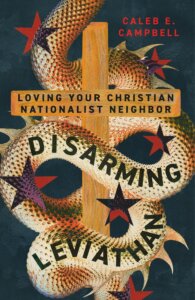 Disarming Leviathan: Loving Your Christian Nationalist Neighbor (InterVarsity Press, 2024) by Caleb Campbell is available from the publisher, Cokesbury, and Amazon.
Related Resources
- Disarming Leviathan website from Caleb Campbell
- Part 1 — Conversations on Christian Nationalism by Calob Campbell and Rachel Williams
- Leading Amidst Christian Nationalism by Lovett H. Weems Jr.
- Leading in an Age of Political Polarization by David R. Brubaker
- Christian Nationalism and the Crisis of Church Unity by Caleb Campbell
If you would like to share this article in your newsletter or other publication, please review our reprint guidelines.