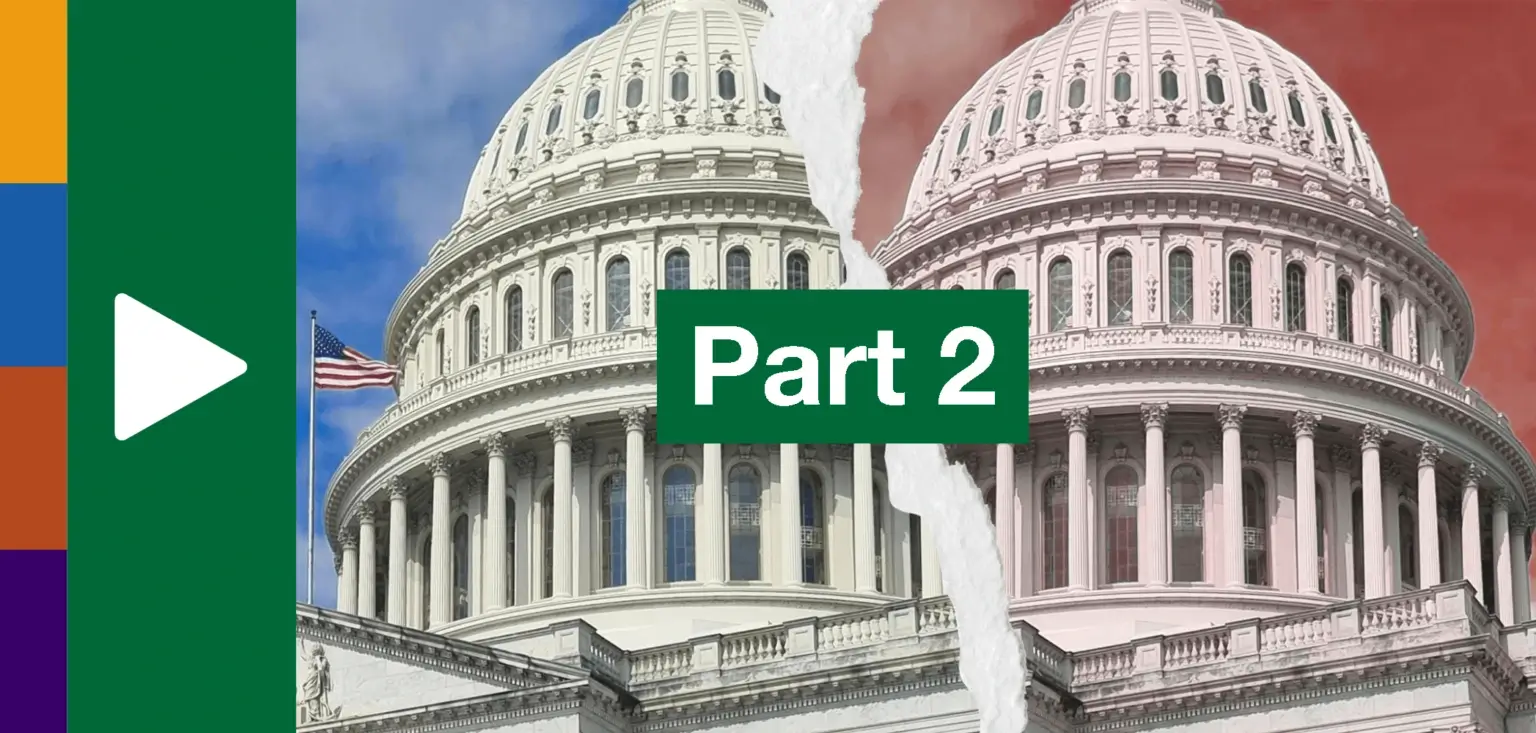



This is part two of Loving Across the Divide: Conversations on Christian Nationalism. Part one is available here.
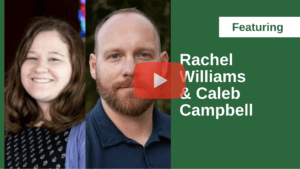
In part two of the conversation on Christian Nationalism, Karen Stewart speaks with Caleb Campbell and Rachel Williams about the challenges of political and cultural division, exploring how Christians can navigate fractured communities with grace and hospitality, and understanding and leading in the face of Christian Nationalism. From Easter dinner tensions to social media’s role in shaping identity, this conversation dives into practical steps for staying in relationship, ministering to divided hearts, and fostering healing in a polarized world.
Listen on Apple Podcasts | YouTube Music | Spotify
Watch on YouTube
- Transcript—Click or Tap to Read
-
Announcer: Leading Ideas Talks is brought to you by the Lewis Center for Leadership of Wesley Theological Seminary in Washington, DC. Subscribe free to our weekly e-newsletter, Leading Ideas, at churchleadership.com/leadingideas.
Leading Ideas Talks is also brought to you by Healing Fractured Communities, a book written by alumni of the Lewis Center Community Leadership Fellows program. Each chapter paints a picture of the work of healing fractures like racism, education inequality, and poverty. Each chapter also includes takeaways to inspire healing in your community plus questions for reflection. All proceeds support the Dr. Lovett H. Weems Jr. Scholarship Fund. Learn more and order now at churchleadership.com/books.
In part two of the conversation on Christian Nationalism, Karen Stewart speaks with Caleb Campbell and Rachel Williams about the challenges of political and cultural division, exploring how Christians can navigate fractured communities with grace and hospitality, and understanding and leading in the face of Christian Nationalism. From Easter dinner tensions to social media’s role in shaping identity, this conversation dives into practical steps for staying in relationship, ministering to divided hearts, and fostering healing in a polarized world.
Karen Stewart: Good morning. I am Karen Stewart and this is the Leading Ideas Talks podcast. Today we are going to be talking about Christian nationalism. All right. Don’t turn us off. I know, it’s a lot. But we’re not talking about it just in terms of what it is. We’re going to talk about it in terms of who they are. And not just that, but what you can do to have conversations with them.
Many of us discovered new things about our family, our friends and our neighbors. So instead of turning them off, why not be in conversation with them? This came to the forefront for me because as I was on a flight, a flight attendant tapped me on the shoulder and asked me if I was a pastor. I said it was, and her response with tears in her eyes because she had been watching the news, was, how do you give people hope in these times?
I had another colleague talk about how her pastor is a person of color, and she just needed to know how to better assist him. That’s our goal today to really unpack what it all is and how we can be who God has called us to be in these tumultuous times. What’s not lost on me is you are hearing this today, smack dab in the middle of us celebrating Jesus, riding it on a donkey for peace, and us getting ready to celebrate Resurrection Sunday. And today is April Fool’s Day.
I think we wake up every day thinking, “Have I woken up in an alternate universe?” The irony is not lost on me. So, we’ve got some great folks that I want to introduce you today to help us unpack and tackle this topic. First is Rachel Williams. Rachel Williams is the budget manager right here in the Lewis Center. But she is also a PhD student at American University, and she is studying justice, law, criminology, and security. Also with us today is Caleb Campbell. Caleb Campbell is the pastor of Desert Springs Bible Church in Phoenix, Arizona, and he is the author of Disarming Leviathan, Loving Your Christian Nationalist Neighbor. Now he’s also a reformed skinhead and a Cowboys fan. Again. Don’t turn off the podcast because you’ve heard that. Welcome, Caleb and Rachel. What a blessing it is to have both of you with me today.
Caleb Campbell: Thank you.
Rachel Williams: Thank you, Karen.
Karen Stewart: So, let’s just start at Rachel from an academic perspective. What is Christian nationalism?
Rachel Williams: So Christian nationalism is many things, but I think the quickest way to explain Christian nationalism is that it is the belief that America is God’s chosen nation and must be defended as such only by, or mainly by, Christians. So, Christians should be the ones in leadership. Christianity as a religion should have a special favored position over other religions in the United States. So specifically, we’re talking about the U.S. context. I should also say that.
Karen Stewart: Thank you. I’m curious as well. I probably should have started here for both you, Rachel and you, Caleb. What got you interested in this topic? We’ll start with you, Rachel, and then we’ll move to you. Caleb. What got you interested in this?
Rachel Williams: So, what got me interested in Christian nationalism goes back. Oh. What is that now? Back to 2013. I was an undergraduate student learning about terrorism and other types of political violence that are going on. And I was surprised at in the explanation of terrorism or, political violence, mainly the only religion that would come up is Islam.
And I was wondering if there are other types of political violence done by Christians or, or in the name of Christianity. And I found it, unfortunately. I learned about different abortion clinic bombings that had happened in the United States in the past, as well as going further back to the acts of the Ku Klux Klan as well. So that was kind of what got me into this area of interest and continuing to learn about the violence that had—the political violence that had been done in the name of Christianity—and the different ways that that has manifested in the United States in particular.
Karen Stewart: Thank you, thank you. Caleb, what about you?
Caleb Campbell: Yeah, I became the lead pastor, at Desert Springs in 2015, right in the middle of the primary season. And did not really see any of this stuff coming. But we had such division in the congregation from 2016 to 2020. I was trying to figure out why so many people were angry about talking about immigration or racial reconciliation, things of that nature. And by the time that January 6th, 2021, came around, right after that, about 80% of our congregation that was there in 2016 had left by the beginning of 2021.
And many of them left loud and accused me of, you know, being demon possessed or being a secret communist or being atheist because the evidence was, we had obeyed government regulations related to, Covid 19. Because we had continued, as we had been doing decades prior, talking about caring for immigrants and refugees. We had continued as we had done decades prior, talking about racial reconciliation. That really, got, a lot of pushback after Ahmaud Arbery and Breonna Taylor and George Floyd were murdered.
And I was struck by the vibe shift in the congregation that I frankly, I met the Lord in this congregation, you know, 25 years ago. So I felt like I knew where we were all at and, what, 2016 to 2020 that season unveiled for me was that, there was an awful lot of, not only division within the congregation, but also a commitment to using the methods of this world to garner power and security, which was striking to me. Because I thought we were doing the Jesus thing.
And January 6th happens. I hear the word Christian nationalism. I’m sure I’ve heard it before, but that’s the time I remember me personally being like, wait, this is a thing? And what understanding the American Christian nationalist movement helped me see was that the reason that people were upset at me and yelling and angry and yelling at each other were not disparate bits. It was that over our movement, there was something bigger happening than just one person over here being angry about this thing and one person over here being angry about this thing. But it was all connected. And I’m three miles down the street from where Turning Point USA—Charlie Kirk founded that organization years ago—I’m about three miles down the road from where they host monthly events, Freedom Nights, at a megachurch.
And they were doing this in 2021. And people that I was pastoring at the time were handing me fliers in the lobby to these events saying, “There’s a revival happening, Pastor Caleb.” And I was so struck by the fact that what I looked at the flier and I thought, “Oh, this is a rally, right, a political rally.” But they said they said “revival.”
And so, me and one of our elders at the church, we went. And I was extremely distraught and disturbed by what I saw, because most rallies that are at churches, they go to the church goes out of their way to say, “This is a public civic event. Thank you to the community.” Maybe they’ll pray, but by no means have I ever seen, at a political rally at a church pretend to be church.
It might be hosted in the building, but this was a church. They did three of the worship songs we do at our church, they did an altar call, they took an offering. And then at the time, the leader of the organization, Charlie Kirk, got up and did a sermon. I mean, he preached “The Word of God says,” and he’s got a Bible in hand. And I watched as he was making explicit political points about taking over America, getting the—getting “them” out, you know, the enemy, and talking about gun rights and school choice, things like this. Making direct appeals to Scripture. And what was striking to me is everyone in the room is raising their hands, saying Amen and Hallelujah.
And so, for me, I was so disturbed by the syncretism, the merging together of a certain way of being political in America with the way of Jesus. That Christian nationalism as a—as a movement, became much more helpful to me to understand what was going on in the people that I was pastoring.
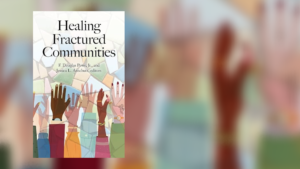
The book Healing Fractured Communities is written by alumni of the Lewis Center Community Leadership Fellows program who are pastoral leaders engaged in the work of renewal, resilience, and resistance in congregations, on college campuses, and in communities. Each chapter paints a picture of the work of healing fractures like racism, education inequality, and/or poverty. Each chapter includes takeaways to inspire healing in your community, and questions for reflection. Proceeds from the sale of the book support the Dr. Lovett H. Weems Jr. Scholarship Fund. Learn more and order now at churchleadership.com/books.
Karen Stewart: Thank you for that, Caleb. Because I heard Rachel talk about identity and this identity fusion. And you have in your book Three “I’s,” Ideology, Idolatry, and Identity. When I read that, I kept wondering to myself, how do I tell the difference? How do I tell, you know, somebody who might be just. That’s who I voted for because I like this platform and that is what I agreed in.
And now all of a sudden I’m categorized. How do I tell the difference in these kinds of people?
Caleb Campbell: I see that political commitments have become identity forming. Elements need forces, meaning, I’m watching people committed to a party, lane change their commitments based on how the party shifts over time.
For instance, my first vote was in 2000. It was the Bush v. Gore. And I remember that immigration was an issue, but the policies that were argued for from the Conservative Party are very different than they are today. Compassionate conservatism, that type of thing. And I watch the party move, the Conservative Party, move from one view to another.
And many people, because of their commitment to the partisan team also are shifting their convictions. And what that tells me is that the primary influence then is the party. So, it’s not like I have my political convictions and then I find the candidates that line up with them. It’s rather I’m on this team and they tell me what to think about these issues, so it becomes formative.
So, one way to tell the difference would be, if you are not a tribalistic partisan, and you’re just saying, “Hey, look, I’ve got these political commitments. And so, I voted for this candidate over that candidate,” one of the key ways that you could tell that a person’s coming from that perspective is they can criticize the candidate that they voted for.
If you are unable to criticize the team that you voted for, it may be that you have formed an idol out of that, that party. So, one of the ways you can tell something is an idol is you can’t suffer critical questions about it. You don’t let other people criticize it. You don’t let other people ask you critical questions about it.
And you certainly don’t ask her typical questions about it. Like one of the ways to know that that money has become a god and greed has said to your heart is you won’t let people ask you critical questions about your bank account. You can’t look over here. That’s private. Right? And it’s similar with our commitments to politics, where I think we as for Christians, I think we need to do some more work is thinking how does Scripture confront my currently held political commitments as opposed to how does Scripture buoy or support the candidate and the postures that my candidate, is offering?
So instead of throwing Bible verses next to political slogans, we rather, allow Scripture to engage our current commitments and then reform and reshape them, and therefore that becomes the primary influence in shaping our commitments.
Karen Stewart: Thank you. We should be able to have real conversations and, getting a better understanding when stuff doesn’t align with what the Bible has to say about it. Right? And I liked how you tied it back, and I’m tying it back to what you said at the beginning. Because it’s about sacrifice, isn’t. Isn’t that what, Jesus modeled for us was his sacrificial service to us in creation.
And so that’s kind of what our Christianity should be founded upon as well. Caleb, I do want to I do want to ask you a little bit more. I said it in your introduction that you used to be a skinhead, but you use that. And how you came to faith, and, eventually to the pastorate of the congregation that you’re that you are leading now based on this whole thing about hospitality and the table.
I wish you would take a few moments and share that with us because I think it might help us to see how we, too, can make our spaces and places hospitable to those we might view as hostile.
Caleb Campbell: Yeah. So, I had, in my late teens, was coming out of the neo-Nazi skinhead movement. And the reason, frankly, why I was coming out of it was because it wasn’t … what was being said and what was happening weren’t congruent. There was not an integrity to it, meaning the argumentation was, you know, white people are the master race.
And we need to protect America for white people and secure a future for, you know, white children. And when I looked around, I started asking, where are the wealthy, successful, all like retired skinheads, and everyone was going to jail or getting shot. And I was like, “This is what’s happening.” And so, because the movement itself didn’t, wasn’t integrated, right?
What was being said, what was actually happening, weren’t quite together. So, I started kind of floating away and was a drummer in a band and was frankly desperate for a community. And a woman from Desert Springs Bible Church was dialog drummers in the classified ads. This is back when, before, the proliferation of the internet.
Karen Stewart: Right. Who knows what a classified ad is?
Caleb Campbell: Yeah, yeah. The more I tell that story, the more I hold. So, she asked if I could come play the drums for the church the drummer had canceled or something, so I did, and as part of and then I got on the, you know, got on the roster and was there every month. So, I became part of one of the bands and a couple, of the musicians who are, husband and wife started inviting me over to dinner once a week.
And after dinner, we would have conversations about the things that made me angry about religion. And it was the right way to the conversation because I was full of rage, and I was still kind of deconstructing the white supremacy thing. But I was also curious about Jesus and faith. But I also was very turned off to what I perceived as religious hypocrisy and, you know, are mongering and things like this.
And so over the course of a year, we would have these conversations, and they were kind to me and gracious towards me and long suffering. I mean, the stuff I was saying was not great. And they were they would say things like, oh, that’s interesting. You know, I think Jesus says something like that. And they would find some way to introduce Jesus into the conversation again.
And that started a process of me, reforming my thinking not only about ethnicity and race, but also about faith and religion. And over those years, found myself following Jesus and undergoing a, you know, frankly, long term repentance project and transformation project. But the key was that they welcomed me in. I felt safe with them. I felt like they wanted me there.
And I think in hindsight, in fact, I know it, that I was unwieldy and sometimes unkind and sometimes disrespectful and sometimes saying things against the faith that they held dear. That was hypocritical. But they were extremely patient with me and handled me with care. And that created an environment in which I found myself following Jesus.
And, you know, the whole repent and believe thing. And it wasn’t one moment. And then I’m a totally new person. It’s years of repent and believe, repent, believe. Right. And that was made possible through their hospitality.
Karen Stewart: Thank you. Thank you for sharing that. What a marvelous story. And it just reminds us that sometimes we’re not going to hear things that we want to hear. And sometimes people will say things that are just in contrary to the faith that we believe in. The Jesus that we hold dear. But because they hung with you, you are the pastor of Desert Springs Bible Church.
Who would have thought when they were just inviting a drummer over for dinner that they were actually entertaining the next pastor of the church that they were a part of? That, to me is remarkable.
Thank you both. Rachel, I’m curious, what are your thoughts regarding the next steps and how do we move forward, and how does our country begin to heal from all of this?
Rachel Williams: Oh. Okay. So,
Karen Stewart: Easy for you! Easy for a PHD Student. It’s a whole dissertation in one question.
Rachel Williams: Right. There’s really a book. To your question, I think what Caleb described is, is a good starting point. It’s a sense of belonging, the ways of demonstrating that people that feel alienated in their communities that are changing, there’s still a place for them to be there.
There’s still a place where they belong. They’re still an important contributor to the community that they love. And so those types of, efforts towards creating that type of sense of belonging will then reduce the strain and the cognitive dissonance of a changing community. So, and the and what is it sounds very big, but it starts with very small, direct efforts and activities.
And I think once again, I think you’re currently seeing that in different ways that people are responding to ways, the government is interacting in their communities. It doesn’t have to be something large and expansive. It can. It starts with things that are small and direct and with the people that you care about. And those efforts are ways to address the larger issues that are going on and the larger changes that are, that are occurring that people are concerned about in different ways.
Yeah. I think that’s where I’ll leave it for now.
Karen Stewart: Caleb, what are people’s next steps? If they’re wondering, what do I do to help my community heal and be reconciled? In light of everything that’s been going on in our country.
Caleb Campbell: The first thing I would say is: we’ve been here before. Yeah. What we are experiencing is not strange to the church.
The American experience has been this divisive. I mean, this is just the fresh expression of our war with ourselves. Yeah. And then for the church, we’ve been here before, reckoning with power. We’ve been struggling with the power of empire. The temptation to the power of empire. Maybe since Constantine, or maybe since, Joseph and Pharaoh’s house.
I don’t know, but the way forward is the way of Jesus. It’s a renewed commitment to practicing. Philippians chapter two, taking on the form of a servant. It’s a recommitment to “loving my neighbors myself.” It’s a recommitment to, pursuing a life empowered by the spirit and to exhibit the fruit of the spirit in First Corinthians 1:2.
I think, to lament the loss that we have experienced and hold to the hope of the Gospel, the lament, I think that’s fresh for many of us, is where we need to lament and grieve the fact that what we once thought was a unified community actually wasn’t unified. And the gift, however, is that now we know what’s real.
It’s painful. I’m going to use this metaphor. I don’t care for it, but I’m going to use it. It’s like going to the doctor and getting a horrible diagnosis. The … that experience is extremely painful, but it is good that now you know that there’s something sick and so you can make steps forward for healing. And I think that for many of us, we still need to grieve the loss of what we had imagined that we had as a community, and to recognize that the apocalypse of the last 10, 20 years, whatever you want to call it, is a gift, because we can see that there’s some sickness in the church and make steps to bring forth healing. And that happens, as was said, at 100,000 kitchen tables across America for the next decade.
Karen Stewart: Thank you. It’s not new. Maybe that’s the great takeaway. It’s not new to the church. For many of us, it’s not new to our lived experience. And mostly it is not new to God. And he has brought us through it before. And he will bring us through it again. Here at Leading Ideas Talks, we love to give our guests the final word.
So, Rachel, I’m going to give it to you first, whatever your final where it is, and then Caleb will follow up with you. What’s the final word that you want to leave with our listeners?
Rachel Williams: Lean into learning more. And learn and find other people that are trying to make the change. Or trying to make the, the connections that you’re also wanting to make.
Karen Stewart: Thank you. Caleb. Final word from you, sir.
Caleb Campbell: This moment is really scary. And yet we have been promised that the Lord will never leave us or forsake us. And so, he is nearer to you than you are to your own self. And in clinging to that anchor and hope we can find a joyful and spirit filled way forward.
Karen Stewart: Thank you. Thank you both. What a wonderful conversation that we’ve had. And it is my prayer that you leave with tools today. That you have some tools to help you at dinner, lean into the conversation and to love your neighbor. Because that’s where still called to do.
I am Karen Stewart. This is the Leading Ideas Talks podcast, and I look forward to talking with you again.
Announcer: Don’t forget to subscribe to our free weekly e-newsletter, Leading Ideas, to be notified when new episodes are published. Visit churchleadership.com/leadingideas.
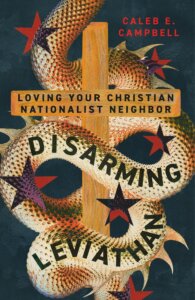 Disarming Leviathan: Loving Your Christian Nationalist Neighbor (InterVarsity Press, 2024) by Caleb Campbell is available from the publisher, Cokesbury, and Amazon.
Related Resources
- Part 1 — Loving Across the Divide: Conversations on Christian Nationalism featuring Caleb Campbell and Rachel Williams — Watch the Leading Ideas Talks podcast video | Listen to the podcast audio version | Read the transcript
- Leading Amidst Christian Nationalism by Lovett H. Weems Jr.
- Leading in an Age of Political Polarization by David R. Brubaker
- Leading between Faith and Patriotism by Lovett H. Weems Jr.
- Preaching Our Principles Not Our Politics by David R. Brubaker
If you would like to share this article in your newsletter or other publication, please review our reprint guidelines.