




What makes people feel like they truly matter in your church? In a season where many are disengaging from church life, how can leaders help people feel truly seen and valued? In this episode, Jonathan Page talks with Zach Mercurio about his book The Power of Mattering, and how simple, everyday interactions can transform church culture. Discover practical ways to help people feel noticed, affirmed, and needed—and why that may be the key to deeper connection and lasting engagement.
Listen on Apple Podcasts | YouTube Music | Spotify
Watch on YouTube

- Transcript—Click or Tap to Read
-
Announcer: Leading Ideas Talks is brought to you by the Lewis Center for Leadership of Wesley Theological Seminary in Washington, DC. Subscribe free to our weekly e-newsletter, Leading Ideas, at churchleadership.com/leadingideas.
Leading Ideas Talks is also brought to you by Discovering God’s Future for Your Church. This turnkey video tool kit helps your congregation discern and implement God’s vision for your church’s next faithful steps. Learn more and watch an introductory video at churchleadership.com/vision.
What makes people feel like they truly matter in your church? In a season where many are disengaging from church life, how can leaders help people feel truly seen and valued? In this episode, Jonathan Page talks with Zach Mercurio about his book The Power of Mattering, and how simple, everyday interactions can transform church culture. Discover practical ways to help people feel noticed, affirmed, and needed—and why that may be the key to deeper connection and lasting engagement.
Jonathan Page: Well. Hey there, friends. My name is Jonathan Page, and I want to welcome you to another episode of Leading Ideas Talks. Today, I am excited to be joined by Zach Mercurio. Zach is an author, researcher, and leadership development facilitator who specializes in purposeful leadership, mattering, and meaningful work. Zach advises leaders and organizations worldwide on practices for building cultures that promote well-being, motivation, and performance.
He has a PhD in Organizational Learning, Performance and Change from Colorado State University, and he serves as one of Simon Sinek’s Optimist Instructors, teaching a top-rated course on creating mattering at work. His new book that we’re going to be talking about today is called The Power of Mattering: How Leaders Can Create a Culture of Significance. He’s been featured in the Harvard Business Review, Forbes, Psychology Today, The Denver Post, ABC news, and now on the Leading Ideas Talks podcast.
So, Zach, it is a real pleasure to be with you today. Thanks for joining us.
Zach Mercurio: Yeah. Thanks, Jonathan. Thanks for your interest. Thanks for having me here.
Jonathan Page: So, The Power of Mattering, you know, we’re going to talk a lot about this book for those who haven’t read it or maybe for those who have, would you would you just share a little bit about your inspiration to write this and kind of why? Why does mattering matter?
Zach Mercurio: It all goes back to my research as a PhD student. We embedded ourselves with a group of janitors as custodians, responsible for cleaning all of the buildings, making everything else possible. Doing really, really hard work that’s often rendered invisible. And we were trying to understand what made work meaningful, what contributed to thriving amongst custodians, and what contributed to languishing.
Not flourishing amongst custodians. And one thing that consistently came up for us was that those who experienced meaningfulness were able to see how they and what they were doing or significant, experienced very small moments with other people regularly in which those other people showed them the evidence of their significance. They saw them. They remembered their name. They remembered who was in their family.
They checked in on them. They showed them the difference that they made. They reminded them that they were needed. And it was these small moments, what we’ve come to call “moments of mattering,” feeling significant to others, which was really the driving force for what made some custodians thrive and what caused others to languish. People who didn’t experience meaningfulness tended to not have as many relationships or interactions in their work, in which they felt that they mattered.
They had a leader who managed them, told them what to do, how to do it, didn’t ever share that with them. Why it mattered didn’t ever, illuminate their unique gifts. And they came to see it as just a job. So those social relationships, those small interactions were so powerful. And then that research led us to study over a thousand people in 22 different occupations.
And we asked them, when do you most feel that you matter? And we did not see any big actions in that data. We saw small interactions. It was very small things like my leader can name a unique gift that I have and show me the difference that it make or makes, or my leader checks in on and remembers details about my personal life.
It was very small things, and this was all happening at a time where people reported they were feeling more invisible, overlooked, more lonely than ever. And I think we finally got to this point—I finally got to this point—where this, you know, people asked me, “Why did you want to write this book?” I didn’t necessarily want to write this book, but I felt that I had to write this book.
I had to share what we had been learning about how we can reenter our relationships, in our interactions, in a way that helps people feel seen, heard, valued and needed, which is so critical for thriving. And that’s the impetus of the book. But it came from just observing it, you know, on the ground with people doing really difficult work.
What the what the power of a moment of mattering means.
Jonathan Page: Yeah. Well, I just think that’s it’s so incredible and such a reminder that every word, every action that we take in leadership really has the capacity to bring significance, has the capacity to bring meaning-making into the space. And I guess one of the things I’m really interested in, you know, for folks who are listening to this who are church leaders, faith-based leaders, you know, we are witnessing in the United States right now a gradual decline in religiosity.
You know, folks who are attending church less frequently, the you know, it’s sort of there’s a there’s a statistic that like faithful church attendance is now, one to two times a month, right? Like this is kind of the the sort of way that we’re orienting religious life.
I’m wondering for you, you know, you distinguish in the book a little bit this dichotomy of mattering and anti mattering. And I’m wondering if there’s anything you might want to say to faith based leaders about this idea of anti-matter as it relates to sort of decline of religiosity. And this there like, are there behaviors that you’ve witnessed in leaders that contribute to folks feeling that lack of significance that maybe could be corrected or could maybe be attributed to some of the sort of space that we’re in with religiosity in this country?
Zach Mercurio: Yeah, that’s … that’s a that’s a big question. And I’ll try to give it, as clear of an answer as possible. But I think it’s important to understand what mattering actually is. As we discuss anti-mattering, because mattering, to matter to another person is a survival instinct. It’s part of our design. You know, one of the first things we do is as humans, as babies, is we reach out our arms in a hugging motion. It’s called the grasp reflex. So, we are designed intelligently, designed to reach out and find someone to be important to before we even search for food. So, think, I mean, think about this. No one in your congregations, in your church, no one would be listening to this podcast if at some point we all hadn’t mattered enough to another person so that person would keep us alive.
But to think about mattering as a—as a visceral instinct, means we have to think about that instinct turning into this fundamental need to feel seen, heard, valued, and needed by those around us. It never goes away. Just like the instinct to sleep or the instinct to eat.
Now I want you to imagine a newborn reaching out and finding no one. Imagine the absolute visceral panic. Too many people today, I think, are facing that same stress of insignificance. And that insignificance when you experience moments where you’re overlooked, you feel unseen, you feel misunderstood, results in this term called anti-mattering, which was termed by a psychologist named Gordon Flat. And anti-mattering is any moment in which that instinct to feel important is not met. When we feel that we’re unseen, overlooked, ignored, uninvited, misunderstood; we feel that we don’t matter.
And what’s important for church leaders to understand is that there’s two behaviors that typically follow an experience of not mattering. One is behaviors that indicate withdrawal. So, acts of withdrawal: isolating, silencing, withholding, leaving.
You know, there’s the trend of quiet quitting in the workplace. You know, a career coach on TikTok said two years ago said, “Hey, if you don’t like your job, just do the bare minimum just to get by.” And that there were there were people listening to that that were like, “Hey, let me share this with my friend,” right? It was at the same time that the lying flat movement in China went viral, where people would take pictures of themselves lying flat on their bed to renounce a society that doesn’t see them, doesn’t hear them.
It’s no surprise to me that as younger generations have been leaving the church, that younger generations also report at the same time the lowest quality interpersonal interactions, and they indicate that they’re the loneliest generation. When people feel that they are insignificant in any relationship, including a relationship with an institution, they will withdraw.
Think about any relationship that you vigorously committed to. When nobody checked in on you, nobody remembered anything about you. Nobody reached out, to help you. And so, I think acts of withdrawal really are one way of understanding why people have withdrawn from the church and other social institutions.
But the second action is people also act out in desperation, complaining, blaming, gossiping, protest. All of these things are usually the language of the unseen and the unheard. So, like quiet quitting or lying flat or disengagement isn’t the result of a lazy, entitled, nihilistic organize—generation. It’s the result of people who are having lower quality interpersonal interactions, who feel more unseen, unheard, and undervalued by those around them, who have been brought up in an age that tells them that they’re worth, that they should. They they’ll be valued once they add value.
When the opposite is true, people need to feel valued in order to add value. That all results in these behaviors of withdrawal, and isolation, or can result in acting out in ways that are perceived as toxic or difficult.
Jonathan Page: Yeah, that’s I mean, really, really incredible insight and such a—I think it speaks so much to the space that a lot of leaders find themselves. And then it’s sort of like, okay, so if we understand some of those root causes and some of those places that people find themselves that might lead them out of spaces of faith based involvement, well, how do we then introduce “mattering” into the conversation, and how do we make sure that we’re intentional about this?
And I love that in the book there’s this framework that’s really a pattern of noticing, affirming, and meeting. And I wonder if you would just kind of give a basic overview of, of that flow and just how leaders can really posture themselves to be able to do … to participate in that flow in a meaningful way.
Zach Mercurio: Yeah. And I will say, you know, as you’re thinking about this, it’s really important to understand the difference between belonging and mattering, because a lot of faith-based organizations, you know, have focused on belonging. You feel part of something; you’re connected to something. Well, I can feel like I belong and I’m connected to something but feel insignificant to individuals in that group.
You know, like belonging is being picked for the team mattering is feeling that the team wouldn’t be complete without you. And mattering happens through interpersonal interactions. So, it’s important, I think, for leaders to understand is that your culture as a church, for example, is the accumulation of the interactions people have on a daily basis with the people around you.
That’s your culture. The culture isn’t the values that you put up, or isn’t your statement of faith, or isn’t any of these symbols. These are symbols that you belong here. You know, I if I go by it, you know, I’ve gone by churches that say like “you belong here” on the outside sign. Right. But what, what matters is that if I feel that I matter to the next individual I interact with.
So a couple of a couple of things that is important around that is. So it comes down to architecting interactions amongst leaders in which people feel those three things noticed, affirmed and needed. I mean, in the way that model was developed is we asked people think about the time when you most felt that you mattered to someone else, what were they doing?
And, they often and if you think about this right now, you’ll find some, some combination of feeling seen and heard. Feeling like someone recognizes something unique about you, shows you how you’re uniquely, how you uniquely add value to a group and then reminds you that you’re needed in a group. And so I think the first place to start is to make sure that especially all leaders in the organization, but then everybody in the congregation is expected to show up for one another in ways where they feel noticed, affirmed, and needed.
And we’ve been able to identify like 25 skills under the noticing, affirming and needing practices that we can, you know, we can dig into in just a little bit where some of those practices are. But I think understanding that this happens at the interactional level, belonging and inclusion can happen at the programmatic level, but no symbol can make up for the daily experience of feeling unseen, unheard, and unvalued.
I will say this also, I want to go back to something you mentioned about the faith. Communities. When people don’t feel that they matter, they will desperately seek to matter to something else.
Jonathan Page: Oh, interesting. Ok.
Zach Mercurio: So, a lot of like division in our country, right? Someone says how, hey, you’ve been overlooked, I get you, I see you no matter what it is, what side of the aisle you’re on or what, what leader or what product is promising or what brand or what other worldly thing is saying, “Hey, I see you, I get you.” It’s almost like every like there’s so many entities competing to show people how they matter, because we know it’s such a desperate instinct that when people have those experiences where they don’t feel that they matter, they don’t feel seen, or they feel misunderstood or they don’t feel represented in a group, which I think is happening in faith based organizations. They will go to a product, a brand, an influencer, a politician who who is saying, I see you. “Hey, you’ve been forgotten in these other places, but not here. Come to my subreddit forum.”
Jonathan Page: Right, right.
Zach Mercurio: So we need to recreate these spaces where people do feel noticed, affirmed and needed.
Jonathan Page: And it sounds like a part of what you’re saying. There’s that, that that work is not the work of an individual. It’s the work of a collective. Right? Like, yeah, like that, that so often, like I run into to churches sometimes that treat their pastors like mercenaries, right? Where they’re hired to do the job that they don’t want to do for themselves.
I feel like there is a distinction, though, between sort of the individual role and how a leader can sort of foster meaning making and foster mattering versus the sort of collective role. I wonder if you might say a word or two about kind of how how do leaders foster that kind of culture in their, in their congregation or in their organization, and in a way that the onus isn’t solely on them to be the ones to make?
Zach Mercurio: Well, I think that it’s what are the expectations of how we interact with one another and setting those very clearly and modeling those are people tend to repeat what’s modeled for them, by leaders. So, if if you’re not modeling this with your elders, the people around you, the leaders around you, seeing and hearing and valuing others and then naming what you’re doing, I think that’s key. Naming the skills.
And then also providing skill development for the people in the individuals, in the congregation, in the entity to be able to do this for one another. It’s important. Like oftentimes I’m struck by how often we say, hey, just make sure you’re welcoming and somebody comes. But do have we thought about that? People might not know how to be welcoming like and so I think thinking about these things as skills that we can develop in people is really important.
Thinking about it as the occupation of the church to create interactions in which people feel that they matter is important. And, one of the things is that, you know, a lot of people will say to me, act like your research is a common sense. Of course, people want to be cared for, want to feel noticed, affirmed, and needed.
The problem is that common sense isn’t common practice. And for leaders who are trying to scale this, they have to be aware of how the skills to see, hear, and value people have been withering over the past 25 years, and that as an organization, we have to upskill and reskill people to do this. We have been socially, we have been de-skilled on how to be good people to one another, largely by technology.
For example, Jonathan, if you give me some, you know, I know a lot of churches are getting sold like platforms for connection and things like that. Right. You give me some bad news. I can take my phone now and I can just send like a thumbs down emoji and say, “I’m so sorry to hear that. I’m praying for you.”
Right? So, every time and every time I send that message, it’s not bad. It’s good for efficiency. But every time I send that message, I get out of the social situation in which I have to be in that discomfort. Sit with you. Seek understanding. Demonstrate empathy. Show compassion. If you give me some good news, I can say, “hey, really proud of you.” Confetti emoji. That’s my favorite. I don’t have to sit with you. Say, I’ve really noticed your perseverance. I’m here for you. Like I’m really proud of you. Think about this. The average U.S. adults, it’s 30 to 40 text based messages a day to one another. We’re more connected that to each other, but we’re lonelier than ever. And so what’s going on?
Well, in psychology there’s this concept called skill decay, where for a social skill we actually lose a social skill which it starts to decay within eight days of not using it. Think about all of the people, potentially people in your church, potentially leaders, potentially elders, who have not had to show compassion to another person in real time in the last year because we’re able to get out of it using digital technology.
So I think that one of the key ways to do this is we have to say, hey, here are the skills and abilities that we need to have to cultivate interactions in which people feel noticed, affirmed and needed. And guess what as part of our educational programing. we’re going to do some sessions on how to listen deeply, and how to notice details of people’s lives and make them feel seen on, how to give meaningful gratitude, of how to remind people how they’re needed.
And we’re going to treat this as a skill that we need to have to deliver our mission in the world.

Discovering God’s Future for Your Church is a turnkey tool kit to help your congregation discern and implement God’s vision for its future. The resource guides your church in discovering clues to your vision in your history and culture, your current congregational strengths and weaknesses, and the needs of your surrounding community. Learn more and watch an introductory video now.
Jonathan Page: That’s a beautiful well, and it’s a great segue to to talk a little bit about that specific skill building set and kind of how to how to lean in on that, because so much of. Yeah, one of the trends that we’re really noticing in church leadership in general is this, this reemergence of the importance of incarnational ministry, in other words, that you show a willingness to abide, with someone the, in hospital chaplaincy, the phrase that get to use often is, being a non-anxious presence. Right. Like this idea of like, but but to do that, you actually have to show up. Right. You have to physically be there to, to be able to make that happen. And so how do you translate that into all the different spaces that church leaders are called into. And so it’s really helpful to think about this, you know, kind of stepping into the space of noticing.
And so, you know, in the book you, you offered this great distinction between seeing people and hearing people. And so I wonder if you think about specifically Faith-Based leaders, could you share a little bit more about the distinction between those and why that’s so important?
Zach Mercurio: Yes. So—and this is so important because, you know, hurry and care can’t coexist. And we’re more in a hurry than ever. Our attention is being fracked more than ever. And I love this idea—you know, I think Mother Teresa called it the Ministry of Presence, right? This idea of of being present, being with somebody, giving someone their attention and your intention and your time and your skilled attention for them.
And that really is what noticing is all about. Noticing people is seeing and hearing them. Seeing somebody is paying attention to the details, ebbs and flows of their life, their work, their energy, and offering them proactive actions to show them that you’re thinking about them, that you’re you’re remembering them. It’s seeing somebody is about asking questions that go beyond the greeting greetings.
Like, how are you? How’s it going? How was your day? How are you feeling? How’s how are things been for you? And going into the question that gets at some details, like what has your attention this morning? What have you been thinking about most this morning? What’s the most meaningful moment you’ve had today? What’s something you’re struggling with?
How can I help? What’s getting in the way of you having a good day today? Is there anything I can remove for you? Any barriers I can take away from you? That’s a skill, right? Asking those deeper questions. It’s also about checking in on people’s energy and emotion and noticing that emotion, and and offering proactive compassion.
Right. Not just relying on empathy, which is seeking understanding and coming to understand what someone’s going through but offering actions to alleviate that struggle. All of those things contribute to that feeling of being seen. Feeling heard is feeling that your inner voice, the meaning and feeling behind the words you say are invited out. When you feel heard.
It’s like when you ask somebody, hey, what did you do last weekend? And they say, one person says, “Oh, I did nothing. I didn’t do anything. No plans.” And then maybe another person said, “Oh, I didn’t do anything. I didn’t have anything to do. I had no plans.” It’s the same objective message, right? It’s the same objective words with the meaning is completely different.
The person who helps someone feel heard listens for total meaning and system. And I notice that you sound frustrated about that. Not having plans. Is that right? And are not afraid to dig into the feelings in the voice behind the words. It’s being able to invite that voice in that experience out. So those two sides are incredibly, important.
But I will say that one of the biggest barriers to those right now is our attention spans, which have nearly halved, researchers find, in the last ten years, our ability to focus on the person in front of us. Ten years ago, on average, we could focus on one thing without getting distracted for about 2.5 minutes. Gloria marks is an American psychologist.
She replicated those studies two years ago, and now it’s about 47 seconds. So we have to have some process to retrain our attention to note down what we here to, to reflect back, to think about people when they’re not with us and then tell them we’re thinking about them. All of those things contribute to helping someone feel noticed.
Jonathan Page: Well, and I think it’s a remarkable space to live in of, of just being able to essentially, in some ways, you’re just being able to tell someone’s story back to them, in a way, and then and then practicing appreciative inquiry in a way that really allows you to go to that deeper level of, of, of going beyond, like you said earlier, it’s going beyond belonging to mattering and, and into the next sort of stage in all of this is this idea of affirmation and sort of affirming look like.
So I think this can be kind of a two part question. So, so the first piece is like, how do you build that bridge from needing to affirming, and, and then within the affirming space, I wonder if you talk a little bit about the difference between public and private affirmation and then sort of, where those how you scale that in, in, in sort of your leadership efforts.
Zach Mercurio: Yeah. So again, noticing the reason why affirming comes after noticing in the model is because we can actually meaningfully affirm people when we are truly seeing and hearing them. The root word of the Latin root of affirm is affirm air, and it literally means to firm up or make stronger. So when you affirm somebody, you’re showing them the evidence of their significance in their environment, which helps makes their belief in their significance stronger.
I think it, you know, there’s a Scottish theologian, name is Oswald Chambers, and he writes “A river. A river’s source knows nothing of where it leads..” Okay. But, a river source knows nothing of where it leads. But as so so as a leader, though, we can reveal the impact back to the source. And that’s what affirmation is.
Because, you know, we can come to believe that we matter on our own, but it takes others to show us how we matter, because we get to be the recipients of people’s gifts, their talents, every day. But it’s it’s reflecting those back. It’s different than appreciation or recognition, which are often public appreciation of showing gratitude for who someone is.
You can do that in a program. It’s like, you know, we have teacher appreciation weeks. Like you could do that in an event or a symbol. Recognition is showing gratitude for what someone does. It’s elevating their activity or their work or the results they produce. But affirmation is showing somebody how their uniqueness makes a unique difference. It is the, it’s revealing the impact back to the source.
So, you can have symbols of value for someone. You can symbolize that someone’s valued or recognized or appreciated publicly. But if they don’t have interactions in which they feel valued every day, those symbols can create dissonance. It’s like when a church tells you someone that you’re valued in. You’re welcome here. But then I feel like no one’s ever checked in on me.
I feel that I’m judged, you know, for for being new or for, you know, doubting or not coming in for a while. You know, those you can’t make up for those daily experiences. So I like to talk about interpersonal affirmation as having those two sides: being able to spot and name people’s unique gifts, and then being able to show people how those unique gifts make a unique difference.
One way to do this is just to give more meaningful gratitude. This is one of my favorite practices, right in your organization. Any time anybody says thank you or good job or praises somebody, make sure that it’s a rule that you go a step further and show people the difference they make and exactly how they make it.
I mean, there’s four components to giving meaningful gratitude. When somebody does something that you really want to elevate, specifically name when and where it happened, describe the setting, name their specific behaviors that they use, but then name their gifts and I think this is really powerful because you’re showing them the gifts that they have been entrusted with on this earth. Right?
And, you’re helping them to reveal what’s good about who they already are. I once had a, coach who told me, you know, you can’t read the label when you’re inside the jar, right? One of the greatest gifts as leaders is to reveal in someone else what they may not yet see in themselves, and therefore gifts.
Everybody gives us every day. They give us their strengths, what they love and what they’re good at. They give us their purpose, how they uniquely impact the group. Does everybody around you in your church know what’s lost when they’re gone? Does everybody know how the moment is better because they’re there? How the conversation is better because they’re there?
Do they know they’re that how their perspective is valued? Their perspective is how only they see the world. And then do they know how their wisdom is valued? Everybody in your church has something only they can teach you. Right. And so being able to being able to name those gifts and then show them the impact that those gifts make on the bigger whole, that is a practice and it’s a discipline of revealing the impact back to the source.
Jonathan Page: Absolutely. Well, and I it kind of bleeds into this, this sort of last piece of the framework about needing and sort of how that contributes to all of the space. I think the, the space that I, my shadow side hears all of this and says, okay, so how do you keep somebody from just like you’re, you’re you’re doing all this work. Is there a way where this can become, like, egomaniacal, you know?
Zach Mercurio: Yeah. Right. Right, right. To the person you’re.
Jonathan Page: You’re like, I’m a size eight hat. I can’t fit through most stores already. Like, how am I going to fit through, you know how. And so, so I guess how do you how do you balance that in a way that, that it doesn’t become pollyannaish or something that feels surface? But.
Zach Mercurio: Well, I mean. I think it’s rooted in Jesus’s teachings. I mean, my, you know, my the parable that comes to mind with the needed component is the parable of the the the shepherd. Would a shepherd leave its flock to go find the one sheep that needs, you know, I don’t think Jesus was very concerned about inflating the ego of the sheep, right?
It was, I think he was more concerned about making sure the sheep knew that it was pursued, that it was needed. And too many people feel just like a cog in somebody else’s machine in most of their lives. Like they’re just a replaceable part. So this is not telling people how great they are. It’s showing people that they and their unique gifts, their unique strengths, their unique purpose, their unique perspective, their unique wisdom is irreplaceable, an ear non replicable and is needed in that, in that community and in the community that that we would leave everybody else just to come get you, find you.
And that’s not inflating someone’s ego. I think that’s revealing to them that they’re chosen and that they’re needed. And so that’s what we’re talking about. And psychologically, when you think about commitment to a church body or commitment to an organization, psychologically, when people feel replaceable, they tend to act that way. Right. When people feel that they’re not pursued, they tend to run a little slower, right?
They tend to like, you know, they get they get apathy, you know, they get apathetic. They get, complacent. But when people feel irreplaceable, when people feel needed, they act that way. So that’s what I’m talking about. It’s not about inflating people’s ego, but it’s about showing them how they and their unique gifts and talents are needed for something, bigger.
One of my favorite ways of doing this is just these these five words, right? “If it wasn’t for you.” Okay. I just want to let you know. If it wasn’t for you, this place would be different. My relationship would be different. My life would be different. My understanding of things would be different if you hadn’t said that.
That’s what we’re talking about when it comes to feeling needed. When it comes to feeling needed in like an organization, it’s putting your big mission at the top and making sure that everybody can can link how they and their inputs and their uniqueness is is almost measurably needed. And ladders up to that big mission, right? Can they see themselves in it every day? And that “if it wasn’t for you,” language helps with that.
Zach Mercurio: And I think that’s beautiful. You know, the the tradition that I come from is, is the United Methodist Church, our listener pool is it’s from a wide variety of different religious contexts and maybe even non-religious context. But one of the principles that that makes United Methodism kind of unique is that it’s it’s necessarily conventional. So, we believe in, in sort of this sharing of resources and being able to, to sort of work collaboratively towards, common ends and that sort of thing.
Jonathan Page: So I wonder if you were thinking about sort of how how were networked together, how did those networks play a role, and maybe not just United Methodist networks, but just in general, sort of the network of faith based community? How does that play a role in scaling, this, this idea and kind of scaling significance?
Zach Mercurio: Well, the good news is that, you know, culture or is the is the accumulation of interactions, the quality of interactions. And the fundamental unit of a network is it’s interactions between the two. So as you as you work from an interactional level, oftentimes we think about it as a even networking. We can think of it as a programmatic level, like we deliver this thing through this network versus an interactional level.
How do we make sure people are choosing to show up in their next interaction and make sure that person feels noticed, affirmed, and needed? That results in a in an environment where people feel that they’re valued and so they add value to the network. And I think that that’s really important because, one of the things that’s interesting is mattering begets mattering.
So the more I feel seen heard in valued and needed, the more I’m more likely to do that to someone else. This is the upward spiral that happens in network. The more I feel valued, the more I add value, the more I add value and see how I’m, adding value, the more I feel valued and the result is commitment, motivation.
And that’s that flywheel and network that gets going once you start scaling and creating relationships at the interactional level in which people feel seen, heard, valued and needed. I mean, the norm that’s kept us together as a species is called the norm of reciprocity, right? That we return a kindness. But what people don’t understand is someone has to go first. Someone has to go first. And I think that that’s that role of if you consistently keep showing up that way, you you build that flywheel.
I will say that there’s we didn’t talk about this and this is going back a little bit further, but it connects to this idea of these the networking piece. For 50 years we’ve taught people to help themselves. For a half century, we’ve taught people to optimize themselves, that they’re independent. And, you know, like if you look at the New York Times bestselling books for the self-help section, they’re all they’re all books on how to how you can cope with the trauma that someone inflicted on you. There’s no bestselling books that are like, how Not to be a traumatized right?
Because that wouldn’t sell very well. So we’ve taught people to be self-obsessed. And I think that one of the things that we have to do is we have to start teaching people that success is really looking outward, right? Success is being compassionate, kind, giving, self-sacrificing. But one of the tensions that I see is while the church teaches that they often operate in economic and other models that, reward the opposite. And so we can’t rely on people to be morally good in a system that incentivizes them not to be.
So we have to we have to also think about our systems and our systems, especially within these networks, encouraging the behaviors and modeling and rewarding the behaviors we say we want. Or are they mad? Or are they or are they subtly rewarding things like status, power, money, influence? And we have to be careful, very careful of that because that can get very sneaky.
Jonathan Page: Absolutely. It’s, one of the, one of the core beliefs I have, you know, coming from a church management world, kind of a denominational office space, you’re finding the two primary measures we were asking churches to take on a consistent basis were worship attendance and giving. Yeah. And so all of a sudden, there you go. That’s the economic model of like, well, do you have bottom of the seats?
Do you have dollars in the plate? When that may not be the end result of faith based living. Right.
Zach Mercurio: That’s an indicator, I think like what’s interesting and this is a good discussion to, to think about as a leader is those are lagging indicators.
Jonathan Page: That’s right. That’s exactly right.
Zach Mercurio: They’re lagging indicators. The leading indicators of those things are how people feel on an interactional basis.
Jonathan Page: Yeah, we have to I’ll have to be careful here because I would nerd out with you about that for the next like hour and, yeah.
Zach Mercurio: But I but I think it’s important that when you’re having these discussions, it’s like, how do we. So I’ll give you an example for the private world just real quick. I had a VP of sales who said, “well, this is all great, Zach, but how do I get people to, how do I show people that they matter when I need them to get their numbers up?”
And I was like, “Okay, well, what do you currently do?” And she said, “well, we have this. I have a meeting. And I tell them they need to get their numbers up,” and I go, “well, how do they feel about that meeting?” And she was like, “they hate it. That’s why I’m reaching out to you. I need help.”
And I say, just start the meeting by saying, how can we contribute more to our customers to get the numbers up? And try that. And she said the energy was totally different. Of course it’s different. Like how how can we more and act on an interactional level? The ministry of Jesus, for example, to get attendance up is a very different conversation.
Jonathan Page: Amen, Amen. It’s so true. Well, Zach, I know we’re we’re kind of getting close to the end of our time together, right? I wonder if if there’s somebody who’s hearing this who maybe, is thinking, gosh, I really want to put this into practice in my context. What’s the what’s a good first step or what’s a good next step for a leader who’s listening to this and saying, all right, I’m ready.
Let’s go. Let’s go do this.
Zach Mercurio: I think that ask the people around you in your in your closest circle when you feel that you matter to me, what am I doing? And sit and listen. And some people say, I’m not going to ask that because I’m worried they won’t have anything to say, but don’t. That’s that’s data as well. But so just ask, you know, when you feel that you matter. I just want to ask when you feel that you matter to me, what am I doing. And you can blame it on us. Blame it on this podcast if you would never otherwise ask that question or it’s uncomfortable, just say, listen to this podcast. This is great question they ask. I want to ask you it when you feel that you matter to me, what am I doing?
And you’ll be surprised at what happens. I was interviewed for this magazine article, and the magazine article never got published, so it might have been a bad interview, but the journalist asked me after she said, “you know, I have a 13-year-old, and I’m really struggling connecting with her. Do you have any advice for me?” And I told her, I said, “ask her this question.
When you feel that you matter to me, what am I doing?” Because it’s a really key predictor of healthy relationships. When you can answer that and you certainly do more of those things. And I didn’t hear from her. Three weeks go by, I get this email from her and she said, I asked my daughter this question and she just said to me, it’s when we drive to school in the morning and we’re just driving in silence, listening to her favorite music, and she said that it got me emotional because that was just a chore for me. It was just a routine for me, but it was everything to her. So, I think that when we ask that question, we’re going to be surprised by how small some of the moments are and how simple some of the actions that we do are that we often forget in favor of all the big things we’re pursuing every day.
Jonathan Page: Wow. What a gift. Zach, this has been really incredible. We always offer our guests the opportunity to offer, like, a last thought, a closing word. What would you leave folks with? As we, as we say farewell today?
Zach Mercurio: I think in this age where everybody’s telling us how to treat everybody else, how to see everybody else, where can feel overwhelmed, like we can’t really do anything, where we’re out of control. I think that it’s very important to not give up the one power you already, already, already always have, which is your interactional power. How you show up in your next interaction no matter what’s going on in the day, no matter what’s happening at a macro level, all the events going on don’t give up your interactional power.
You know, I often say that. I often say that your next great leadership act is your next interaction.
Jonathan Page: And this has been just so good. Zach, I think you’ve given folks a lot to think about and a lot to chew on. And, and we’ve been really blessed by this, again, Zach’s book is called The Power of Mattering. He’s also got a great book called The Invisible Leader, about transformation in your life, work, and organization.
The power of authentic purpose. You can find them in a lot of places. But we’re glad that you found them here. The Leading Ideas Talks podcast. Zach, thank you so much for being a part of this.
Zach Mercurio: Thanks, Jonathan.
Announcer: Don’t forget to subscribe to our free weekly e-newsletter, Leading Ideas, to be notified when new episodes are published. Visit churchleadership.com/leadingideas.
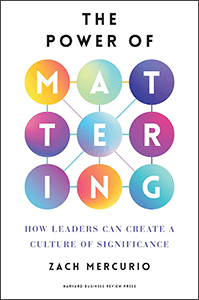 The Power of Mattering (Harvard Business Review Press, 2025) by Zach Mercurio is available from the publisher and Amazon.
Related Resources
- Why Great Leaders Ask So Many Questions by Lovett H. Weems Jr.
- 50 Ways to Multiply Your Church’s Leadership Capacity, a free Lewis Center resource
- 5 Purposeful Practices to Foster Shared Leadership by Jimmy Arthur Atkins
- Church Leadership Trends for 2026 by Jonathan Page
If you would like to share this article in your newsletter or other publication, please review our reprint guidelines.