


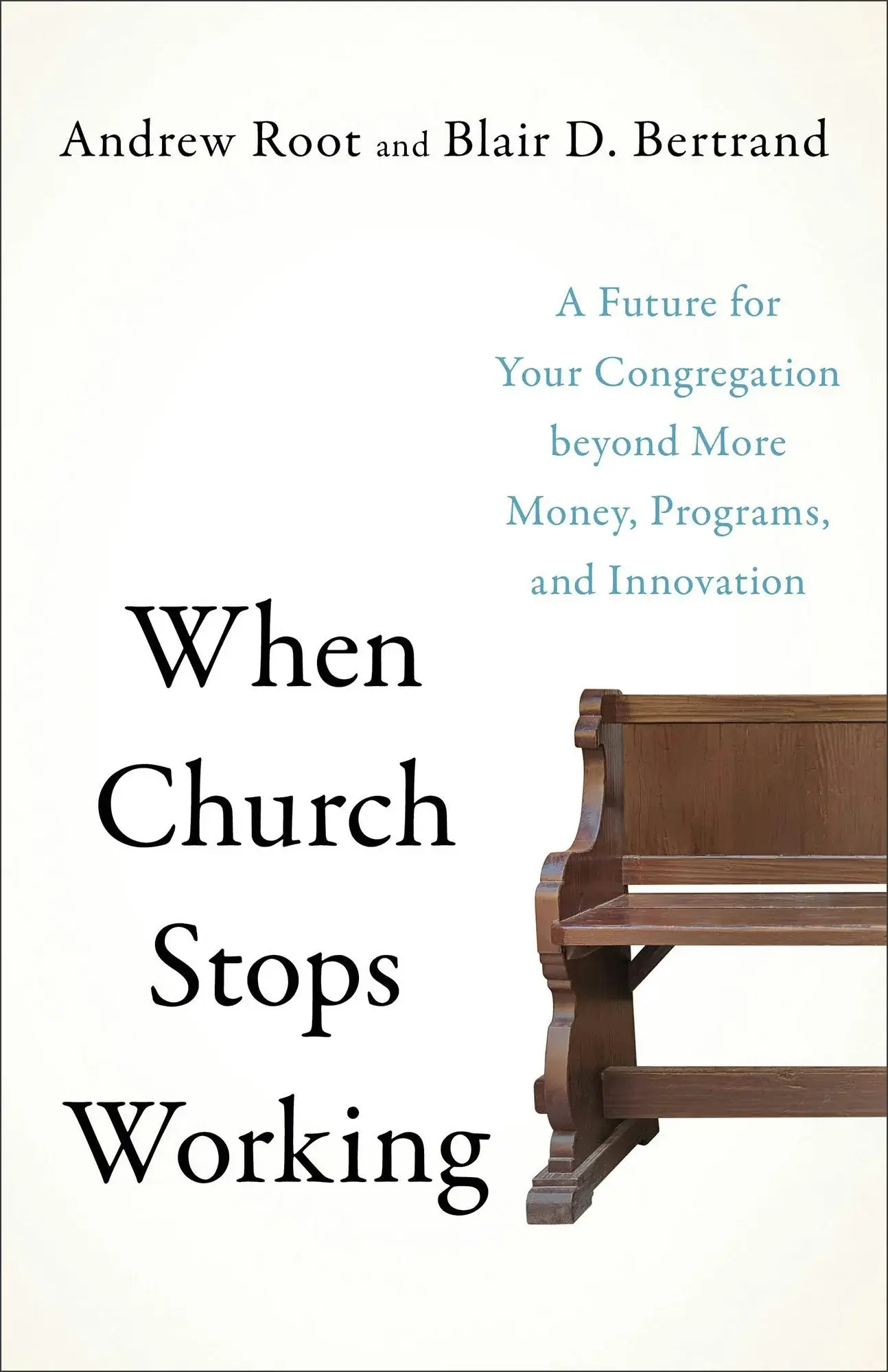
Is the church’s biggest problem decline—or distraction? Craig Meek says that the answer may be unexpected. He engages with When Church Stops Working by Andy Root and Blair Bertrand, challenging common assumptions about leadership, innovation, and growth. Rather than offering another strategy for success, the answer may be to slow down, discern, and recover a way of being rooted in God’s action.
There’s a specter haunting the Christian church in North America. Whether traditional or progressive, conservative or liberal, evangelical or mainline, you probably sense that something is wrong; that many people are no longer interested in what the Christian church is or has to say about either this life or the next. According to Andy Root and Blair Bertrand, these sentiments are well-founded. They reflect three significant problems that plague the church today: too little influence, too few people, and too fragile belief.
Many of today’s church “experts” maintain that the solution to these problems are things like more effective leadership and management styles, more creative innovation, more strategy and marketing, more programs, more something—whatever it might be. But are they right? Are the church’s most pressing problems really a lack of influence, people, and belief? Or are these symptoms of a much larger challenge facing God’s people in the present day?
An Alternative Community
What does it mean to be the Christian church in a secular world? What is its mission and purpose? Why does it exist, and how does it survive? For Root and Bertrand, the answer to the church’s decline is not more; it is not acceleration. The church’s mission is not to reclaim and re-enchant the world by working harder, leading better, organizing more effectively, or protesting louder. Rather, the church’s mission is to foster an alternative way of being and living together—to create resonance; to create a space within which people learn to attune their lives more faithfully to the living God who acts within and among them, even when they fail to notice.
According to Root and Bertrand, the church and its leaders need to get more serious about this alternative way of being and living in the world. Rather than trying to keep pace with secularization through more effective innovation and leadership strategies, churches and their leaders ought to focus on developing what they call new ways of “having.” Practicing meaningful humility and integrity, confessing our tendencies to chase after numbers and influence, and giving thanks more frequently to God for our lives and life together.
To be clear, Root and Bertrand do not view these practices as components of an effective strategy, so much as a way of nurturing a particular kind of identity among a people—an identity centered on waiting for God to act in the midst of our lives and communities rather than anxiously pressing forward with our own agendas, initiatives, and ideas.
Waiting on God
However, the problem is that we don’t like to wait—even on the living God. As church leaders, it’s much easier for us to baptize a new initiative in religious language and align God’s work with our own. It’s much easier for us to respond to our congregation’s panic about decline by trying something—whatever that might be. Over and against this temptation, Root and Bertrand remind us that faithful leadership and strategic innovation require patient and thoughtful discernment. It requires a persistent commitment to waiting on God, so that our leadership and innovation follow God’s initiative rather than our own. What the church needs in pastoral leadership today is not someone with more ideas and strategies. The church needs pastoral leaders who really believe that God is up to something good and life-giving in our world and have the patience to discern both what that is and how God’s people might join in the holy mischief.
Get a “watchword.”
But again: waiting on God to lead the way is difficult, and Root and Bertrand are not without pity on those of us who squirm at the very thought of slowing down rather than accelerating. Their suggestion? Ditch the mission statement for a season and focus instead on a watchword.
Mission statements come from the world of our ever-accelerating secular culture. They focus on and emphasize our own actions and abilities. By contrast, a watchword is more like a signpost that helps us keep a lookout for what God is up to, so that we can be ready when called upon to join in God’s good and life-giving work. Fostering resonance, developing new ways of “having” through practices of humility, confession, and prayer—these are all ways that we stay “ready” for that moment when God surprises us by showing up in our lives and communities, inviting us to join in that holy and life-giving mischief that gives life to the world and its people.
And so, my question to you—pastor, lay leader, congregant—is this:
When God shows up in your life and community, what will God find? A devoted people waiting expectantly to join in God’s work? Or an anxious people too worried about their own survival and too busy with their own initiatives and innovations to recognize what God is up to and join the fun?
Related Resources
- What Does Declining Attendance Portend for Congregations and Their Leaders? by Lovett H. Weems Jr.
- 7 Things to Do When a Church Is in Decline by Ron Edmondson
- There is No Such Thing as Church Revitalization by William T. Chaney Jr.
If you would like to share this article in your newsletter or other publication, please review our reprint guidelines.