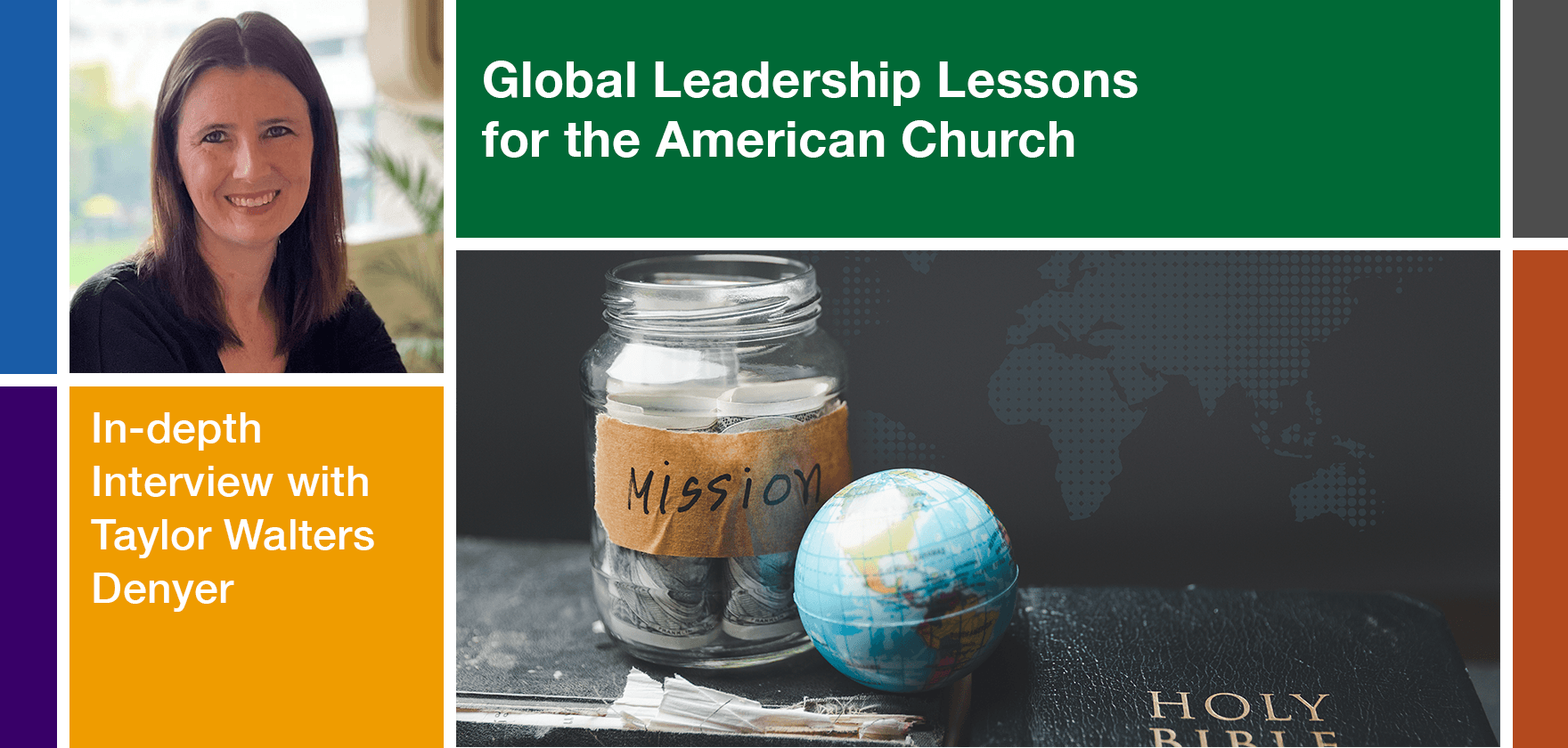
Church leaders face constant pressure to adapt in a changing culture, yet the deeper challenge may be how the church understands its mission. In this conversation, Jonathan Page speaks with missiologist Taylor Denyer about how global experience reshapes leadership in the U.S. church. Drawing on insights from the worldwide church, Denyer presses leaders to reconsider how mission shapes every aspect of church life and leadership.
Jonathan Page: One of the things that strikes me about you, Taylor, is you truly are globally itinerant. You’ve served in India, Slovenia, Algeria, Djibouti, Zambia, Chile, the United States, the Democratic Republic of the Congo. As you think about all of those different settings, the thing that comes to my mind is John Wesley’s line, “The world is my parish.” How have your various experiences around the world shaped who you are as a leader?
Taylor Denyer: Well, it greatly shapes me. But I will say, especially with my life, I often hear folks use that quote, “The world is my parish.” But I do want to say that that quote’s taken a bit out of context when we use it when we talk about around the world. As a missiologist this really matters because what John Wesley was saying in that moment was that his calling isn’t limited to the boundaries of the church property. It’s out there in the communities, out there in the field. That’s very important no matter where we are in the world to understand our calling.
In terms of my traveling around the world, it does help you see the forest for the trees, I think, and see how things are different. I can see the patterns, I can look at the U.S. in particular, our churches in the U.S., and I’m looking at it from the outside. I do think it gives me a perspective that’s harder to have when you’re there in the middle of the trees in a local appointment.
Jonathan Page: A follow up to that is there something that we do in leadership in the American church that you would say is challenged or critiqued by the experience of the global church? Something that, that you would say, “Hey, here’s something that I see happening in the U.S. church that, based on my international experience, we might say ‘Whoa, why are we doing it that way?’”
Taylor Denyer: Oh, so many things. You know, speaking about my home conference of North Katanga, there are a lot of really great Wesleyan practices that North Katanga continues to use, and use in a way that’s building up communities and building up the church that the U.S. has forgotten about or considers no longer practical. Things like (and part of it is some of the challenges of life in the U.S.), but for example, the congregation where I attended when I was living in Kamina, the area around the congregation is divvied up in sort of a grid pattern of geographic blocks. Every member of that congregation is assigned to a block based on where they live, and those blocks then meet weekly in someone’s home.
Not only do they meet as study groups, they get assignments as a block. So, the announcement in church that week might be, you know, “This week block 82 is in charge of the sweeping of the building.” So, blocks might get assigned janitorial duties that week. Or for example, when there is the birth of a child or a death in the congregation, or someone’s hospitalized, when they announce it in the congregation, they don’t just announce it. They give folks their marching orders. So, they’ll say, “This block is assigned to go to this hospital after church today to visit with these people. And this block is assigned to go to this home to give condolences to this family.” I’ve never seen that happen in the U.S.
Another great example that my late father highlighted in one of the books he wrote, in North Katanga when we have the signage on a United Methodist church, the big letters are always, “The United Methodist Church.” And then underneath is the name of the congregation. So, it’s:
The United Methodist Church
Lubudi Branch.
Whereas in the U.S. you’ll see the big name and then in small letters, oftentimes, sometimes in tiny letters, the, you’ll see the UMC branding. That’s not just a marketing difference. That’s a theological statement.
Jonathan Page: Absolutely. The need to brand the local space over the theological grounding of that space is a fascinating choice.
Taylor Denyer: So, in North Katanga, when someone joins United Methodist Church, it’s really understood as “I’m joining The United Methodist Church. I’m becoming a United Methodist, and this is the local branch that I attend, but I’m joining something much bigger than that.”
They even send letters. If you move to a new town, the pastor will write a letter to present to the new pastor saying, “Here’s a member of our congregation. They’re moving to your town. They’re your flock now.”
Jonathan Page: Wow. One of the things we’ve been talking about in the Lewis Center in this calendar year is how the trend for 2026 in the American church is likely to be more team-based and community focused. This speaks to that, right, the need to say, “How are we seeing the work of the church being through multiple people, not just the pastor or not just a lay leader? How are we focused on building community and not being in competition as much as we are in collaboration?” I think that’s a beautiful expression of all of that.
Taylor, I’m curious. So, you have so many hats, right? But maybe most amongst those is that you are a missiologist. Could you define what a missiologist and then as you’re defining that, explain how do you think the theology of mission is something that can really shape church leaders?
Taylor Denyer: So, missiology, breaking it down in simple terms is the study of mission. In sort of bigger terms, it is—in the way that philosophy asks a lot why questions—missiology starts with the question, “What is God doing? What is the mission of God?” Depending on how we answer that question, it splits into different sections, “But then what is God inviting us to do? How are we being invited to participate in that mission?”
In the way philosophy has lots of different branches, missiology has lots of different branches that don’t always agree with one another. But for me yeah, it is one of my primary identifiers is as a missiologist.
Jonathan Page: So as a missiologist, as somebody who’s deep in this space of really having a nuanced theology of mission, how do you think that sort of development in any leader, how does the development of that sort of theology and perspective of mission influence somebody’s leadership in their local church setting?
Taylor Denyer: I think it’s crucial. To be honest in the U.S. context, I think the lack of a healthy, fully integrated theology of mission is what has been at the root of so many problems the church has faced. That, and you know I get a bit on my soapbox, but mission in the church—and I’m not just picking on the United Methodist Church because it goes well beyond the denomination—mission in the U.S. context tends to be treated as an extracurricular.
I’m being descriptive, not prescriptive. Its primary function in most churches is to help the members feel better about themselves. The things that get labeled “mission” and church in U.S. based churches today tend to be activities that help members feel less guilty about their place in the world, and the privileges they receive from an oppressive system. But mission should be at the foundation.
When mission classes are offered in seminaries, who takes it? Well, the United Methodists have to, and maybe a few other folks who are considering a calling that takes them overseas. But if I had my way, the mission the mission class would be front and center. It would be the, at the core of the curriculum.
Because what is mission? Mission is the conversation of, “Who is this God that we worship? What is this God’s purpose? What does God want? What is God doing, and what does God invite us to do?” When we start with those questions, then everything else falls into place and everything gets seen through the lens of mission.
If the class you are taking in seminary is not building your capacity for participating in the mission of God, why is it being taught? Everything is mission. I feel that so much of the problems we face in the church are because we send our clergy out into the world with extremely flimsy, unintegrated understandings of mission.
Jonathan Page: I could argue it’s not just mission that we do that with. I’ve been thinking a lot. It’s this whole mentality, like this is a very uniquely American thing, I think, that like the church doesn’t exist to satisfy individuals. It exists to glorify God. We are not the subject of the sentence, right? God is the subject of the sentence. We’re participants in God’s work in the world. From your perspective I love that idea that mission can ground that if we allow it to, instead of allowing—that line about it being a soothing of our own guilt is a brilliant and wise and a good diagnosis of some of the challenges that the church faces.
I’m going to pivot us a bit, Taylor. At the 2024 General Conference you were elected as an alternate to the United Methodist Judicial Council and are now fully serving on the council. How do you anticipate that might shape your leadership perspective?
Taylor Denyer: Well, it’s still very early in the process for me, so it’s too soon to say. I’ve been involved in denominational polity and committees and things since I was a teenager in the nineties. Since I teach United Methodist polity at MTSO, I’m sure this will really force me to up my game in my deep knowledge of the Book of Discipline and so I’m excited about.
Jonathan Page: A lot of folks who listen to this podcast have some sort of connection to Wesley Theological Seminary. You’re an alum of Wesley and American, our next-door neighbor. So, I’m still new to, to Wesley and the D.C. community. What about Wesley have you carried with you into your leadership life and what should I be excited about being a part of this community?
Taylor Denyer: Wesley attracts a special kind of folk, and it particularly pulls in people who care about social justice issues, people who see things on a larger scale. I made so many great friendships there at Wesley that I cherish, and I very much appreciated the courses I took there, the theology, the grounding and some of the most important lessons I took away from Wesley weren’t the kind of things that you would find on an exam.
Some of the best advice I got at while at Wesley that I frequently pass on to other people for clergy is the importance of Sabbath and the importance of carving up time for yourself. I was taught to take your schedule and to block out times for rest, block out times for reading, block out times for going out and connecting with God in nature. Block out times for spending time with the family, for spending time with friends. Block it all out, put it on your calendar, put it in ink, and then whenever somebody asks you if you’re available for a meeting or whatever, during those times you just say, “I’m sorry, I have something else on my schedule,” and you’re not lying. You really do have something else on your schedule, and you don’t have to tell them that’s something else on your schedule is binge watching Netflix. It’s on your schedule.
I loved my time at Wesley, and I loved my time at American University. I did the international development program there, and obviously that also has helped me as I’ve bounced around the world. It’s where I met myself.
Jonathan Page: Taylor, this has been such a rich conversation, and you’ve taken us in a lot of places, and I know I speak for our whole audience when I say thank you for doing that. I’m curious, one of the things we like to do is give you the last word. As we’re wrapping up is there a last word or thought that you’d want to share with folks who are listening to this?
Taylor Denyer: Well, I’m not sure what day this will be going out. But I think all of us have current events heavy on our hearts. I would leave with a couple words of wisdom on that. One is to take care of your nervous system. Take care of your needs. On airplanes, they say, you know, “Put your oxygen mask on first.” But in times of crisis, for all those who are church leaders, people are going to be understandably afraid and upset. And one of the best things you can offer them is a regulated nervous system. To be that calm.
Which is also something I learned at Wesley: it was taught to me that the pastor is the non-anxious presence. But for me, it translates better as I’ve learned trauma therapy and that kind of thing. Regulated nervous system. So, don’t underestimate the power of a regulated nervous system.
The other thing I would say is don’t underestimate the power of being with. That is really—that has become the core of my missiology. The deep solidarity, the “being with.” I know right now we all want to fix things. We want to know what is it that we can do to stop and fix, and obviously that’s very important, but don’t forget that it’s also very important to just be with people. Be with people in their fear. Be with people in their grief. Just be with them. Be with them, be the regulated nervous system. Sometimes that’s all we can do. And that’s okay because sometimes that’s the most important thing we can do. So those are my words of wisdom in, in times such as these.
Related Resources
- Taking Church to the Community, a video tool kit resource from the Lewis Center
- Global Leadership Lessons for the American Church featuring Taylor Denyer — Watch the Leading Ideas Talks podcast video | Listen to the podcast audio version
- How to Stay Focused on Your Mission by Barry Winders
- Leveraging Church Property Can Sustain Your Mission by Lovett H. Weems Jr. and Ann A. Michel
If you would like to share this article in your newsletter or other publication, please review our reprint guidelines.