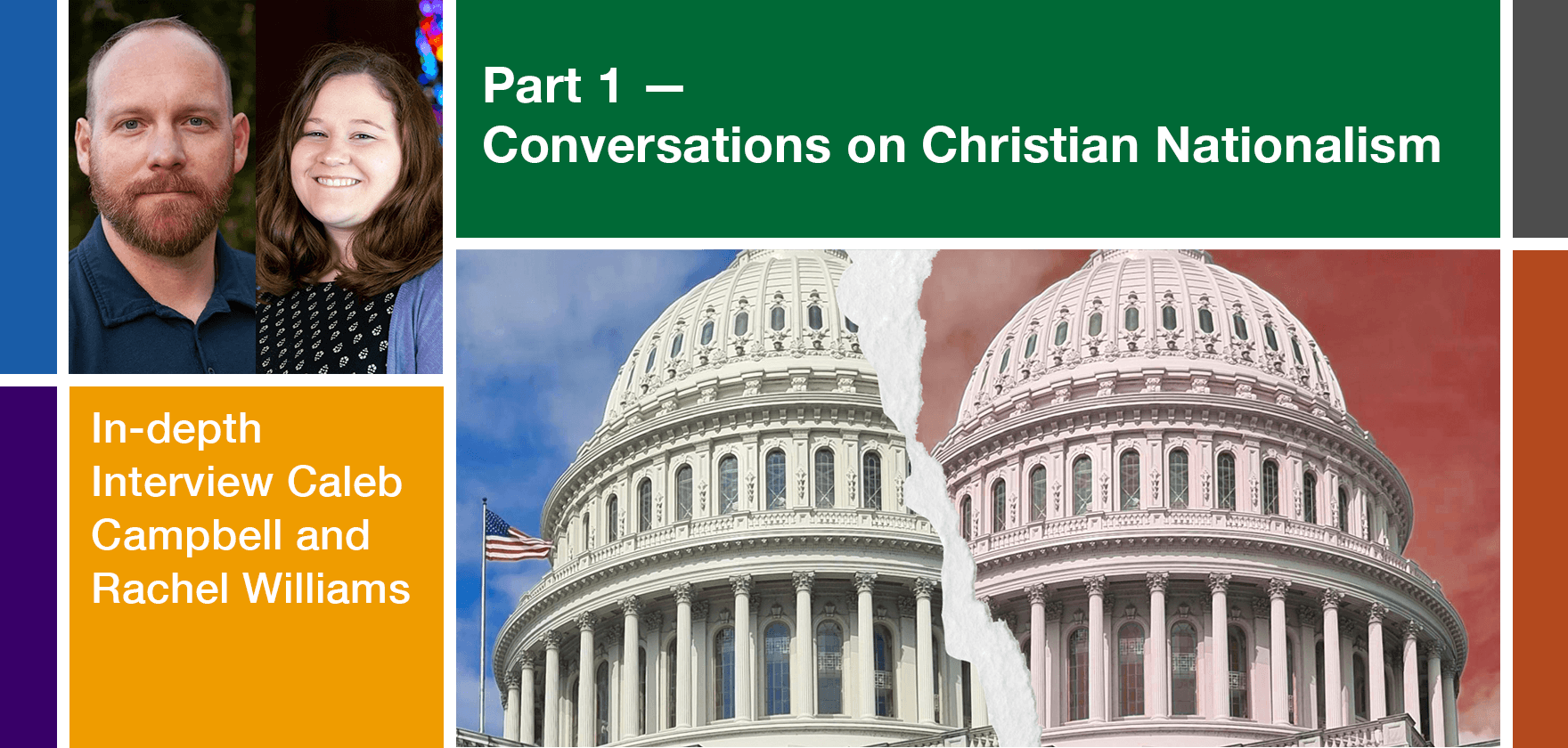
In a cultural moment marked by deep division and difficult conversations, this episode steps into one of the most complex and emotionally charged topics shaping faith communities across the United States: Christian nationalism. Caleb Campbell, author of Disarming Leviathan: Loving Your Christian Nationalist Neighbor, and Rachel Williams explore not just what Christian nationalism is, but who it impacts and how we can engage with our neighbors.
Watch the interview video, listen to the interview, or continue reading.
Karen Stewart: Today we are going to be talking about Christian nationalism. But we’re not talking about it just in terms of what it is. We’re going to talk about it in terms of who they are. And not just that, but what you can do to have conversations with them.
Many of us have discovered new things about our family, our friends, and our neighbors. So instead of tuning them out, why not be in conversation with them? Our goal today to really unpack what it all is and how we can be who God has called us to be in these tumultuous times. So, let’s just start with Rachel. From an academic perspective, what is Christian nationalism?
Rachel Williams: So Christian nationalism is many things, but I think the quickest way to explain Christian nationalism is that it is the belief that America is God’s chosen nation and must be defended as such only by, or mainly by, Christians. So, Christians should be the ones in leadership. Christianity as a religion should have a special favored position over other religions in the United States. So specifically, we’re talking about the U.S. context.
Karen Stewart: What got you interested in this topic? We’ll start with you, Rachel, and then we’ll move to you. Caleb. What got you interested in this?
Rachel Williams: So, when I was an undergraduate student learning about terrorism and other types of political violence, I was surprised that the explanation primarily pointed to Islam over other religions. My curiosity to learn more led me to learning about different abortion clinic bombings that had happened in the United States in the past, and acts of the Ku Klux Klan as well. So that was what got me into this area of interest and continuing to learn about the political violence that had been done in the name of Christianity in the United States.
Caleb Campbell: I became the lead pastor at Desert Springs in 2015, right in the middle of the primary season. We had such division in the congregation from 2016 to 2020. I was trying to figure out why so many people were angry about talking about immigration or racial reconciliation, things of that nature. By the time that January 6th, 2021, came around, right after that, about 80% of our congregation that was there in 2016 had left by the beginning of 2021.
Many of them left loud and accused me of, you know, being demon possessed or being a secret communist or being atheist because the evidence was, we had obeyed government regulations related to COVID-19. Because we had continued, as we had been doing decades prior, talking about caring for immigrants and refugees. We had continued as we had done decades prior, talking about racial reconciliation. That really got a lot of pushback after Ahmaud Arbery and Breonna Taylor and George Floyd were murdered.
I was struck by the vibe shift in the congregation that I frankly, I met the Lord in this congregation, you know, 25 years ago. 2016 to 2020 unveiled for me was that there was an awful lot of— not only division within the congregation—but also a commitment to using the methods of this world to garner power and security, which was striking to me. Because I thought we were doing the Jesus thing.
And January 6th happens. I hear the word Christian nationalism. I’m sure I’ve heard it before, but that’s the time I remember me personally being like, “wait, this is a thing?” And what understanding the American Christian nationalist movement helped me see was that the reason that people were upset at me and angry and yelling at each other were not disparate bits. It was that over our movement there was something bigger happening than just one person over here being angry about this thing and one person over here being angry about this thing. But it was all connected. I’m three miles down the street from where Charlie Kirk founded Turning Point USA, and from where they host monthly events, Freedom Nights, at a megachurch.
And they were doing this in 2021. And people that I was pastoring at the time were handing me fliers in the lobby to these events saying, “There’s a revival happening, Pastor Caleb.” And I was so struck by the fact that what I looked at the flier and I thought, “Oh, this is a rally. Right? A political rally.” But they said “revival.”
And so, me and one of our elders at the church, we went. And I was extremely distraught and disturbed by what I saw, because most rallies that are at churches, the church goes out of their way to say, “This is a public civic event. Thank you to the community.” Maybe they’ll pray, but by no means have I ever seen a political rally at a church pretend to be church. They did three of the worship songs we do at our church, they did an altar call, they took an offering. And then at the time, the leader of the organization, Charlie Kirk, got up and did a sermon. I mean, he preached “The Word of God says,” and he’s got a Bible in hand. I watched as he was making explicit political points about taking over America, getting “them” out, you know, the enemy. And talking about gun rights and school choice, things like this. Making direct appeals to Scripture. And what was striking to me is everyone in the room is raising their hands, saying Amen and Hallelujah.
And so, for me, I was so disturbed by the syncretism, the merging together of a certain way of being political in America with the way of Jesus. That Christian nationalism as a—as a movement, became much more helpful to me to understand what was going on in the people that I was pastoring.
Karen Stewart: I’m curious as to how we got here. For me, as a woman of color, the things that I see in Christian nationalism aren’t new to me, but I’m hearing from others that it is new to them.
Rachel Williams: In many ways this has always been part of the United States and what the United States has been as a country. This connection between Christianity and the power of the state, of the power of the government, as a way of both of those being interlinked and to continue to consolidate power for groups of people. And so that’s been around for a while. I think specifically what we’re currently experiencing in the United States can to some extent start at the point of the 1960s, kind of the reaction to the Civil Rights Movement and different social and societal changes that were happening at that time, and then the reaction to those societal changes.
So, for our current situation that, that is a typical starting point to moving forward because that includes the creation of the moral majority and the other processes that came from the moral majority. So that would be like the starting point. And that then has continued on through different processes of talking about abortion and other political concerns that people have and then connecting those directly and mainly with Christianity. So, those movements have brought us to this point in different ways.
Karen Stewart: Caleb, as I was reading your book, you made a real distinction between the nation and the state. Can you unpack that a little bit more for us?
Caleb Campbell: In America, we say, “One nation under God, indivisible,” and all that stuff. But that’s not actually true. We are many nations. So, thinking about America, we are many different people groups. For instance, we have people groups like Creole, or Cajun. But they are also American. They’re part of the country and the state is America.
We’re all Americans. But I recognize that the thing that binds me together with those different nations is that we are all part of one country that’s bound together not by common ancestry, not by common ethnicity, not by common King, but by an idea. And so, we are nations in a state. And the reason why I think that’s important is because we’re using the term Christian nationalism. When you put a modifier in front of the word nationalist or nationalism, you’re answering the question, “Who gets to be in charge of the state?”
Karen Stewart: Can you help us better understand the distinction between a patriot and a nationalist? What I might think about what patriotism is—because I feel as though I can’t be a patriot because now this term “Christian nationalism” has become so prominent that even leaving the country saying that I’m an American draws ire around the world. So, help us to make a distinction between those two terms as well.
Caleb Campbell: Patriotism is about love; nationalism is about power. So, C.S. Lewis talks about this in his book The Four Loves, that healthy patriotism is the word that we call family love. The love I have for my family extended out to the broader nation or people group to whom I belong. It’s the love for the places, the food, the music, the people, the way of being in the world. I experience a phenomenon when I travel for more than a couple of weeks and I’m in a strange country, I experience what we sometimes refer to as homesickness where I am not at rest when I’m in places that are strange to me. They talk differently, the culture is different, I always have to be on and aware.
Moreover, there’s a lot about America that’s familiar to me that I love and adore and celebrate. Patriotism is all that stuff kind of wrapped up together. True love is self-sacrificial. So patriotic acts are usually in service of others out of love for the people. So, you know, “it’s my patriotic duty” would be something that we might say if it’s an act of service for the larger group.
Nationalism can leverage patriotism (and often does). But nationalism says, “Hey, this people group that you love, or this thing that you love, you get to be in charge and dominate over others.” So, it’s about who gets to be a church.
And I might just make a quick note that people who argue for Christian nationalism don’t actually mean it. And here’s what I mean. Christianity is a very broad movement. They usually mean a honed expression of Christianity that they approve of. So, it’s usually a kind of like denominational nationalism. I would just notice that no modern American Christian nationalist is arguing that Mennonites should be in charge of the Department of War. So, while we’re using the term Christian nationalism, people usually mean a subset of ideas or ideals and political postures that they bundle together to call Christian.
Karen Stewart: So, as a Christian I can be comfortable saying that I’m a patriot because you can be a Christian and a patriot without contradiction?
Caleb Campbell: Well, the term gets misused, sometimes. I think that healthy patriotism is—and I agree with C.S. Lewis in this—the love that I have for my family extended out. And I think that that’s good. Where it becomes malformed is when it now seeks to dominate over others.
Karen Stewart: Rachel, you mentioned that this used to be very undercover. We may not have known who felt the way they felt. We knew that there was this undercurrent within the country, but we didn’t necessarily know who. Now, it seems very up in your face as to who it is. I do not like the term “majority minority” because I don’t like the term minority. I think it’s very degrading to people of color. But there’s a term I’ve also heard called the Great Replacement. Does that have some bearings into how we find ourselves where we are today?
Rachel Williams: So that phrase is connected to the Great Replacement theory. The Great Replacement theory as you described it references a particular date where the demographics are going to change in the United States of America. The Great Replacement theory takes that to the point of that is a conscious effort being done by particular people for particular purposes in order to take away power from others.
So, it’s almost like there’s a concerted effort in a way. That’s one way of looking at it. Another way is, this is something that’s going to happen, and we need to stop it from happening because we are—everything’s going to change in a way that we will not have a place in it anymore. In a lot of ways, what we’re really talking about is white Christian nationalism.
There’s a racial component to it. There’s a particular way of Christianity and a particular way of who is being considered. It’s not just a true American it’s not just being a Christian, but also a white Christian in particular. So those are also pieces of what we’re talking about when we’re talking about Christian nationalism and that’s how those two things come together in it, in what is happening right now.
Karen Stewart: I’m curious as a follow up to that. Because I hear you saying that Christian nationalism is white. Is it also gender based? So, is it more men than it is women? I know I was, listening to Ed Stetzer as he was talking about the demographics of the church and—this was last year—he did some data on the demographics of the church, and he made two assertions that I had heard had not heard before.
One was that women and girls were starting to leave the church. As well as that there is a rise of boys or men in the church. And I’ve often wondered … could that potentially be tied to the changes in the climate that we see happening with Christian nationalism and the people that it has a tendency to reach more of it?
Rachel Williams: Yeah. So, I have also seen those articles and I’ve heard that data. And it is right. There’s actually a bit of a question to it is: are young men and boys joining the church more, or are women and girls leaving the church? Like what is actually making the changes? To some extent, I think the data still needs to be collected as to how far this change or how pronounced this change is going to be in the coming years.
In one way, the there’s always been like a connection between masculinity, religion, and the well-being of the state. That’s kind of been a through line in a lot of different ways, in the United States. And so, part of it is the way of men being in the party, in having positions of power. That is how we continue to keep our power and to keep like, a balance in order that, that will continue to keep the United States in the good graces of God, but also as a successful nation.
So that’s kind of a very broad understanding—a broad overview of where those connections come into play. And then as the focus becomes more of a particular power, power for men and less power for women, more women and girls would then less want to be at church. That would be kind of the narrative at play with kind of these recent stats that we’ve been seeing. So, in some ways you can connect a Christian supremacy to a male supremacy at the same time.
Karen Stewart: Caleb, tell me how you see the Great Replacement as playing into where we find ourselves with Christian nationalism today.
Caleb Campbell: Yeah, I see the anxiety about pluralism is rampant in this movement. The communities in America are changing. As was said earlier, you know, this side of the 1960s, the pluralism in America has become exponentially more vibrant. And that creates anxiety in folks.
For instance, Aunt Betty’s been going to the same grocery store for 50 years. She walks right down the street. She gets her bread or milk or eggs. She has a chat with the clerk. It’s lovely. But just the other day, she was standing in line. And—you won’t believe this. The clerk was talking a different language to the person in front of Betty. And for that fleeting moment she wondered, “Am I going to have to learn a new language to go to my grocery store? Am I welcome here? This strangeness is happening in a place that I find familiar.” Now that anxiety can be handled in healthy ways and unhealthy ways. But the change is real. And many folks who are purveyors of American Christian nationalism will latch on to that real change and that very real anxiety.
And they’ll add gasoline to the fire, so to speak, saying, “That’s right, Betty. They are coming to take over, and you won’t be welcome in your home anymore. They’re going to replace you.” And so, what do we do? I mean, what do we do if our home and safety are under threat? You reach for the sword.
A buddy of mine, Ryan, who studied the rise of fascism in Germany made a statement that I think is true here. He says authoritarianism grows in this seedbed of anxiety about pluralism. And as the community changes it makes us feel unsettled sometimes. So authoritarian leaders swoop right in and make promises to keep that from happening to solve the anxiety. And as a pastor, my invitation for folks is regardless of the source of your anxiety, we don’t look to leaders with swords to solve that anxiety.
We look to the King of kings who takes on the cross and who dwells with us and promises to never leave us or forsake us. And so, the commitment that many folks have to American Christian nationalism is a misplaced trust that the movement will give them safety, belonging, and purpose as they feel, either unwelcome or unsafe in their own communities.
We love to hear from our readers! If you have any comments, suggestions, or questions about this article, please leave a voice message directly from your computer, tablet, or smartphone via Speakpipe. You may also email lewiscenter@wesleyseminary.edu or leave a comment on Facebook, Instagram, YouTube, and Bluesky.
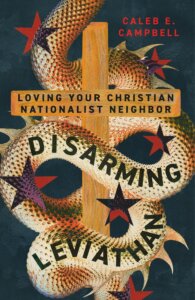 Disarming Leviathan: Loving Your Christian Nationalist Neighbor (InterVarsity Press, 2024) by Caleb Campbell is available from the publisher, Cokesbury, and Amazon.
Related Resources
- Leading Amidst Christian Nationalism by Lovett H. Weems Jr.
- Leading in an Age of Political Polarization by David R. Brubaker
- Leading between Faith and Patriotism by Lovett H. Weems Jr.
- Preaching Our Principles Not Our Politics by David R. Brubaker
If you would like to share this article in your newsletter or other publication, please review our reprint guidelines.