

Many congregations are asking what faithful ministry looks like in a time of change and uncertainty. Lovett H. Weems Jr. explores recent research on church attendance while challenging the notion that stability should be the church’s primary goal. Instead, he calls congregations to reclaim an outward-focused mission by building relationships with the people God has placed in their communities.
One goal I had in writing An Aura of Hope: United Methodism’s Next Chapter in the United States was to offer church leaders clues that can guide them in discerning God’s next faithful step for their congregation. A recurring theme of the book is an invitation for congregations to focus on the people God has given them in their communities. Thus, ministry does not so much begin with serving members but rather membership begins with ministry with the people God has given us we do not yet know. Most churches will discover that this model was exactly what church life looked like in their first years of existence.
A positive trend noted.
As church leaders look for clues to move forward with hope amidst changing circumstances, it is useful to examine research that helps describe where we are now. Amid the constant news of declining religious commitment, it was encouraging to see a positive trend noted in a recent report by the Hartford Institute for Religion Research, Signs of Rebound Amid Uneven Recovery: The Changing Congregational Landscape.
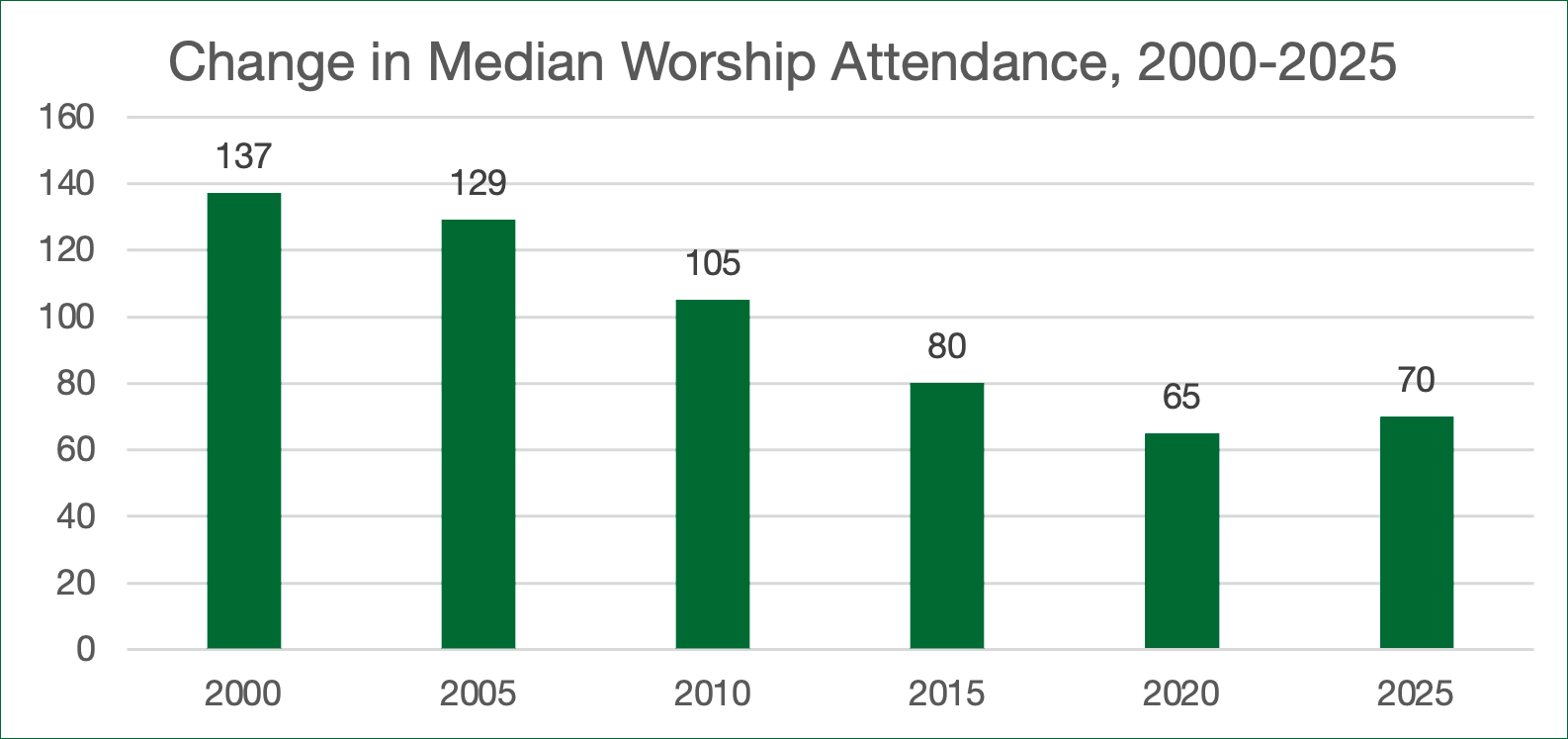
Scott Thumma and a host of researchers he engages have produced insightful surveys of congregational trends every five years since 2000. One consistent trend since 2000 has been a decline in the median in-person worship attendance. (They remind us that median attendance means that half of churches have higher attendance and half have lower attendance than the median). The median attendance was 137 in 2000. The median figure reported in 2020 before the pandemic decline was 65. While the pandemic brought the median down to 45, the median attendance rebounded so that by 2025 it was 70. While this may not appear “encouraging” compared to 25 years ago, it is significant to see the rebound following not only the pandemic but also the steady lower trend already occurring in years prior.
Source: Faith Communities Today
The shrinking number of “stable” churches
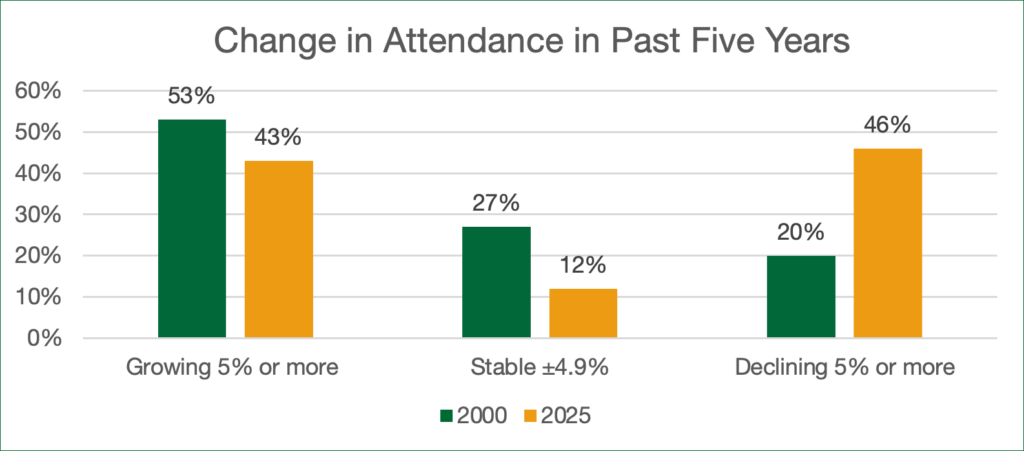
Another trend this research follows is the percentage of congregations that grew or declined in attendance over the past five years by 5% or more. There is more good news there. In the past five years, a higher percentage of churches grew, and a lower percentage declined in attendance than before the pandemic. As you might expect, far more churches declined and fewer grew than was the case when these surveys began in 2000.
There is one other category of congregations that do not fall into the growth or decline counts. These are the churches that in the past five years maintained about the same in-person worship attendance. These churches reported attendance that grew or declined but not as much as 5%. This cohort of “stable” churches continues to decline. In 2000, there were 27% churches with stable attendance numbers over five years. By 2025, the percentage was 12%.
Source: Faith Communities Today
For those in faith communities who continue to be troubled by the declining worship attendance and fewer persons being involved in congregations, attention to so-called “stable” churches is an important focus to examine.
Some denominations have even smaller percentages of “stable” churches. For example, the United Methodist percentage of stable churches is even smaller than the statistics noted above from across all faith traditions. Between 2019 and 2024, just under 8% of churches remained within 5% of their 2019 attendance in 2024. Now, this five-year period was not necessarily representative for United Methodists. It not only included the pandemic but also the disaffiliation of many churches due to disagreements over human sexuality policy.
Why talk about “stable churches” now?
My experience is that many long-established congregations think of themselves as “stable” churches. They understand their churches as not so much growing or declining but remaining about the same. Certain behaviors, however, flow from this mindset. For example, if they call themselves stable, it is logical that most of their time and energy go into the daily and weekly tasks of keeping their stable church stable.
But the habits of so-called stable churches no longer fit for most congregations.
One habit of a church thinking of itself as stable when that is no longer the case is the tendency to give time and priorities to practices that worked when they were stable, but those are precisely the practices that no longer fit. When a church has a stable church mindset, there may be signs that their earlier passion for others is diminished. And efforts to engage those not already connected to the church often do not receive the sustained and daily attention necessary to meet the opportunities God is giving us in our communities. The outward movement of a church’s growth years may be replaced by a more inward preoccupation.
How is daily time used?
Think about the daily use of time by the church’s pastor and staff, lay leadership, and membership. How much of the time goes to helping new people receive God’s love and welcome? How much activity is directed toward those not already connected with the congregation? How many new connections and beginning relationships with new people occur during a week? We may discover that our daily practices do not adequately, if at all, reflect the reality of our call to connect with the people God has given us in our communities.
When we think deeply about it, we come to realize that a pattern of churches operating as stable churches, for which continuing present practices will suffice, is actually inappropriate for all churches. In the early years of any congregation, most of the energy, passion, and time go outward toward making connections and developing relationships. However, when a congregation begins to think more of survival or stability, it risks doing ministry without a deliberate plan fueled by mission with an outward orientation. The movement of time and energy will increasingly turn inward each year.
What might we forget?
The “myth of stability” can emerge in any congregation. We forget we are called to ministry with the people God has given us we do not yet know.
When that happens, a new perspective is required to call all members and leaders to see that their first task is to serve rather than be served. It means reclaiming the outward passion and energy for mission and new relationships those founders had in their early years—or they would not have become a congregation at all!
Therefore, a key responsibility for every church and every leader is to strengthen our entire congregation to understand our community as our parish. And together we respond to the call to open ever more doors for witness and service to the people God has given us—especially those whose names we do not yet know.
A version of this article first appeared in the Substack newsletter United Methodist Focus by Lovett H. Weems Jr. Used by permission.
We love to hear from our readers! If you have any comments, suggestions, or questions about this article, please leave a voice message directly from your computer, tablet, or smartphone via Speakpipe. You may also email lewiscenter@wesleyseminary.edu or leave a comment on Facebook, Instagram, YouTube, and Bluesky.
 In an upcoming Leading Ideas Talks episode, learn about the strengths of small and rural congregations plus how churches can thrive by focusing on discipleship, mission, and community impact rather than simply chasing growth. Church Renewal in a Changing World featuring Lovett H. Weems Jr. and Allen T. Stanton will be available on August 5.
Related Resources
- An Aura of Hope
 by Lovett H. Weems Jr.
 - The Future of the United Methodist Church featuring Doug Powe and Lovett Weems — Watch the Leading Ideas Talks podcast video | Listen to the podcast audio version | Read the in-depth interview
- How Healthy is Your Church Culture? by Jim Ozier
- An Inclusive Church Will Be a Growing Church by Lovett H. Weems Jr.
If you would like to share this article in your newsletter or other publication, please review our reprint guidelines.