

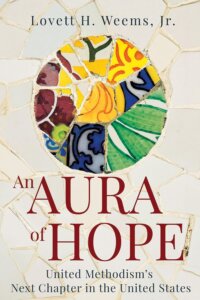
Healthy churches pay attention to the people God has placed around them. When ministry reflects the realities of the surrounding community, congregations bear fruit; when it does not, decline often follows. In this piece from his new book An Aura of Hope, Lovett H. Weems Jr. challenges leaders to ask a simple but revealing question: Who is missing—and how is God calling us to reach them?
Churches are fruitful when they understand who the people are around them and develop ministries to reach them, especially those in their communities but not in their churches. There are at least two periods in which Methodist denominational plans matched the dominant demographic realities of the United States. Bishop Francis Asbury’s rural strategy of sending people and resources to the expanding frontiers of a new nation fit the population movement for at least a century. Another time of alignment occurred after World War II, a period that featured population growth and rapid suburbanization. However, from the 1970s onward, the misalignment of denominational efforts with new demographic realities led to immediate and continuing decline. This new era, increasingly characterized by racial and ethnic diversity, found the church needing to reach people unlike themselves. When the people God had given us began to change, our ways of working did not.
Those who say “growth is not the point” are correct. Accomplishing the mission God gives to the church is the point. The diversity of the early Methodist movement in England did not come from diversity goals but as a byproduct of God’s call to share the Gospel with people of all kinds. The church grows in diversity just as it grows in numbers because that is what a church is intended to do. While worshiping at a Methodist church in England once, I wrote on the church bulletin some words from the pastor I wanted to remember: “The early church grew because it never occurred to them to do otherwise.”
Who’s missing?
As a pastor in Mississippi, I found one question especially helpful as I met with small groups of members during my first months at a new church. I asked, “Knowing this community as you do, when we worship on Sunday, who is missing?” In other words, who are the people God has given us (those who live in our communities) who are not represented in our worship in proportion to their presence in the population? And so today, the United Methodist Church is called to ask anew, “Who is missing?”
People of Color
People of color, particularly but not exclusively African Americans, were part of the Methodist movement in the United States from the beginning. At no time have people of color been absent from the American Wesleyan witness. But the response of the majority white constituency to such diversity has been, at best, mixed. Virtually all divisions in American Methodism exhibit examples of racism and classism. While we have made progress and have admirable commitments to diversity, we still do not reach any racial group as effectively as we reach white people. The church’s vitality in the years ahead will be shaped largely by its willingness and ability to respond to the changing face of the country. In 1965, the last year of membership growth for the two denominations that later formed the United Methodist Church, the racial makeup of the U.S. population was 84% white and 16% people of color. Today the makeup of the U.S. population is 54% white and 42% people of color.
Younger People
One way to understand the overall age of a denomination’s membership in relation to that of the general population is to compare death rates. Soon after the United Methodist Church was formed, the death rate of members in 1969 was 10 deaths per 1,000 members. The comparable death rate among the general population (counting only deaths of persons 13 or older) was 12 per 1,000 population. These figures indicate that the makeup of the denomination was somewhat younger than the population as a whole. But as membership decline continued over the years, the denomination became older and had death rates higher than those of the general population. In 2019, the United Methodist death rate was 13 deaths per 1,000 members while the national death rate of persons 13 or older was 10 deaths per 1,000 population. The youthfulness of the growing but underrepresented racial ethnic population contributed to the aging of the denomination.
Less Well-Off People
John Wesley saw engagement with the poor as spiritual practice much more than social ministry. That is part of the Wesleyan story but one supplanted in the United States as Methodists became more well to do. By the mid-20th century, Methodists rightfully thought of themselves as a middle class church. Thus, Methodism did well in the years after World War II as economic growth propelled millions into the middle class. The proportion of families in the middle class peaked in the 1970s followed by decades of middle class decline. Middle class people are still proportionately represented in the denomination, but there are not as many as before. Today, it is wealthier people who are disproportionately overrepresented and poorer people disproportionately underrepresented.
Intentions did not match practices.
Not only was 1965 the last year for membership growth; it was the year the Immigration and Nationality Act passed, altering U.S. immigration policy and leading to a more diverse and multicultural society. It abolished the national origins quotas, in place since the 1920s, that favored immigrants from Northern and Western Europe, while limiting immigration from other regions. This led to a dramatic shift in the demographics of immigrants entering the country. So we see Methodism’s U.S. presence declining during the decades of significant added diversity in the country.
However, Methodism’s slide from the diversities it cherishes goes further back. Today we talk more about racial diversity than in the past, but it is significant to remember that when Bishop Asbury died, one quarter of all Methodists were African American. And we have always had an awkward relationship with the poor. For example, insofar as I have been able to learn, every split in American Methodism has resulted in those leaving being poorer on average than those staying. It was true for all divisions based on race. It was also the case with the Methodist Protestant; Free Methodist; Wesleyan; Methodist Episcopal, South; and Nazarenes. In the 2019-2023 disaffiliations, disaffiliating churches came proportionately in greater numbers from counties with lower median household income compared to churches that remained United Methodist. In all these cases, while there were well-to-do people who left, the average income of those leaving was always less than those who stayed. Thus, the remaining church was wealthier per capita after the divisions.
Progressives will be central to the vision of growth.
For a long time, those seeing themselves as conservatives have claimed a passion for reaching new people and sometimes suggesting that perhaps others did not share the same evangelistic passion. The situation was never that simple nor were the results. Our new day is likely to be different. There is a genuine desire that the United Methodist Church not continue to withdraw its presence from the United States but expand its witness.
There is also a commitment to a truly inclusive church that reflects the diversity of the people God has given us in our country. As we realize that this dream can never become a reality without becoming a growing church, those not previously associated with a growth agenda will be among those leading the way. We cannot shrink our way to inclusion. Even if we could, that is not our heritage or God’s calling for the church. The next generation—including those younger and more diverse whom God has given us—deserve a robust, vital denomination, and it is our work to make every effort to create it.
One clear opportunity for inclusion is among those repelled by 50 years of political infighting in which people with different sexual orientations were treated with hostility and anger. When people feel their needs for understanding and acceptance are rejected by people of their own denomination, denominational credibility is severely damaged. No action by a single General Conference will erase the legacy of hurt. The remarkable fact of the past 50 years is that so many never left their denominational home despite hostile treatment. We know there are greater evangelistic opportunities among people still seen by some as on the margins of conventional society.
Becoming a growing church again will not happen quickly. In fact, the continuing factors leading to decline will probably ensure declining overall numbers in most statistical categories for a number of years. However, the impact of a growth mindset and mandate will bear fruit long before the tide of decline recedes. There are already pockets of growth. Those will expand. Stories of fruitful congregations that are both serving and growing will become more common. Most importantly, the energy of the church will turn from managing inevitable decline to locating the rays of hope for the future and celebrating and replicating them.
This article is an adaptation from An Aura of Hope: United Methodism’s Next Chapter in the United States, published this week by Abingdon Press and available from the publisher, Cokesbury and Amazon. Used by permission.
 Related Resources
- An Aura of Hope by Lovett H. Weems Jr.
- 10 Ways to Make Your Church More Inclusive by Brandan Robertson
- 10 Keys to Intergenerational Leadership by Valerie Grissom
- The New Welcome, a Lewis Center video tool kit resource
If you would like to share this article in your newsletter or other publication, please review our reprint guidelines.