
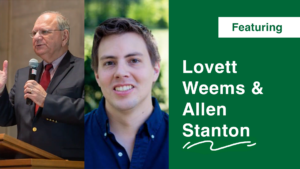
Is the future of the church dependent on institutional growth, or is faithful discipleship the key? In this episode, Jonathan Page is joined by Allen Stanton and Lovett Weems, author of An Aura of Hope: United Methodism’s Next Chapter in the United States, to discuss the future of Methodism, the strengths of small and rural congregations, and how churches can thrive by focusing on discipleship, mission, and community impact rather than simply chasing growth.
Listen on Apple Podcasts | YouTube Music | Spotify
Watch on YouTube
- Transcript—Click or Tap to Read
-
Announcer: Leading Ideas Talks is brought to you by the Lewis Center for Leadership of Wesley Theological Seminary in Washington, DC. Subscribe free to our weekly e-newsletter, Leading Ideas, at churchleadership.com/leadingideas.
Leading Ideas Talks is also brought to you by Discovering God’s Future for Your Church. This turnkey video tool kit helps your congregation discern and implement God’s vision for your church’s next faithful steps. Learn more and watch an introductory video at churchleadership.com/vision.
Is the future of the church dependent on institutional growth, or is faithful discipleship the key? In this episode, Jonathan Page is joined by Allen Stanton and Lovett Weems, author of An Aura of Hope: United Methodism’s Next Chapter in the United States, to discuss the future of Methodism, the strengths of small and rural congregations, and how churches can thrive by focusing on discipleship, mission, and community impact rather than simply chasing growth.
Jonathan Page: My name is Jonathan Page. I’m the director of the Lewis Center for Church Leadership at Wesley Theological Seminary, and it’s my joy to welcome you to another episode of Leading Ideas Talks.
Today’s podcast is going to be a little bit of a different form, and it’s probably going to be a pleasure because you’re not to listen to me at all. You’re going to be able to listen to two great experts in a conversation about the direction and future of the United Methodist Church. I’m excited today to be joined by two awesome individuals. The first is Reverend Dr. Lovett Weems. Lovett, the former director of the Lewis Center for Church Leadership, has a long legacy in the United Methodist Church and is the author of a brand-new resource called An Aura of Hope.
We’re also joined today by Reverend Allen Stanton. Allen is the senior fellow for Leadership, Faith and Community at the Town Square Collaborative at the University of the Ozarks. He is also the Director of Reclaiming Rural, the author of The Gift of Small, and the two of these gentlemen are going to be engaging in some conversation around Lovett’s new book and also just about kind of the direction of the church and how we move forward together. So, Lovett, Allen, it’s good to be with you today. Thanks for being a part of the Leading Ideas Talks podcast.
Allen Stanton: Yeah, thanks for having us. This is really great. And Doctor Weems, thanks for thanks for agreeing to do this with me.
Lovett Weems: Well, thank you for the opportunity from the Lewis Center. And it’s good to be with you, Allen.
Allen Stanton: All right, should we dive in then? Doctor Weems, I, I think one of the fun things that you start out in the book with, and I’m going to read the quote because I think it’s really important as part of the context and it aligns with something that I read once in Gil Rendell’s book about the nature of leadership in our denomination right now.
And you say, “We have not been a generation of leaders who have engaged the change context of this nation adequately for years.” So where do you think we went wrong? I guess is my is my first kind of conversation opener.
Lovett Weems: Well, success can be a dangerous thing, and Methodism in the United States had much success. It started out in the late 1700s as the smallest religious group in the country, and then within a matter of decades, by the middle of the 1800s, it was not only the largest denomination, but it was largest by % larger than the second size denomination.
And so until the mid-20th century it had really been the dominant Protestant denomination in the country. But you can see, uh, changes in the momentum. For decades Methodism grew much faster than the population grew, and then it grew about the rate of the population and then it was growing, but less than the rate of the population. Then it finally caught up.
There was the post-World War 2 boom from the baby boom and just a renewed focus on religion and Methodism did well as others did there. But. Uh. The things that that worked no longer worked as well, and partly because the context was changing.
So, if you think about membership decline beginning in 1966, so that was a major marking point for the changing diversity of the country. In 1965 the Immigration Act of 1965 was passed. That radically changed the immigration patterns because it opened up immigration to parts of the world that had been excluded. And so, the diversity of the country it would have been in the mid-teens, probably in the 60s. Now it’s well over 40% population made-up of people of color. And that’s just one example.
There are second example is the Bishop Asbury’s rural strategy of sending clergy where the people were going that westward move. Uh, it served the church well for over 100 years, but then the population started, uh, consolidating or moving closer together. So, in the 1920s and thirties, 80% of the population was rural and now, uh. Probably. Uh, the percentages are reversed, so United Methodists still tend to be located more where the population is less dense because of those movements. Those would just be two examples.
The interesting thing is you would think that a connectional church that would be looking at the whole, not just each church by church would be in the best position to see what’s going on and to make plans. But that has that’s not been the case.
Allen Stanton: I think are you familiar with that Cal Turner junior of the Dollar General family. So I got to work with him for a long time and one of my favorite sayings he had was the Methodist leadership takes the worst business practices of 20 years ago and implements them badly. And that kind of speaks to that comment about. Yeah, well, you would think we’d be in a position to really look at this, you know, so one of the interesting things I was reading when I was looking at your book is I really like when I’m out talking to groups, I often bring up Francis Asbury’s model, right?
And so, we look at 90% of our churches are, are what we would consider smaller congregations and. There’s definitions for that. And then depending on how you define rural, you’re talking, you know, defining rules always a thing. But I think in the book you say 20%, and I think that’s a reasonable definition for rural. Depending on which definition you use, you get like 70% or 50%, so it’s all over the map, but 20% is probably a reasonable estimate.
I would almost argue the opposite point to say, why aren’t we locating our future denomination inside of small and rural congregations since we have the infrastructure there and I’m wondering, there seems to be a generational shift in this too, where I see you’re kind of looking at the the broader denomination and the infrastructure of the denomination and saying the infrastructure isn’t supporting what we need to do, whereas a lot of younger clergy are saying maybe it’s time for us to dismantle some of it. And I’m just curious about your reaction to that or what your thoughts are on that.
Lovett Weems: Well. United Methodism came to its heyday in the same era that the, uh, the, the nation was expanding. And so, you can almost follow the developments in the secular world in terms of the development. Corporate models and organizational structures, and see how much United Methodism tended to follow that.
I’m sure it would be a healthy thing to reassess all these models and to check the fruitfulness of all of them, whatever the structures are of something that Tom Berlin and I developed in in our book called Bearing Fruit was the concept of “so that” that with everything we have, for instance, you might say we have districts so that we have an annual conference “so that” we have bishops “so that.” What’s the outcome? What’s the fruit of the harvest from that? And is that happening?
But. We’re getting clear because most things that we do, and this is true in local churches too, we need to ask that, you know, we have worship “so that.” Um, we have Sunday school so bad because the answer to most of those things is, for instance, we have a choir so that we have a choir, right?
The Sunday school so that we have a Sunday school. We have ushers so that we have ushers. But if there is not some outcome that’s related to our mission. And then we, we don’t know who to recruit, we don’t know how to spend the preparation time. So that’s, that’s the key to get back to what is the, what is that outcome, the fruit that we believe God’s asking us to bear by creating it because we know all of these things originally derived from some purpose and what happens is that you create the forms in one era to meet needs and then the power goes away. But you still have the forms, right?
So, the Church then looks for good, good managers who can keep those forms going because as long as the forms are still there, we can all sense it’s just like it used to be. When it’s not. You have to admit many of the forms have lost their power. Now. What do we need to do?
Allen Stanton: So this is one of my criticisms of, of how the denomination and not just the United Methodism. I would say this is true of when I’m talking to Presbyterian pastors or Episcopals … the “so what” has often I think gotten lost in the in the way we’re operating as a church. So, in my previous book, I talk a lot about how we’ve gotten sort of co-opted by an economic imagination of like, growth is better, bigger is better and we’ve lost the theology of what we’re trying to do. And so, we’ve conflated, I think sometimes. And this is not to say that like we should not be evangelizing because I think evangelism is one of our core purposes of the church.
But to say, I wonder if we have gotten to a place as a denomination sometimes where we are more afraid of the denomination fading away or not having enough people. So that that has become the metric that we’ve used rather than saying like our “so what” is the development of faithful disciples forming people to be disciples of Jesus Christ? And how do those two theologically work together?
Because I think you’re right, like I think a lot of our systems have sort of lost the power that animates them because they’ve gotten so focused on perpetuating a system that is. Sometimes look at and go like what? What is the system doing, you know?
Lovett Weems: Well, our problem is not too much of A focus on growth because clearly, we have not been doing that for six years. But even with that, developing faithful disciples, in the next year we will develop faithful disciples so that. And growth is not bad. Growth is good. Um. And because if you want to reduce poverty, then fewer people in poverty, that matters. If you’re wanting to increase commitment to your political goals, then more people would be better so the outward dimension. It’s because of our commitment to the people God is giving us. And I think that the danger is—and it can even be, if the focus is on making or more faithful disciples—is inward turning, that we will make ourselves purer or we will make ourselves more spiritual. We certainly want that. But. God has called us on behalf of the people God has given us. And so, you think about any community and the churches in that community.
The tendency is to begin for leaders in those churches to think first about those who are members or participants in their church, whereas if God is viewing that community. God will see it in a different way. God will see all the people. And so what would it be like for our congregation to see they’re calling among the people, God asked them. And so, the first thing you say is of the people God has given us in this community. Who is present when we gather, and who’s missing? And I wonder why? What are their needs, what are their concerns, and how is God calling us given our giftedness? To be able to reach out and connect and to serve.
Allen Stanton: So I want to nuance something you said, you said at the start of this, you said, I don’t think that I don’t want to get the words right. I don’t think the focus is like we’ve been overly focused on church growth because we’ve not been doing it. I would say yes, and. We’ve been focused a lot on church growth. I think we’ve not been doing it well. Like we, I think there’s almost a hyper focus sometimes on it to a detriment. And one of the things I see is you go out to these communities and people—I was in a church last week and they were saying, you know, we just want to grow and we’re looking at all the other gifts that we sort of abandoned by an overly focused on trying to get people into an average worship attend like into Sunday morning to a detriment of saying like, we’re not even recognizing the way that we’re in community with the people that we already are in community with.
And so, I see a lot of churches, you know, we’ve almost gotten to a point where we overlook. The very real ways that people are engaged internationally and ministry, whether that’s through a program or whether that’s just through their natural way of being.
Because it’s not translating into a specific metric. And I think metrics are really great. I think having … there’s got to be some kind of dashboard, I think like to say we want to get people into average worship. Like we want to increase our average percentage, and we don’t want to overlook the ways that we’re building community outside of this central moment.
Lovett Weems: No, I mean, there’s no one metric, but there are a lot of indicators. Some of those that are easily measurable and some are not. So that’s what we need to be looking at. Are we, you know, it’s like once a year asking the question, if our church closed today, who would miss it other than our members? Well, is that list getting longer or is it getting shorter when we do that mission?
Alright, once, once a year, what kind of impact are we having on our community? How many neighbors do we know? How connected are we to the to the community? Do we know the issues facing our community? And so there are there are churches that are probably not going to grow in numbers, but you can certainly tell the difference in two churches with the same small number of people there certainly survival is not a worthy goal, right? Fruitfulness is. It’s … fruitfulness is kind of God’s answer to the success. That’s what we’re called to be.
And so, what are the fruit we’re seeking to bear and what are the fruit that we are or bearing? How are we making a difference in the lives of people?
Allen Stanton: I worked with a church for about a year in Arkansas, and they had gone through all these changes. A new pastor at a Presbyterian Church and new pastor, natural disaster tornado, you know, in the community. And one of the fun things I started the time together with [by asking]if I gave you $10,000, just I’ll give you a $10,000 check. What would you do with it?
And the first gut reaction, I put it in a CD. And where it could generate interest, right? Then over the course of the year, we really talked about like, what is the purpose of the church? Like, what are you trying to be here? What does it mean to be a faithful disciple in this community? And it was fun to watch the shift get to, you know … we may still die as a congregation, but if we do, we’re going to do something. We’re going to go out following Jesus. And watch them like invest that. So, we ended up giving them a $10,000 grant and watching them invest that in children and anti-poverty work and childcare in the community.
And the way it brought new life into the congregation where they weren’t really afraid of death anymore, it was we’re going to be faithful until the end. It was the new goal and attitude. And that brought on a new life, like almost a resurrection, is how one of the members described it to me. It’s a really beautiful thing when that happens.
Lovett Weems: Absolutely, yeah.
Allen Stanton: So I, wonder, you talk about being a connectional church and then looking to places kind of in these urban cores or more populations. One of the questions I have is one of the fears I have about the Methodist Church is we would follow the example of other mainline. Nominations who have done that sort of work and then sort of fizzled out or fizzling out. I’m going to name like the Presbyterian Church right PC USA will likely soon be under a million members average worship attendance. Episcopal Church is usually rooted in more urban communities. How do we avoid that where we avoid the same mistakes that they’ve been making so that we can continue on our mission?
Lovett Weems: Well, if we’re going to reach the people that we’re currently not reaching. People in proportionately in more densely populated areas, younger people, people of color. We can’t do it by just using the same methods we use to improve things. We can’t act as if we really know how to do this. So, we get some of us together and come up with some ideas and do things. We’ve got to start by realizing we don’t know how to do this.
And so, we’ve got to learn. And to learn, you’ve got to spend time with the people, and you’ve got to develop some models and then learn from those models and improve those models or disband those models. So there’s got to be this, this kind of experimentation, but it starts with acknowledging we really don’t know how how to do this. The reason for starting. I talk about in trying to reach new people that there is like a focused approach and there’s an inclusive approach and then the focused approach I’m encouraging of conferences, for example, to look at the counties where two thirds of the population live and then look at the churches that have 251 or more in attendance. This is the only sized church in the denomination for several years now where there are more professions of faith than deaths each year.
And then you learn from them and you invite them to help others learn from some things that may be applicable. Not everything will be, but also, you’re sending a subtle message that to whom much is given, much is required. That is in all these annual conferences where there may be a handful of churches with 251 or more and a handful of counties with two thirds of the population. There are a couple of hundred other pastors who would welcome the chance to change places with any of those pastors because they are in places where there’s not been population growth.
In some states, there are more counties now that would be classified frontier. That is using an early American standard of you must have six people or more before you move from frontier to settlement. There are more counties that are frontier now by that standard than 100. years ago and those pastors and those lay leaders have a calling. But it’s a different calling than those in larger churches and more densely populated areas.
But if those who have the calling, whichever place, if they are not being faithful to that calling, then no one else can do that. All four of them need a certain kind of attention because for instance, if 15 or 20 years ago, a number of annual conferences when they discovered that a high percentage of churches had no profession of faith. At the last year they set a goal to have every church have at least one profession of faith. Now that puts the focus on your goal, right? And what on people coming to faith in Christ?
So the goal would have been one year from now. He will have more professions of faith than this past year. And so, if that happens, it’s going to come primarily from those who are already having professions of faith, having professions of faith again and doing more. It’s like giving from one year to the next. If your giving improves, it’s going to be primarily, not exclusively, but primarily from those who are already giving, giving again, and some of them giving more.
And there will be some who will give for the first time, but not many from when here. To the next. So there are lots of things people can learn well.
I’ve been amazed with some church examples of small churches where they have done a one-person confirmation class where there are lot of churches where that might. It and it would never cross their mind to do that, and they would be anxious to learn how some others did it.
And there are other examples like that aren’t church that realized in their community a high percentage of children were being. Reared by their grandparents and so they started a community wide of a group for those grandparents to support one another and help them.
How are you handling this? How are you handling that? So all of a sudden here is a church that’s not saying to the world, “Come serve us,” but they’re saying, “We’re here to serve the world.”
One thing I think churches need to do is we give the subtle signal to members that we want them to do something for the church. Like you’re announcing a Bible study for LIVE. And you say we’re going to have these topics, and we hope everyone will sign up. And if I’m sitting in the Pew. I’m hearing, you know, the church wants me to do something. But we need to turn that around. Begin with the people so that our churches should be, should be communicating that this church exists to help you take your next faithful step. On your spiritual journey. All of us at different places.
But for instance, we are offering these courses now if one of these is what you need at this moment to take your next step. They want you to know they’re available for you. Now if I hear that, I’m hearing cool, they’re offering something that I may be interested in and then your church exists to give you the opportunity. Express the ministry God’s given to you by service to others in our community and beyond.
That’s a very different way of approaching things.
Allen Stanton: I really like that.
One of the challenges I think for small, and I’m going to talk about small churches in this, but like I hear a lot of small churches thinking like we can’t do XY and Z because we don’t have the capacity or like we can’t get people to show up.
And the reality in the small church is like you have limited capacity and people are busy and volunteers engage differently in small organizations than they do in large ones.
So, they’re going to be more operational and they’re going to engage like more of their personality into it. It’s going to feel like more of an identity. It’s going to be more of their social network, and they have strong emotions about it. Whereas the larger organizations, like a larger church staff take care of that.
And so, people are engaging in a program or you know, Habitat for Humanity building. What I love, like I was one of those pastors that did a one person confirmation and I loved it because I had a 13 year old that sat with me and every week we walked through part of the Apostles Creed together. And you know, what does this mean for life? Together and then, what does it mean to be Wesleyan in this until we get to a confirmation?
And she sort of kept extending it, right? Like “I want to do more. I want to study more, I want to study more,” and I wouldn’t get to have that in another place. And so one of the things I really encourage small churches to think about is: you don’t have to mimic what it means to be a large church like a mature large church and do all these things and then guilt people into coming to it.
You have to be faithful enough to understand how you can invite people into this walk of discipleship using the the way that you are already structured, the gifts that you already have, and sometimes that is just the personal relationships that exist within your community.
Or sometimes that’s the natural way you do missions and evangelism. I, I love this one church that I asked them what they did out in the community and their answer is basically like, well, we find the need and then we go meet it. We don’t have a program, but when the school calls us and says we need this, we give it to them. And then we’re the only public tornado shelter in our county.
I mean, it’s just this really great way of living out of faithfulness that is not dependent upon being something that you’re not. And I hear kind of that’s what you’re saying a little bit is we, we have to help churches be faithful in what they’re doing, where they are
Lovett Weems: Absolutely.
Discovering God’s Future for Your Church is a turnkey tool kit to help your congregation discern and implement God’s vision for its future. The resource guides your church in discovering clues to your vision in your history and culture, your current congregational strengths and weaknesses, and the needs of your surrounding community. Learn more and watch an introductory video now.
Allen Stanton: So what is the role? Because one of the one of the questions I had when I was reading your book, you talk a lot and you talked about here this notion of starting with churches 251 or more. Obviously that’s not most of our United Methodist churches, that’s minority of them. So what is the role of the small church in the future of Methodism if we’re starting from that perspective?
Lovett Weems: Well. I would hope they would the the issue is focus. It’s very hard for us to have focus. We have to come up with goals and plans that cover such a wide variety of of stakeholders that it’s hard for there to be focus.
So, there may need to be geographic focus there. They may need to be focus around ages are around particular racial or ethnic groups, but we need to be clear where is it we’re called to have that focus. So no matter how small the congregation, I think they would want to use some of the same. Techniques that a leader of a conference would.
Number one, you start by remembering that everything begins with people. Not with churches, not with clergy, not even with doctrine. For Wesley starts with the people. So who are the people God has given us? What are their needs? And then he said you have to focus more. Of those, are there places where we have natural connections?
Are there people who have needs that we’re already trying to meet?
If not, who should we be talking with? How do we identify those issues and those needs, and how do we respond? And so it’s … I talk about. A vision more is what is the next faithful step God is calling us to and that next leap will step may be a small thing.
For one student passed her that I had as a student once he was serving the church where. Having the first Vacation Bible school for the whole community since 1965 was that next rightful step. But. It was a part of a larger vision. It became the springboard for many, many, many other things when he left many years later, which is not common for a student pastor.
There were more children in the church than there had been people that when he arrived. So where do you find that place of energy? Where do you find that spark? And then it it becomes what Margaret Wheatley calls a field of energy out of which other things emerge.
Allen Stanton: I think one of the concerns I hear a lot from smaller churches is this notion of like, if we over focus on large churches, then it creates like this sort of one-size-fits-all. And I saw some of this come out with the Towers Watson report, right? That was now way outdated, but they had one of my favorite stats and it was highly vital small membership church has 5.1 small groups and a non-vital small membership church has 4.6 small groups, right? Which is sort of like the statistical, well, you can’t have half a small group. And there was this motion like, you know, more small groups, which is fantastic. And I’m all about small groups.
One of the funny things that happened one time I was talking to a church where the biggest—single biggest—influx of people moving in was a rapid rise in baby boomers who are retiring and they’re moving into this community and droves and the nomination, they called a consultant in the denomination and they kind of came down and said, You really need to focus on youth and young children and stop recruiting aging adults. And the pastor was sort of like, well, wait a minute. You know, this is the like, the antithesis of what’s happening in my community.
Now, so I want to be, and I mentioned that because I think I want to be clear to say like I did not necessarily read that and what you were saying. You were really saying we need to look at what the churches are doing and then help other churches, other congregations and other demographics find out how to do these same sort of theological frameworks in their own communities. Not just replicate something that happened in New York City and then put it down into rural Nebraska.
Lovett Weems: Oh. No no. It’s everything’s very contextual. But if people aren’t asking the questions, if they’re not stirring the waters, um. And so many churches are really in a maintenance mode, and it’s how do we keep things going? But good leadership can help them not in judging but in building on their heritage, learning the stories so you can tell the stories of what the church did during the Great Depression or what it did in its early days, or how the church building was also served as the first public school. The community, you learned those stories. What does that mean today? And. So yeah.
The criteria, the problem with the report you mentioned, Tower Watson was not with the research, but it was with some of the criteria that they were given to assess those churches. For instance, 1 was, again, it’s not their fault, it’s what the committee gave them. The vital church will have the average; the per capita giving will be higher. It’s just the opposite. There are some, I won’t call any particular district at conferences where they would be the most vital because they have gone down in people, but they’re giving has gone up because they have had to go up right still be open. Whereas a growing church will have a lower average giving often because the people that are they’re reaching are younger, not as well, not as educated often and certainly not as spiritually mature as others.
So it’s it’s that. Of that kind of thing that skews those things. Um, there is no, no formula. There are clues that you can get. And that’s what you’re asking people to do, to look for clues in their community. There’s a wonderful example of a district Superintendent who had a heart for reaching a youth and young adults, but the district she was assigned to probably had three churches in it that had decent side youth group and some young adults, sure. But what she did was she went to every charge conference after she had been there a few years and had the confidence of the people, and she said “I wanted to ask you to do something over the next couple of months. I want to ask each of you to have a conversation with a young person. Could be a neighbor, it could be a relative. You can rent one and you get whatever you need to do. You find some youth and I’m going to give you the three questions to ask them.
you can ask them if they go to church, not to judge, but if they say yes, then ask, what’s good about that? And if they say no, it’s their reason for that. But second asked, what did you do last Friday night? And the third was, I’m not remembering right now what the third was, but they all kind of smiled because they were not easy, but they did it.
And she said, I want you after you do this, to get together, talk about what you learned about the youth of your community, and then write a paragraph or so for me so I can better understand the youth of our district. Well, the most important thing was the conversation they had with each other, right?
And one thing I found that will help if you start making a list of the people who are in our community and also in our church by various demographics, and then you also make a list of some people who are in the community.
But not in our congregation. It’s like that question I mentioned in the book that I would ask during the small group session said when I went to a new church in Mississippi, one of them would be some of you’ve lived here all your life. All of you have lived here longer. I am. I have You all know this community better than I do, so help me. Who, when we gather for worship on Sunday, who’s missing?
Yeah, you see. Now the second part of that is you’ve got that list of who’s missing, and you’ve got to say, well, let’s take a group of those. Maybe it’s single parents. Or maybe it’s young adults or whatever. What are their questions? What are their challenges? What are their values? What are their dreams? But you have to set a ground rule. You cannot say anything negative because that’s exactly for church. People will go, 1st we judge very well.
Well, they don’t want to get up on Sunday or they are too busy. No, they have baseball. You know, they were here. That’s not how they would describe themselves.
How would they have described themselves. What would they say? And then how do we continue that conversation so people know their communities. They don’t know their communities as well as they think they do.
Allen Stanton: Yeah. I love that. You know, a friend of mine is in Minnesota. And he’s a theology professor out there and he does a lot with Hispanic ministry and he’ll go to these rural communities and say, look, tell me what you’re doing with the Hispanic people in your community. “Well, we don’t have anyone that’s Hispanic in our communities.” Like, no, I was literally just over with the Spanish speaking congregation, you know, like you do. You just haven’t asked the right question.
And I love that. I mean, there’s been in my experience coming into Methodism, there is a—as a millennial, when I was in college, there were all these like think pieces like what millennials want in church, what millennials are looking for. And I remember thinking, “I wish that they would just like ask us just, you know, send me an e-mail and say, like, what are you looking for in a church?”
Because they were way over complicating it. And I love about your answer and your comments there is like … we have not always asked the right questions and we’ve kind of started sometimes with poor assumptions about what vitality looks like. There’s going to be a higher per capita giving. Well, that’s an assumption and we need to actually spend more time thinking about the real questions that we should be asking.
And I think that for me was one of the big takeaways in reading your book was, are we asking the right questions? And how do we ask better questions about the future of our denomination so that we can get to what we’re trying to be faithfully living towards?
So, I’m gonna close with this question. Where do you see the most hope in our denomination and the future of mainline churches and the church in general?
Lovett Weems: Well, there is at the moment, I think, a more positive spirit among United Methodists. We’ve gone through a lot, and a lot of congregations have endured a lot of struggle. But there is a sense that not everyone agrees. But we have chosen a path to a better future and that there is something in our United Methodist and Wesleyan heritage, what I call an evangelical spirit and a liberal tradition, that has served us well. Has served the people well. But needs renewal.
And I think though the future will look very different from the past, there are things, some basics that we can learn from what it is that we begin with people, we pay attention to where the people are, we focus on serving, and we remember. Especially the less well off. We’ve got to find ways to break out of a fairly narrow band of people that we are reaching.
There was a time when the makeup of the regular attenders of United Methodist segregation would have matched pretty well the makeup of the community. That’s not the case anymore. Now, many of those churches are still financially viable, but they’re viable without children. They’re viable without youth, they never gave much money to start with and so they don’t get the attention that we need. But the finances really represent a lagging indicator. And it’s the children and it’s the youth. And it’s the people who don’t have much money. These are some indicators that can point to a future.
You know there was a time when the greatest vehicle of spiritual formation was the camp meeting movement in many parts of the country. And there would be dozens and dozens of camp meetings in a state. And then the Sunday school movement came and … but at annual conferences, people would want to talk about their Sunday schools. And but the conference leaders would say “we’re going to lose another camp meeting this year if we don’t do something about it.” But the Sunday school continued to flourish. Yeah. And we lived off of that for about 100 years. That’s where the power was. So, we need to find where is the power, where is the connection today?
Speaking of a Sunday school, when it first started, it was not primarily a religious activity. I mean, it started in England before the child labor laws came in. Sunday was chosen to work with children because it was the only day they had off from work and so they taught them reading, writing, math, and religion. And then the children would often go home and teach their parents what they had learned. Then with child labor laws, compulsory education, general elementary education would need—for the other types of secular training were no longer needed and so we have Sunday school rooms that are empty all over the denomination. What would it look like today for those to become places? Fear of what is needed for today, whether it’s around language or tutoring or whatever. Because then everyone would know … they would know us by our service to the community.
Allen Stanton: One of the really hopeful things I saw during COVID even was the number of, uh, you know, in rural places, there’s less broadband and less access to stable Internet. And I love that there were churches all over that were opening their Sunday school rooms so kids could go and finish their school assignments and finish out the school year. Because they were all of a sudden in a place where they didn’t have access to Internet and they could use the church’s Internet. And what a beautiful thing that is to kind of take this space that we don’t use on a Sunday morning and open it back up to the community in a faithful way to say this is what the church should be doing.
Lovett Weems: Great example.
Allen Stanton: Yeah. Well, Dr. Weems, thank you for the conversation I always enjoy getting to talk to you. And Jonathan, thanks for hosting us today.
Lovett Weems: Thank you very much. It was a pleasure.
Jonathan Page: Thank, thank you both for just such an engaging and lively conversation. Thank you all for listening and being a part of this. And we look forward to another episode of the Leading Ideas Talks podcast very soon. Have a great day.
Announcer: Don’t forget to subscribe to our free weekly e-newsletter, Leading Ideas, to be notified when new episodes are published. Visit churchleadership.com/leadingideas.
We love to hear from our readers! If you have any comments, suggestions, or questions about this article, please leave a voice message directly from your computer, tablet, or smartphone via Speakpipe. You may also email lewiscenter@wesleyseminary.edu or leave a comment on Facebook, Instagram, YouTube, and Bluesky.
An Aura of Hope: United Methodism’s Next Chapter in the United States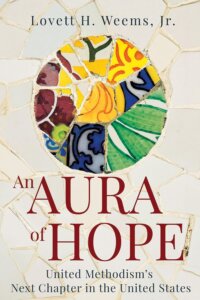 (Abingdon Press, 2026) by Lovett H. Weems Jr. is available from Cokesbury, the publisher, and Amazon.
Related Resources
- The Future of the United Methodist Church featuring Doug Powe and Lovett Weems — Watch the Leading Ideas Talks podcast video | Listen to the podcast audio version | Read the in-depth interview
- Restoring Trust in the Institutional Church Requires Allegiance to Our True Purpose by Gil Rendle
- Discovering God’s Future for Your Church, a video tool kit resource from the Lewis Center
- The Importance of Why by Graham Standish
If you would like to share this article in your newsletter or other publication, please review our reprint guidelines.