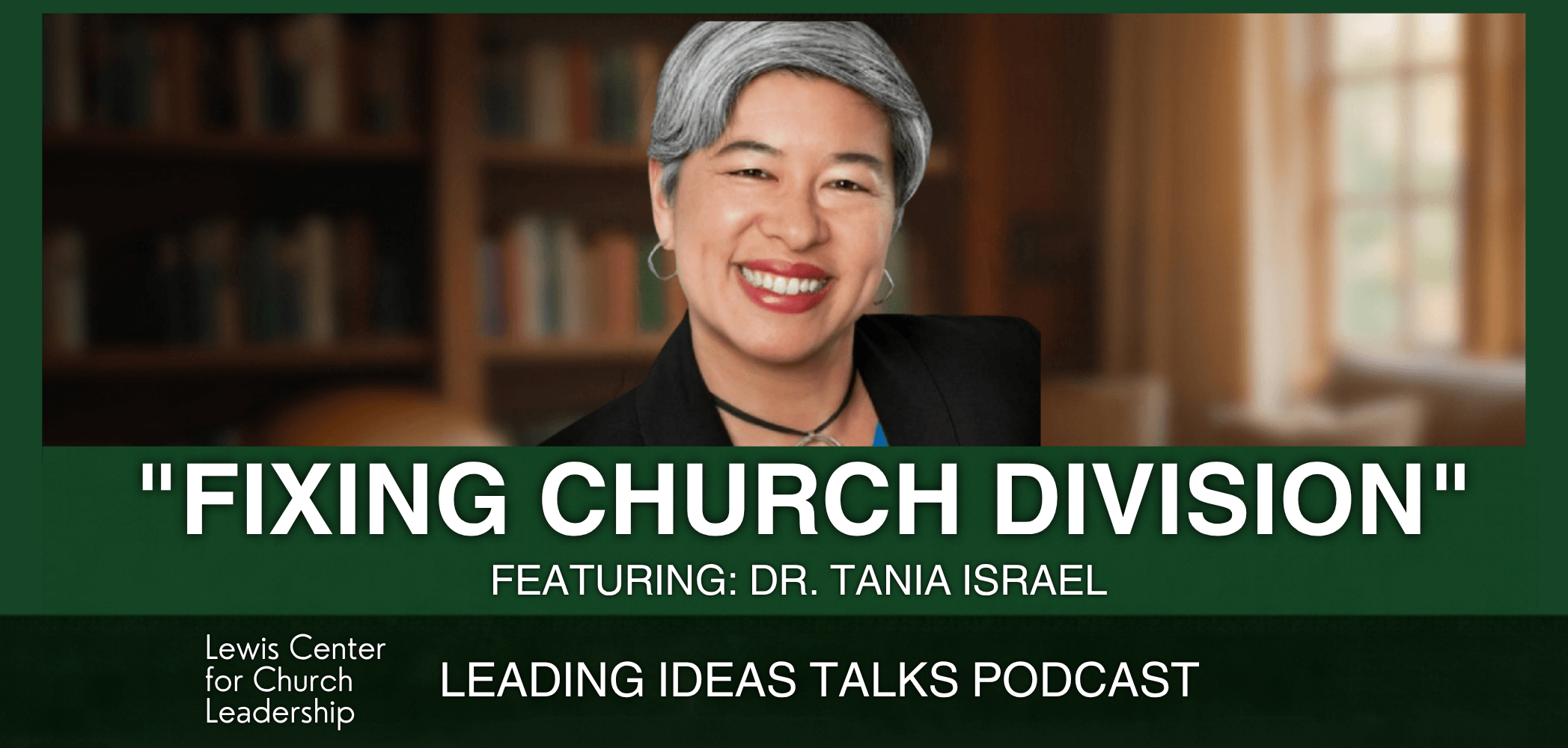


How can church leaders foster connection and lead faithfully in communities divided by politics? In this episode of Leading Ideas Talks, Jonathan Page speaks with psychologist and author Dr. Tania Israel about navigating polarization to create congregations where people can belong despite their differences. She offers practical insights on how curiosity, intentional listening, and a willingness to examine our own biases can help leaders bridge divides and strengthen relationships within their churches and communities.
Listen on Apple Podcasts | YouTube Music | Spotify
Watch on YouTube
- Transcript — Click or Tap to Read
-
Announcer: Leading Ideas Talks is brought to you by the Lewis Center for Leadership of Wesley Theological Seminary in Washington, DC. Subscribe free to our weekly e-newsletter, Leading Ideas, at churchleadership.com/leadingideas.
How can church leaders foster connection and lead faithfully in communities divided by politics? In this episode of Leading Ideas Talks, Jonathan Page speaks with psychologist and author Dr. Tania Israel about navigating polarization to create congregations where people can belong despite their differences. She offers practical insights on how curiosity, intentional listening, and a willingness to examine our own biases can help leaders bridge divides and strengthen relationships within their churches and communities.”
Jonathan Page: I’m so excited to welcome you to another episode of the Leading Ideas Talks Podcast. Today, we’re joined by Dr. Tania Israel, Professor Emeritus at UC Santa Barbara. Uh, Tania is an expert in psychology in so many different things. And, uh, today we’re going to have a conversation about some of the spaces that we’re living in right now in the wake of an election. Uh, this episode’s dropping on November 3rd, the day after, uh, an election, mid-term elections in the United States. And so, uh, Dr. Israel’s background, she’s written two great books, uh, Beyond the Bubble—or excuse me—Beyond Your Bubble and Facing the Fracture. And we’re going to be navigating in this next, uh, few minutes together some conversation about: What does it look like to lean into the tension that exists in the wake of an election? Uh, it is likely that the congregations and communities that we serve aren’t universally happy or unhappy with what happened last night. And so we want to be able to think together about: How do we lead well in those settings? How do we navigate the murky waters, uh, that can exist sometimes and some of the disconnects between congregations and the communities in which they’re embedded in? And how can we take that next faithful step together? And so I hope you’ll enjoy this podcast as we dive into some of these themes and more as we seek to become better leaders together.
Well, uh, Tania, it is good to be with you, good to see you all the way out in California. Uh, thank you so much for taking some time, especially, uh, the day after the election. Uh, full disclosure, we’re recording this before the election, so we don’t have any clue, uh, what the outcomes were of the election last night. But we know that everybody listening to this is probably living in the wake of that. So, as we’re—as we’re getting started, uh, I’m just curious, you know, across our listening audience, we have church leaders who are tuning in from a wide variety of different geographies. Some are bustling urban centers, others are deep rural communities, some serve multi-ethnic congregations, others are in very mono-ethnic or mono-generational settings. And regardless of where leaders are, many today are going to be walking into their offices feeling the weight of deep fractures. So, based on your work in psychology and polarization, I wonder if you’d be able to take a few moments to describe what’s happening emotionally and psychologically in communities right now the morning after the midterm elections?
Dr. Tania Israel: Absolutely. And thank you so much, Jon, for inviting me to be part of this and—and to the listeners for tuning in. I think this is such an important conversation. Faith leaders are so important in this moment, um, whatever this moment is, since we don’t know, we’re looking into the future. But—but what I can tell you is that looking at the past can tell us some things. If you feel like you are on one side or another of the political divide, you probably don’t feel like your side won in both 2020 and 2024, you know? So, you’ve probably had an experience of being on one side or another, and also in moments of uncertainty, you know? And so I feel like those are some of the things that are happening for people. Either they’re feeling really excited that—that there were some wins, uh, for the things that they care about, uh, or you might be feeling really deflated, and you—you might—you might really feel confused. I—I know, uh, when I woke up the morning after the 2016 election, I—I was shocked. I—um, as you mentioned, I’m in California, and—and that’s a specific context where, you know, the people around me had a certain way of thinking, and that’s kind of what shook me out of my bubble, was realizing, oh, there’s some really different ways that different people are thinking about it. So, there is—there—there may be some disappointment, some distress, um, some celebration, some uncertainty. Whatever it is, I like to think of it as a moment of opportunity, because whatever it is that you’re feeling as, you know, as a voter, as a leader, there are other people who are feeling differently right now. And this is a moment that we can try to gain some insight into—into both ourselves and other people. And if there’s anything good that can come out of being in a divided society, that’s probably what it is.
Jonathan Page: I think that’s really, really helpful. Hey there, friends. It is good to be with you today, uh, and welcome to another episode of the Leading Ideas Podcast. My name is Jonathan Page, I’m the Director of the Lewis Center for Church Leadership at Wesley Theological Seminary, uh, and today I’m excited to be joined by Dr. Tania Israel. Uh, Dr. Israel is, uh, a professor at UC Santa Barbara. She is a writer, uh, she’s written, uh, two books: Beyond Your Bubble and Facing the Fracture. And today, uh, this podcast is dropping on November 3rd. Uh, we had a little election. Oh, yeah.
Dr. Tania Israel: I think that’s a great question. The—the first thing is that sometimes things aren’t as homogeneous as we think they are. Uh, so what I hear from a lot of people, uh, is that in their—in their congregation, they feel like, you know, maybe there’s this, um, illusion that everybody is on the same side, that everybody thinks the same way about politics. And—and so people will just be talking as if that’s true, the leaders will be talking that way, the congregants will be talking that way, and there are some people in there who feel really alienated, but you might not be hearing from them. So, I would say that’s the first thing, is to recognize not everybody’s going to see things the same way. Even—even if people are basically on the same page, there’s always that little bit of a difference like, “Oh, they have a child who’s experiencing, you know, this thing that, you know, other people don’t understand in the same way,” or, you know, what—whatever it is, there’s—there’s always some diversity of thought if you get down, you know, below the—the surface, or sometimes even on the surface level. So, I think it’s really important not to assume that everybody has a singular view about things. That’s—that’s the first thing. The other thing is to recognize that even if, you know, people are seeing things very much the same way, that’s actually also an opportunity because it—it helps you say, “Okay, what is it that we’re not getting just by listening to the other people in this room?” And, uh, to—and—and how does that limit us? How does that limit our growth? How does that limit our hearts? Um, how does that limit our democracy to truly not understand people who see things in a different way?’
Jonathan Page: I think that’s really—that’s a really interesting concept, because it almost, I mean, you talk about the—hey there, friends, it is good to be with you today, uh, and welcome to another episode of the Leading Ideas Podcast. My name is, uh, Jonathan Page, I’m the Director of the Lewis Center for Church Leadership at Wesley Theological Seminary, uh, and today I’m excited to be joined by Dr. Tania Israel. Uh, Dr. Israel is, uh, a professor at UC Santa—
Dr. Tania Israel: So, one of the things that—that leaders can do is to first of all—and—and I’m going to say something shocking right now. This is like a mic drop. We are not as divided as we think we are in this country. And—and that goes against everything that everyone is seeing in the media, and on social media, but—but it’s true. And so I—I—this isn’t a strategy as much as some really, and an important kernel of knowledge. When we talk about polarization, we think that the fact that we are more polarized than we’ve ever been in history—I mean, at least in modern history—um, we—we think that means that our views are really far apart, um, and that they’ve gotten much, much farther apart. Well, our views have gotten a little bit more consolidated on either side and a little bit farther apart, and that kind of difference is what we call ideological polarization: How are our views different, our opinions different from each other?
What has ramped up drastically in the last 10 or 15 years is something else that we call affective polarization. Affective polarization has to do with the—the distance, the distrust that we feel toward people who are on the other side of the political spectrum. That’s what’s increased so much. And that is what leads people to say, “I do not want to live near, or work with, or have a family member marry somebody who is in a different political party,” and we’re really seeing those, um, those numbers, um, drastically increase. So, that’s what is making us feel so divided. It’s not actually difference of opinion as much as—as a—a schism in how we feel toward each other.
Jonathan Page: It’s fascinating. And—and I have to imagine that of—of anywhere in society, uh, a congregational space might be a space that we would look to to address that sort of, um, distrust of—of other—other people. Um, a lot of the pastors I know—certainly not me, wink, wink—uh, feel a need to fix things like that, right? Like this—uh, this sense of, like, when there’s tension, uh, when there—when there’s this—this distrust-kind of space. Um, but I think what we’re describing is more than just a, “Well, let’s sweep this under the rug and move beyond it.” Uh, it’s something deeper, uh, that—that really is critical to sort of our human nature. Um, I—I wonder, what does healthy post-election healing, trust-building, uh, what does that look like within the context of a faith community, especially for leaders who are trying to figure out their next best step?
Dr. Tania Israel: Yeah, that’s a great question. And I’m a psychologist, so I too have that drive to fix things. After the 2016 election, I was like, “Wow, we’re really having trouble connecting across the divide. I’m going to—I’m going to make resources that are—that are going to be helpful.” So the first thing that I did is I created something that I call the flowchart that will resolve all political conflict in our country.
Jonathan Page: That’s—what a—that’s great branding, I’m here for it.
Dr. Tania Israel: Absolutely. I was like, “This is going to do it, people just need a flowchart, then we’re good.” Um, you know, spoiler alert, it has not actually resolved all political conflict in our country. I tend to think it’s just a distribution issue, so everyone can go to Taniaisrael.com, download it for free, send it to everyone they know. You can get a Thanksgiving-themed placemat version of it. But it’s, um, one of the things that I realized from that is it’s just not so simple, um, because then I started doing workshops, I wrote a book, still haven’t resolved all political conflict in our country. And so, you know, actually my first book, Beyond Your Bubble, was about how to have dialogue, and some people were like, “This is perfect, this is great, this is exactly what I need.” But then there were all the other people who said, “Well, Tania, it’s lovely that you wrote a book about how to have dialogue, but I don’t want to talk to those people. But I’m still really struggling. What do you have for me?” So, that’s when I realized that our healing needs to go a lot deeper than conversation. We can’t start a conversation, it’s not where everybody is, and it’s not even where everybody needs to be. So—so where is that healing?
Um, I—I’m going to talk for a minute about cognitive biases. I’m a psychologist, I’m legally required to talk about cognitive biases. Every time I open my mouth. Um, there’s three cognitive biases that are really driving and connected to political polarization.
The first one is confirmation bias. That’s the one where we focus on information that supports what we already believed to be true, and we ignore or dismiss information that conflicts with our existing beliefs. Uh, you know, that’s—you’re choosing which—which news sources to focus on, you’re following certain people on social media, and they’re telling you that your view is right, and the people on the other side are—are wrong, and maybe even evil. And—and as we keep exposing ourselves to that, we keep just believing more and more that we’re right. So, that one, people seem to be a little bit more familiar with that these days, although we typically are familiar with the idea that other people are susceptible to confirmation bias, we’re not usually recognizing that we are ourselves. So—so the first thing is we have this narrow view based on the information we’re choosing to expose ourselves to, um, so that’s the first—that’s the first challenge that we’re facing.
The second one is a—a bias called naive realism. That’s the one that where we think that we’re objective, and they are biased. And we all think that. So, we can’t all be right about that, um, and it turns out we’re all partially right in that we’re all biased, um, that bias is a natural part of our—our brains. And so—so naive realism, the problem with that is that thinking that we actually are objective.
The third one, and the one that I think is really most corrosive in society and in our hearts, is one called motive attribution asymmetry. This is the one where we think that we are motivated by good, by protection, by caring, and we think that the people on the other side are motivated by greed and corruption and—and hostility. This is the one that I think is leading people to say, “You know, this is not about politics, this is about morals,” and because they’re saying it’s not just that those people are seeing things differently or have different policies, but they’re actually bad people, they’re really evil, and their motivations are corrupt.
So, I think that the first thing we need to do is look at ourselves. We need to explore our own way of viewing things, and that’s the first step in—in healing our relationships with other people, is really adjusting for those cognitive biases, correcting those misperceptions that we have not only about other people, but a little bit about ourselves, too.
Jonathan Page: Yeah. Well, it’s—it’s funny as you’re—as you’re talking through those biases, I—I’m thinking of a—a story of a—a friend that I met for the first time, and, uh, and we were sitting at the—at a lunch table together, and we were talking about something that was relatively divisive, and he leaned over and he said, “Well, you know, Jonathan, in my humble but accurate opinion,” and then kind of moved on to whatever—whatever it is that he had to say after then.
I’ve always remembered that “humble but accurate” kind of space, and how that a lot of times when it comes to the morality of politics, I feel like congregations have a tendency to sort of embody that level of cognitive bias. And so, um, I—I wonder, maybe this is a good opportunity to kind of think through the concept of righteousness? And what is—so, there’s a distinction here, probably, between self-righteousness and righteousness. And I wonder from sort of the—the psychological lens, can you talk a little bit about that, and what are the implications of that for congregational leadership in this season?
Dr. Tania Israel: Absolutely. I—and—and I love that distinction, um, because I—I think that often we—we feel like what we’re being is righteous. We are—and—and so I’ve—I’ve talked to faith leaders about like, what does righteousness mean? I—I’m curious about: Do you have a—a definition of righteousness, a way that you think about that?
Jonathan Page: That’s a great question. Uh, there’s a—I’m immediately drawn, there’s a—a hymn, uh, that goes, “Seek ye first the kingdom of God,” uh, and—and there’s a—there’s a sort of a flow of thought from that that says, if—if that’s the lens through which you’re seeing the world as sort of like the fruit of faithfulness, uh, and how God’s love is present throughout, uh, all of creation, that that in and of itself is inherent righteousness. The problem is putting on that lens still requires me to see with my eyes, uh, and my eyes are going to have their own bias built into that. And so I think that’s a—um, those—those hopefully are corrective lenses, but, uh, as somebody who has astigmatism, uh, I think about like—I don’t know how deep down that analogy rabbit hole we need to go, but, uh, you know, there—there are just—we can correct for some of the biases that can be in place from the get-go, but I don’t know how they can be fully transformed without something more supernatural taking place.
Dr. Tania Israel: Right. Absolutely. I—mean, I think that that idea of righteousness, you know, one—one faith leader I talked to said, um, “Righteousness is about being right with God, or—or right with yourself, but with—with a—with a self that really has an integrity.” Um, so we often think that we’re being right with ourselves, but we’re being skewed by our cognitive biases. Um, when I think about integrity, like integrity comes from a word that means “wholeness,” like—like it’s about us being whole. And so it’s not about us having that—that narrow and skewed perception. It’s really about us coming from a place where—where we have a fullness of—of understanding, and we can only do that if—if we’re interested in, if we’re curious about, if we’re taking in other ways of viewing things that—that are different from the way we might, you know, either naturally or because of the people we’re surrounded by, um, or because of certain beliefs, uh, the way that we would think. So, it’s—it’s really a wholeness that comes from a broader view than just our own. And so if we are right with that broader view, or if we are right with God, then—then how is that different from self-righteousness? Well, self-righteousness is where, you know, that—that humble, but absolutely correct view… that we know that we have. So, when—when we are so certain, not only that we’re correct, but that ours is the only correct way of seeing something, that’s when we get into self-righteousness. So—so being—being righteous isn’t about saying, “Oh, I’m wrong, and, you know, everybody else must be right then.” It’s about, um, saying, “Here’s the way I see things. I’m really curious about how people could see things in a different way. I really, truly want to understand other people.” And that is—is a really solid and whole place to come from. When people are just spouting their views, and shutting down other people, and not interested in, and—and not, um, not feeling like there’s any merit to being interested in other people—you know, this is what I hear from people so much. I hear people say, “I just can’t understand how people could see things that way.” And, but the way people say it is like, “I—I am so moral, I am so well-informed that I can’t possibly imagine a different way of viewing things.” But they say it almost like it’s a badge of honor, like to not comprehend other humans is something to, um, you know, to feel good about. And that’s disturbing to me. So, I think encouraging people to notice if that’s what’s going on for them, if they’re feeling really good about not understanding other people, what’s going on with that, and how do we encourage people to at least try to understand? I—I think it’s actually disempowering for us to not understand a view other than our own. And so it—it—it brings us more information that helps us as—as people, as partners, as parents, as community members, as congregants to actually be able to take in more perspectives than our own.
Jonathan Page: That’s such a generous perspective. It—uh, it calls to mind, uh, the TV show Ted Lasso, uh, which is a great source for theology, uh, or theological reflection. But, uh, there’s—there’s a scene in the first season of that show that takes place in a bar, and—and Ted Lasso’s playing darts, uh, and he references these, uh, this—this tendency in human beings to not be curious. And how the failure of curiosity often leads to a presumption of judgment. Uh, and—and there’s—I think a lot of what I hear in what you’re sharing, Tania, is this idea of maintaining a posture of curiosity, uh, is—is one of the best ways that we can truly know one another, uh, and be able to hear different perspectives and different stories, even if they’re—they’re distinct from our own. And—and I think that’s so important because, um, one of the things that I think can happen sometimes in, especially in mainline, uh, Protestant churches, there’s this inherent value on being a purple church, uh, where like, you know, there’s the assumption that like, “Okay, well, we’ve got some people who are red and some are blue, uh, and—and that means that we’re going to live in this sort of purple space.” Well, one of the realities that our listeners face is sometimes red and blue don’t make purple, uh, sometimes it makes like a muddy mess! And a compromise, uh, that doesn’t really satisfy anybody. Um, and so I wonder if—if you might speak to: How is it that congregations and leaders of congregations, uh, can honor distinct, deeply held convictions while still maintaining a public witness that transcends any sort of like party affiliation?
Dr. Tania Israel: That’s—that’s a great question. Um, there—there’s a—there’s a researcher, Hahrie Han, who’s been doing work with this, uh, with—with a church that—an evangelical church that has a very strong, um, uh, focus on diversity. And that—that’s not always what we hear about. Um, and so she was curious about, you know, what was going on with this church. And one of the—one of the foundations of the work that they were doing is they said, um, “Belonging before belief. We welcome everybody in, um, you, you know, and—and we want you to feel like this is a place for you. We want you to feel like this is a place where you belong. And, you know, you m—you may not have all the same views that we do, but—but that’s not going to—we don’t—we don’t want you to stay out because of that. We want you to feel comfortable here.” And I think sometimes about, you know, those signs people have on their lawns, like, “In this house, we believe this and this and this and this and this,” and basically saying like, “Do not cross my threshold if you don’t agree with me on every one of these and feel just as strongly as I do.” And what that does is it—well, I mean, it keeps us in these ironclad bubbles then, but it also keeps out people who really might be valuable to—to us, to our congregation, and if—if there’s—if we want to, you know, if we think that we have something valuable in terms of the way that we think about things, whether it’s our political beliefs or our faith beliefs, and we would like to make that available to other people, we better be open to inviting in people who don’t already have those beliefs, because otherwise, you know, we’re really limited to just who we already have in the room.
Discovering God’s Future for Your Church is a turnkey tool kit to help your congregation discern and implement God’s vision for its future. The resource guides your church in discovering clues to your vision in your history and culture, your current congregational strengths and weaknesses, and the needs of your surrounding community. Learn more and watch an introductory video now.
Jonathan Page: Yeah. Yeah, well, and it—it seems to me like a big part of how we sort of flex that muscle and build that muscle is a spirit of empathy. Um, and—and so I—I wonder, you know, in a lot of your work, you’ve—you’ve noted that sort of the—where political division does take place, recognizing what you said earlier, uh, that—that a lot of that, people are operating from different frameworks, different media ecosystems, different moral priorities. Um, so I’m wondering, again, in thinking about that church who might be largely culturally isolated from other perspectives, um, how can leaders help congregations build empathy across those larger chasms without demanding that people compromise their integrity?
Dr. Tania Israel: Mm, such a good question. Oh my gosh, I’m so glad you brought up empathy. Um, I—again, I’m a psychologist, so big fan of empathy. There’s this study that’s about empathy that’s so interesting. I’m just going to describe it briefly. Um, in this study, they had people read this scenario. Um, you’re on a college campus, there’s a controversial speaker who’s been invited, this speaker says really negative, um, you know, vitriolic things about people in the other political party, and the room for the speaker is packed. It’s packed with people attending to hear the speaker, it’s packed with protesters, the protesters are really, you know, up in arms, and—and actually manage to shut down the speaker, um, uh, but not before one of the protesters accidentally whack one of the attendees in the head with a sign. So, this is a scenario that people read, and, you know, when I—when I talk about this on college campuses, people are like, “How did you know that this had just happened on our campus?” Because it’s like so, you know, this is happening everywhere.
Jonathan Page: You’re a psychologist, you know!
Dr. Tania Israel: Right, exactly! Um, but then the participants were asked a series of questions about, you know, “How do you feel about the speaker being shut down? Was it good because it—they were, you know, spewing hate speech? Was it bad because, you know, it was a limitation of free speech? What about this person who just got whacked in the head? Are you calling 911, or are you like, ‘Well, you know, any follower of that guy really deserves it?'” And whether or not people, you know, how people felt about those things, you know, of course depended on whether or not the speaker was aligned with their own views or not, like, “Am I on the side of the speaker, or am I on the, uh, the side of the protesters?” But that only made a difference if the participant was a generally empathetic person. If they scored high on empathy, then the political party, you know, the affiliation made a difference. What that tells us, you know, and—and the really terrible thing is that the people who were—who felt a lot of empathy were then like, “Yeah, that person who got hit in the head, you know, whatever.” Or, “That speaker got shut down, that’s okay by me,” um, you know, depending on what their political affiliation was.
That says to me that empathy, seemingly a wonderful quality, can be corrupted in a context where things are polarized. So, the reason for this, because we’re very tribal, you know, as humans. So, if we are empathetic, what we—the people we’re empathetic toward are the people who are on our side, or who our side feels like it’s our job to protect. And if we’re super empathetic toward them, what we see in the other side is those people are trying to harm these people who I am trying to protect, and that’s what we see about the other people. We’re not empathetic toward them, we’re empathetic toward our people. And we—we have, not only not empathy, we have, you know, we’re—we’re kind of hateful toward those other people. And so I’m like, “Uh-oh!” Like, empathy, that—that’s the thing that I’m always promoting. What do we do about this? It seems like what we need is not this kind of, um, corrupted empathy that—that—that that we get, where—where we’re only empathetic toward some, but not toward all. We really need a sort of broader kind of compassion that goes toward—toward all beings. I, um, on my website, you can find a—a meditation, a guided imagery that’s—that’s sort of derived from Buddhist practices in loving-kindness, that’s really about trying to open our hearts toward people who have different views than we do, um, because—because that’s the problem. It’s not whether or not you’re empathetic, it’s whether you’re empathetic broadly or narrowly.
And—and I really think about the quality then, not as empathy, but as courage. So—so courage—I know, courage is so good! Courage comes from the French word cœur, which means “heart.” And what we need is opening our hearts. And in order to do that, we’ve got to take off some of that armor that we have toward people on the other side, and we’ve got to be able to be kind of vulnerable out there without our armor, opening our hearts, and that’s the only way that we’re going to get to a truly loving place for ourselves, for the people around us, and—and the people who are more distant from us.
Jonathan Page: I have to imagine that there’s probably a pastor or a lay leader that’s listening to this right now and saying, “You know what, Tania, um, that sounds great, but I’m tired. I’m weary. This is a lot right now. Um, it’s the day after the election. Folks have that sense of weariness or that sense of exhaustion, even—even if the result is what they hoped for and—and they’re energized by that.” Um, is there—is there an immediate, practical step that a leader can take to practice that disarmament, that sort of release, uh, that you’re describing?
Dr. Tania Israel: I think that the first thing to do is to turn off the news, turn off social media, and breathe for a little while. And I’m not saying we should never know what’s going on, we want to stay informed, I think that’s important, but we need to limit what our intake is of all of that, and—and what we need to do is have actual human interactions rather than interactions with people’s social media accounts. And that’s, I think, probably the first step that we can take, um, just turning toward ourselves and turning toward each other, and turning off our phones for a little bit.
Jonathan Page: That’s really, really helpful. And then as we move kind of beyond the immediate, whether that’s today, this week, kind of the—the recency of the events that are taking place, um, what does it look like for leaders to foster congregational settings, community settings that are really beacons of hope and maturity more than mirrors of social polarization?
Dr. Tania Israel: So, people say to me all the time, “You know, Tania, how can you be so optimistic, um, ab—about—about our relationships, about our communities, about our country?” The more I do this work, the more optimistic I am. And that’s because I—I’m not just playing in those, um, in those echo chambers of social media. I’m actually engaged with other people.
And, here’s the other thing, I’m tuned into what we call the bridging movement. There is a movement of people in this country who are focused on fostering connection and strengthening our democracy. And this—it’s an astounding group, um, because, you know, if all—and the news is not reporting on this nearly enough, so you might not have heard of the bridging movement. So, tune into the bridging movement, I’m just going to say a little—I get nothing for this: Go to the Listen First Project website and sign their Listen First Pledge, and you will hear more about the bridging movement. Um, so that keeps me optimistic because what I see are the people who are working for connection. What I see are the people who are strengthening our democracy without trying to be divisive about it. And that’s huge. So, I think just tuning in a little bit to some of those more positive, um, things that are going on in the country, tuning out some from the vitriol, and—and really facing each other, and—and being in connection. We can—we can talk, if you want, we can talk a little bit about what that, um, looks like, you know, if people do want to have dialogue.
Jonathan Page: That would be great.
Dr. Tania Israel: So, often when we think about dialogue across political differences, we—you know, people shudder, um, because what they’re imagining is what they’re seeing on the news and—and in their own minds, and it’s really ugly. So, just going to give you a couple of quick tips.
The first thing, if you want to do this, go in with some curiosity. So, you really have to want to understand another perspective in order to get the most out of it. Um, how do you do that? Well, the most important thing that you do is you create a warm and trusting connection with the other person. You do that by listening to them. You want to give somebody uninterrupted time to speak. You just really want to hear what they have to say, and when they’ve said something, rather than sharing your own perspective, you can share back with them what you heard them say. So, don’t say what you believe, say what they believe: “Oh, what I hear you saying is this.” And that helps people to feel understood, it helps them to feel like you’re interested, and it also makes sure that you got it right, that you really did hear them right.
Um, the next thing you want to do is to encourage them to elaborate. So, don’t just go with that like they’ve said something, oh, you want to hear more because you’re curious. So, encourage them to say more, you know. You can ask them questions, or you can, you know, even just reflecting back what you heard is a way of encouraging people to just go on and giving them that space to do that.
And people get frustrated with me when I say all of this, because they’re like, “But—but when do I get to talk?” And so the thing is, if you’re truly going in with curiosity, if your goal is to understand them, then, I don’t know, maybe you talk, maybe you don’t talk, but you can still meet your goal just by gaining some—some additional insight.
But it also pushes people’s buttons to listen to a view that’s different from their own, and so it’s also important to practice ways of just regulating our own nervous system. Deep breathing is a great way of doing that, and so we have a physiological response to a—a different view.
We—we feel it as a threat, and anything that we feel is a threat, our body goes, “Oh my gosh, I feel a threat, it must be a saber-toothed tiger!” We go into fight, flight, or freeze mode, and so we can get ourselves out of that by breathing, by—we can even like touch our own hand to physically ground ourselves, so things like that that we can do.
Um, so all of those are going to be little things that we can do when we’re in those conversations that are going to, uh, make it a more positive and more productive experience.
Jonathan Page: I think that’s—that’s a really, really helpful, uh, tool that you’ve just given us, and as you were talking, I found myself thinking about, uh, some of the learnings that I’ve had over the years about prayer, uh, and that, like when I was a child, I remember reading there’s a scripture that says you should pray without ceasing, and I remember going to the pastor of my church and saying, “Uh, but—but I can’t talk 24 hours a day, and I can’t—I can’t like, I—I have to do other things.” And the pastor just gently smiled and looked at me and said, “Well, if you think prayer’s just about what you have to say, you’ve missed the point, uh, that, um, that like prayer is just as much about listening to God as it is telling God what it is that you want or need.” And—and—and so I think that might be a—a helpful frame for leaders to think about is—is that if you’re just listening, waiting for your turn to speak, if you’re just looking to—to speak, uh, that that’s—that’s not actually communication, that’s like a stump speech! And—and really being able to—to model that posture of a—of a prayerful almost, uh, space with the other people that you’re in, uh, can—can be transformative to how that space becomes more whole, and—and, uh, more, and maybe even more uniquely human, uh, in that—in that kind of setting.
Tania, you have been so generous with your time and your perspective. I want to give you the floor to offer, uh, any sort of last word, any sort of, uh, just wisdom that—that you’d want people to be able to take with them into this day, into this season, just into what’s ahead. What—what would be kind of a closing thought from you?
Dr. Tania Israel: You know, one of the things that I ask people is: What is it that makes you even want to talk to somebody who’s got a different view? And—and I’ll tell you the things that I hear. Some people say, “There’s somebody in my life who I want to stay connected with, and we’re having trouble doing that because of our different views.” Some people say, “I want to persuade or convince someone.” Some people say, “You know, I want to heal the divide or find some common ground.” And some people say, “I simply cannot fathom how people can think or act or vote as they do, and I’m trying to gain some insight.” It turns out for any of those motivations, the kinds of—just exactly what you’re talking about, listening, um, is—is the thing that we should be doing to achieve any of those goals. So, in this moment, when we are—we are post-election, there may be some uncertainty, you may feel like you had wins, you may feel devastated because you lost, then know that this is a tool that we always have to be able to listen to in—internally and use this as an opportunity to—to grow and learn more perspectives, and also an opportunity to strengthen our understanding of other people and our connections with them.
Jonathan Page: I love that. Tania, this is great. Uh, I think this is going to be a really helpful conversation for folks who are seeking to lead in this time and in this space, and, uh, your wisdom is just incredibly generous and incredibly valuable in this—in this time and in this season. So, thank you so much for sharing. Can we do a shameless plug of your—of your books? Uh, and—and, uh, so the—the two books, uh, are Beyond Your Bubble and Facing the Fracture. Uh, Beyond Your Bubble came first, and Facing the Fracture is kind of that—that next step beyond dialogue into—into what is ahead. Um, we are just so, so grateful for your, uh, for your time and your wisdom and your energy. Thank you so much, Tania, and blessings on all that is ahead.
Dr. Tania Israel: Thank you, Jon, for the work that you’re doing, and for everybody listening, good luck, and, um, and I’ll be thinking about you.
Jonathan Page: Awesome, thanks so much. I want to thank you, uh, Dr. Israel, for your time and for being with us today. Um, the two books, uh, that you’ve written are available. We’re going to drop links to those in the, uh, in the show notes. Uh, those are Beyond Your Bubble and Facing the Fracture, if you want to pick those up, uh, you can learn more and glean more from Dr. Israel’s wisdom. Uh, and what I’d love to ask is, is if, especially if you’re, uh, catching this on social media, uh, drop something in the comments, or on YouTube, drop something in the comments about: What’s that next step that you think you’re going to take now? Uh, in the wake of this conversation, in the wake of all that’s happened, it’s—it’s November 3rd or later, uh, and so what’s next for you as a leader, and how might this motivate, uh, how you’re going to lead in your community setting? I am really, really grateful to all of you who have taken the time to listen today. Thanks for tuning in for another episode of Leading Ideas Talks. We’ll look forward to connecting with you again real soon. Take good care.
Announcer: Thank you for joining us for Leading Ideas Talks.
Don’t forget to subscribe to our free weekly e-newsletter, Leading Ideas, to be notified when new episodes are published. Visit churchleadership.com/leadingideas.
We love to hear from our readers! If you have any comments, suggestions, or questions about this article, please leave a voice message directly from your computer, tablet, or smartphone via Speakpipe. You may also email lewiscenter@wesleyseminary.edu or leave a comment on Facebook, Instagram, and YouTube.
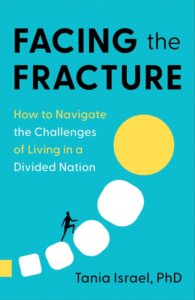 Facing the Fracture: How to Navigate the Challenges of Living in a Divided Nation (Greenleaf Book Group,2024) by Tania Israel, PhD is available at Amazon, Barnes & Noble, and more.
Related Resources
- Tackling Tough Topics in Church by Elizabeth Evans Hagan and Ann A. Michel
- Communication Strategies for Addressing Conflict by Craig Gillia
- Reading Between the Lines: Navigating Church Politics with Insight and Wisdom by Doug Powe and Jessica L. Anschutz
- 6 Silver Linings in the Clouds of Doom and Gloom by Ann A. Michel
If you would like to share this article in your newsletter or other publication, please review our reprint guidelines.