
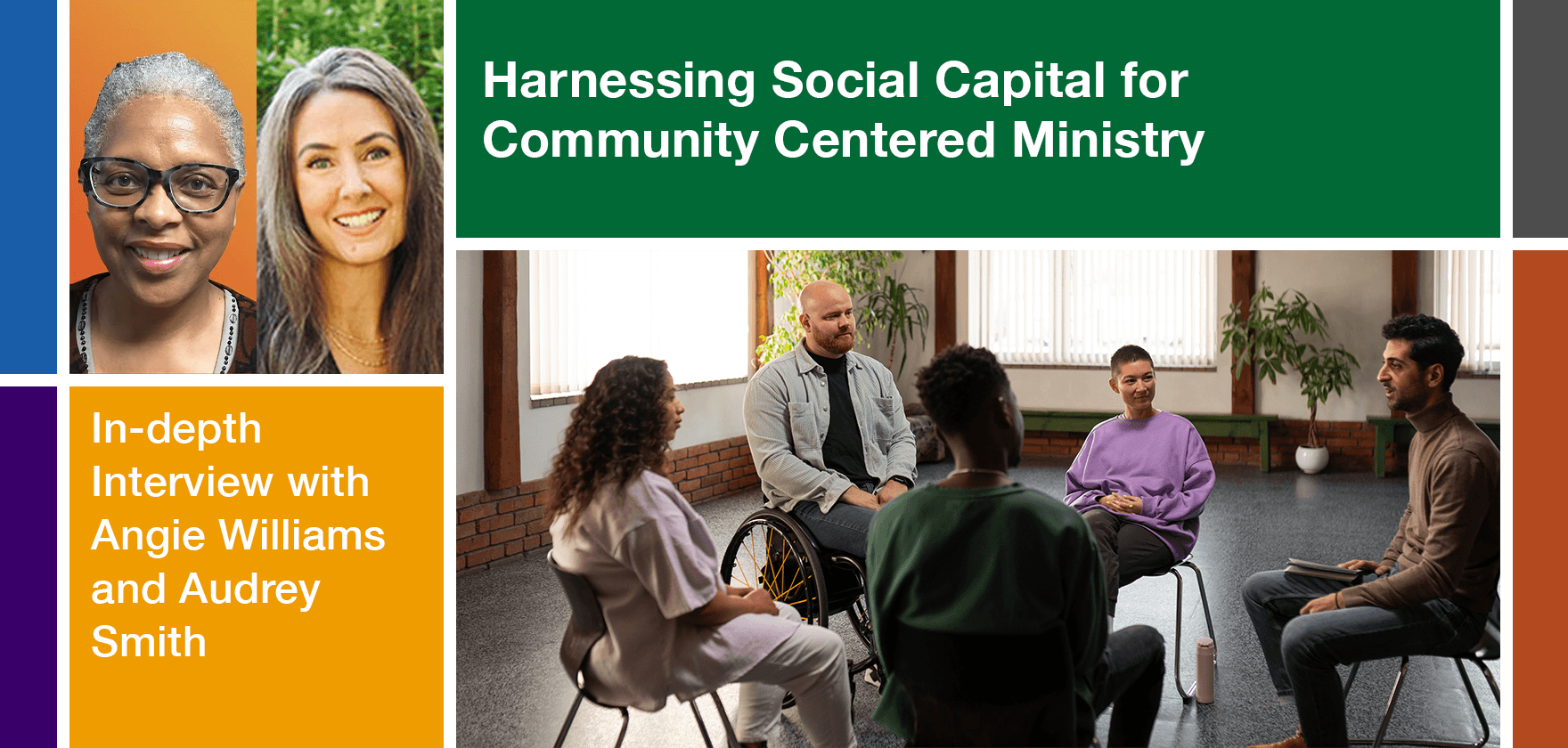
What does it look like for churches to truly center their communities in their ministry? In this interview, Audrey Smith and Angie Williams explore the practice of community convening, emphasizing deep listening, relationship-building, and the power of social capital. Drawing from their work in Ettrick, Virginia, and with Open Table, they invite churches to move beyond assumptions, rediscover their neighbors, and embrace a shared purpose shaped by the community itself.
Watch the interview video, listen to the interview, or continue reading.
Jonathan Page: Today I’m excited to be sitting down with two good friends of mine: Audrey Smith and Angie Williams. We’re centering today’s conversation around the theme of community-focused ministry, and what it looks like to lead with the community at the center of our spirits and work. So, Audrey, I wonder if we would start with you. Can you give just a little bit of background to what you’re doing. Who you are? Why we’d want to be talking to you about community-focused ministry?
Audrey Smith: Sure, Jonathan. I’m a licensed local pastor in the United Methodist Church, and they sent me out as a church planter into Petersburg in 2021. That work has translated into community convening in the tiny village of Ettrick, Virginia and working with Open Table on their community convening model using the principles of asset-based community development.
Jonathan Page: That’s awesome. Angie, you’re a part of Open Table, and I wonder if you’d tell us a little bit about what the Open Table is doing with community convening.
Angie Williams: Yeah, absolutely. So, Open Table is a national nonprofit. We train communities, and we train individuals what it looks like to access their social capital, to organize that, and to invest it through relationship in the lives of other people. We have models that we train at all different levels. So, we train one-on-one at the individual level; we train small groups to do this; we train organizations; and we train the community.
So, for community convening, the whole idea is: What does it look like for the church to rethink and reconsider how they define who they are and who they’re called to be in the community, as it relates to the community itself?
Jonathan Page: So, Angie, in what you were sharing, you talk about community convening and social capital. I wonder if you could define that a little. What exactly does the community convening process look like for churches in their communities?
Angie Williams: So, social capital is very simple. It is who we know and what we know, and it’s looking at that at all levels. It comes directly from the relationships that we each have. But what is important is being intentional in how we take the relationships that we have—who we know, what we know—and bring all of that together to invest it into the lives of other people and in our communities. Particularly into the challenges that our communities are facing.
For the church, community convening is an intentional model and a process that teaches the church how to go out into the community by defining the neighborhood. Often, churches have become a place where people travel from far and wide to attend, so it doesn’t necessarily look like its neighbors. It doesn’t necessarily have a relationship with its neighbors. And so, community convening is really when we ask the question: “How can we be intentional about going out into the defined area around the church to get to know our neighbors again?”
Part of the process of community convening, and the part that’s the most important, is a process called “socially valid indicators.” This process invites neighbors through relationship, through getting to know them, to let them be the ones to name what they believe are indicators of impact. It asks them what outcomes they want to see in the community. Once that has been named, and once you discover that through relationship with the neighborhood, then the church has the opportunity to redefine who they are, how they live out mission and ministry through a defined shared purpose with the community because of what has resulted from learning that and getting to know that from the community.
Jonathan Page: I think that’s incredibly cool, and what a novel concept too. It sounds like that’s really invested in a space of deep listening and really being able to be attentive to where people are. Audrey, what are some of the outcomes that you’ve seen in Ettrick from practicing this in real time?
Audrey Smith: Listening is key. Getting people to speak is even more important. So, we’ve gone out with the intent to listen, but as the church has become separate from its communities, there’s a lack of trust. So, in practice, the process takes a while. It’s a process that be long-term and for the long haul.
It’s interesting to see who will talk to you and who will not. We’ve been at community events; we’ve engaged young people from Virginia State University to go out into the neighborhoods. And when you’re listening it’s also kind of cool to hear what people are not saying. Right? The traditional asset-based community development approach is to find a “Person of Peace” or a “Minister of Introduction,” and then you tag onto that person and that person will lead you to the other people, so you can hear the voices that are speaking
What’s been surprising to me is how long it gets people to talk to you. So yeah, listening is at the core of what you’re doing, but you must be really patient and find different people.
When we listened to a little over a hundred people, what we found is that what was really important to them was safety. It’s at the crux of being a human being—that need for safety. Safety for community could mean streetlights or speed bumps or more presence of police in the neighborhood. But it can also mean more social connections with people, so they know and trust their neighbors.
The other two socially valid indicators are education and job training. When we’re talking about community convening, we’re also talking about repairing local economies. Ettrick is a community in a large county, but it’s one of those tiny places that’s been neglected. The people there have not had job opportunities, and so they leave. When you’re trying to get information from a community, you have a great deal of people who are renters or transient. That’s just part of the process and that’s why anyone considering doing this needs to know upfront that it’s going to take time and consistent presence.
Jonathan Page: When you use the language “Person of Peace,” or “Minister of Introduction,” what does that mean for you? How do you identify that person?
Audrey Smith: A “Person of Peace” is somebody who cares about the people in the community. They are connected, grounded, rooted in that community. The closest we’ve come in Ettrick is a barber. I went in one day and asked, “Can you connect me with people in the neighborhood?” because he knows all of the older residents who are invested in this community. So, I’ve kind of tagged him as a “Person of Peace.”
Jonathan Page: So, Audrey mentioned, like one of the socially valid indicators that they came up with was safety. I’m wondering from an Open Table perspective, how do you coach churches through their capacity and how to enter in on those spaces? Angie, how do you help churches respond to their needs?
Angie Williams: It’s so important to understand the need as it is being communicated by the person we’re talking to, and not from us making assumptions based on our own lived experience or what we have encountered. Once the needs, challenges, or focuses are defined, we identify a priority support need. We ask what the most critical thing a community needs to overcome a barrier or accomplish a goal is and go from there.
Churches have to think about the institutions in their communities and build relationships them. They need to ask, “Do we know our schools? Do we know the local businesses right in our community? Do we know our local government officials? Do we know the other nonprofits, the healthcare sector, human services?” Then you bring everyone together to collectively address the need. Through social capital, even a small group can reach thousands. the beautiful thing is that the neighbors and the community, through that community convening process, they do finally start to see the church as a trusted community partner. And again, a shared purpose with the community, where the church is existing for its neighbors and for its community starts to form and, really, that is how transformation comes in the community.
Jonathan Page: Audrey, how do you keep people motivated on the process when it is so lengthy?
Audrey Smith: This is Holy Spirit driven work. Without that, it doesn’t happen. We’ve had monthly meetings and one day we decided to walk the neighborhood. We went to communities and schools. We went to the train station. So, that day was a day of seeing all of the assets. And what really happened on that day is that our stakeholders really became a community of their own. It didn’t require me to motivate them. It just happened.
What it requires is a person who listens and is in tune with the Holy Spirit because we have pivoted and adapted and changed so much in the year 2025, and that comes from deep listening and time spent with the Holy Spirit and just almost say “ready, set, go.” So, an idea might come to you, and that might be that your “ready.” It doesn’t mean you go yet. And then you’re waiting for the “set.” Does everything come together? Do all of the pieces just work together? Is there a flow to what’s going on in the work, and then no individual leader has to motivate people, has to just beg people to do something. That’s what we do with leadership in our churches, right?
Jonathan Page: How do you handle pivots?
Angie Williams: Once relationships are built, you lean into what you’re hearing, even if totally different from what you were expecting originally. One church thought food insecurity was the issue, but after taking stock of the situation they discovered that there was plenty of food, plenty of food banks, food ministries, and discounted food. But they discovered that transportation to get to the places where food could be accessed was the real challenge.
Audrey Smith: When we started, we wanted to repurpose the former Ettrick UMC. But the community didn’t say that was important. with prayer and discernment, it dawned on me that the United Methodist Church that had been on that place for 180 years, but excluded black people, may be a symbol of oppression. And how can I get the community to engage with me when what they see when they see me is somebody who represents that symbol of oppression? I had no idea we would get to that place, and I held that in check for a while.
Angie and I had a conversation one day, and she asked, “Audrey, if money were no object, what would you do?” I said, “I would just start in a parking lot, just on asphalt pavement somewhere to begin a ministry of presence.” Perhaps you could have mobile clinics, mobile washers and dryers, mobile showers, maybe a modular trailer that we start in, right? So that people know you are invested here, you’re going to be here. These are the days and times that we are here. I said I would start with a ministry of presence—mobile services, consistent presence.
She then asked me what we would do with the building, and I said “I would demolish it. As a symbol of…of oppression, as a symbol of injustice, as a symbol of the United Methodist Church saying, ‘We confess and we repent of racism and discrimination, and we want to repair, reinvest in this community.’” So, in 2023, when we first went in those doors together, to get to that point two years later was wholly unexpected, and I think it was a Holy Spirit speaking in a way none of us could anticipate, Jonathan.
Jonathan Page: What’s next for Ettrick? Where are y’all headed now?
Audrey Smith: The big, hairy, audacious goal is that Ettrick becomes a place where people want to come. That this little, sleepy village comes alive again because a small group of people paid attention and followed the prompting of the Holy Spirit to not give up on it, to engage with residents, to help them see with eyes that are new what their community can be. That would be the goal. That there’s a pinpoint on a map of places to visit, and that would be Ettrick because God is at work there.
Jonathan Page: Angie, how can people get involved and connect with Open Table if they’re interested in this?
Angie Williams: Number one, I think it would, for any church that might be considering this or any organization, it can be any group of stakeholders in a community that being willing to maybe sit in on one of these communities of practice and hear more from Audrey—hear more from some of the other organizations that have participated and what they’ve learned from it. And so, we would be more than happy to help facilitate that and make those connections.
And then, just on a more detailed level, reaching out to me, reaching out to Audrey. We can provide our contact information. We would be very happy to talk with anybody one-on-one that would be interested in exploring this and talk about what the process might look like. Audrey alluded to this, but in general, you are looking at a one-year commitment. Of a regular rhythm and flow of meetings and then these action steps that you have in the community. But then you’ve learned it. It’s just something that becomes natural about who we are, the way that we live and practice mission and ministry in the community.
Jonathan Page: Audrey, do you have a final thought you’d want to share with folks?
Audrey Smith: I would say that community convening is a Wesleyan approach to community. It’s about social holiness and connection. John Wesley laid it all out when he said, “Yes, we need personal holiness, but you also have to have that social holiness and that community connection, and that when we all do this, we become whole together,” right? Our communities improve because everyone in the community is a part of it. So, I would ask people to really go back and think about Wesley again, and how he went out into the fields, and how he connected different kinds of people together. Knowing that we’re just really going back to find something new.
Jonathan Page: Angie?
Angie Williams: I would piggyback off that by saying: reclaim what it looks like to make the world your parish or even just your neighborhood. That is what it’s all about. How can we make sure that, indeed, the world is our parish.
 Related Resources
- Open Table, a non-profit training organization
- Building Congregational Engagement in a Church-School Partnership by Jake McGlothin
- Creatively Engaging Your Community While Remaining True to Who You Are by Paul Nixon
- 3 Critical Components of Rethinking Outreach by John Hughes
- Taking Church to the Community, a Lewis Center video tool kit resource
If you would like to share this article in your newsletter or other publication, please review our reprint guidelines.