



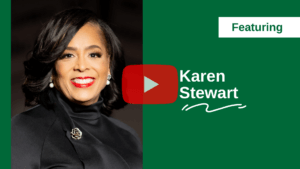
How do we lead faithfully in a world that’s changing faster than the church ever expected? In this episode, Lewis Center Director Jonathan Page speaks with Karen Stewart, a seasoned ministry leader and Project Director at the HUB for Re-imagining Ministry at Wesley Theological Seminary. Together, they reflect on Karen’s 30-plus years of pastoral and nonprofit leadership experience, her passion for intergenerational faith formation, and the opportunities and challenges facing today’s church.
Listen on Apple Podcasts | YouTube Music | Spotify
Watch on YouTube
- Transcript—Click or Tap to Read
-
Announcer: Leading Ideas Talks is brought to you by the Lewis Center for Leadership of Wesley Theological Seminary in Washington, DC. Subscribe free to our weekly e-newsletter, Leading Ideas, at churchleadership.com/leadingideas.
Leading Ideas Talks is also brought to you by Discovering God’s Future for Your Church. This turnkey video tool kit helps your congregation discern and implement God’s vision for your church’s next faithful steps. Learn more and watch an introductory video at churchleadership.com/vision.
How do we lead faithfully in a world that’s changing faster than the church ever expected? In this episode, Lewis Center Director Jonathan Page speaks with Karen Stewart, a seasoned ministry leader and Project Director at the HUB for Re-imagining Ministry at Wesley Theological Seminary. Together, they reflect on Karen’s 30-plus years of pastoral and nonprofit leadership experience, her passion for intergenerational faith formation, and the opportunities and challenges facing today’s church.
Jonathan Page: Well, hey there, friends. My name is Jonathan Page. I am the director of the Lewis Center for Church Leadership at Wesley Theological Seminary, and it is my joy to welcome you to another episode of Leading Ideas Talks. This is a podcast where we engage in conversation about church leadership, tell stories about leadership, and learn more about what’s happening in the life of local churches and how we can best be resourcing leadership in the local church.
And so today, I am excited because I’m joined by a very special guest. I’m joined by Karen Stewart. Karen is a part of the team at the HUB for Re-imagining Ministry at Wesley Theological Seminary. And what I’m really excited about is that, Karen, we’re doing this fun experiment, where Karen is also joining our team at the Lewis Center for Church Leadership. She’s going to be helping a lot with the development of content for our newsletter and our podcast, and we’re going to do this experiment to see if we all play nice together. And, and if we can all work together in that; and hopefully, hopefully this is more than an experiment. But we’re excited for just what’s ahead. And I was excited that Karen had some time to be able to come on and talk a lot of her background and just introduce herself to the wider Lewis Center audience. So, Karen: Welcome, it’s good to have you.
Karen Stewart: Thank you. It is great to be here. I am excited about this experiment as well.
Jonathan Page: It’s always fun, like, if you had told me… do you ever have those moments, like when you first felt that call a ministry, whatever it would have looked like? I think about, like, for me, it was an altar call experience. And so, there are moments where I’m just like: Okay, would I have actually walked down that aisle if I had known what I know now kind of thing?
Karen Stewart: That is the question. If we knew. Hindsight is always 20/20. And if the Lord would show us: “Now, this is what it’s really going to look like,” would it make us really say to ourselves, “Am I really going to answer the call, or am I going to go the other direction?”
Jonathan Page: Right. Right. And so, like, one of the things … thinking of ministry as like a lab that was that was … I was in high school. I had to do, like, biology labs. I didn’t like labs back then. Now, I really like them a lot. I like experiments, and I like testing things out. And I’m especially excited, to—to be able to test this out with you, Karen. You bring just a ton of background and experience, and I wonder if you would just tell our listeners a little bit about, kind of, who is Karen? How did you get here? Tell us—you don’t’ have to go into your whole life story—but tell us your life and ministry, and kind of how you got to this point.
Karen Stewart: Thank you. And I’m sad you don’t want to know my whole life story (laughing).
Jonathan Page: Yes. Yes. I do want to know your whole life story. I’m just mindful of time, that’s all.
Karen Stewart: Yes. Yes. So, I’m really—I’m located in Phoenix, Arizona. I’ve been in Phoenix, Arizona, I claim it as a native, I’ve been here since the third grade. And so, as you all are digging out of the snow in Washington, D.C., we’re over here shoveling sunshine. The challenge is the summer is coming, and our shovels will melt because it will be so hot.
But I come with about over 30 years of ministry experience in the local church. With a Pastoral background, I have done everything in the church from … except being the custodian or the senior pastor. And the truth is, if you work at the church, everybody is the custodian. So, the only role I have not had is that of being the senior pastor.
But I’ve worked my way up the ranks. I was home grown, the church that I was a member of made an investment in my education with no strings. I didn’t have to stay at the church; but because they invested, and I love the church, I’ve been there and spent over 30 years in ministry there.
And I’ve done, like I said, everything. So, my last position was the Executive Director of Ministries, which is very similar to the senior pastor. I had a counterpart; I was over ministries, and I had a counterpart who was over the operations. And I gave oversight to everything the church did ministry wise. I have been in the evangelism department. I cut my teeth in ministry in the children and youth department. I think most of us, that’s kind of where we get started. I was the first, first executive director to the nonprofit affiliated with the church. I did that for five years. I was the first woman who served as the executive director of ministry there.
And that gave me insight into nonprofit management and gave me insight into how church is run, because I’ve done everything there. And so, I gave oversight to the marketing department. We had a footprint online already, but when Covid came, it was the development of all of the online content that we would have to keep our members engaged.
So, I’ve done everything from the very smallest thing to event—from event planning—to everything. So, I have that. I also started my own consultation firm where we help… I help churches. It’s called Slack Solutions: Stewart Leadership and Consultation, where our motto is, “We pick up the slack,” and we help churches to think about their mission and vision and values; and Ministry structure, staffing structure, even if they’re going to start a nonprofit in their organization to work alongside the church ministry. I do that as well. But my masters has an emphasis in nxfonprofit management, and so I have a love for what the church does, how the church grows—the local church and the church universal, what God is doing in the church.
So, as I was looking to retire from ministry and move on to what God would have me to do next, I landed upon an application for Wesley, the Hub at Wesley, D.C. Now, the HUB for Re-imagining Ministry. And I looked at that and said, “Huh, this is something I can actually do.” So, I retired in November: two years ago, three years ago, and then I started with Wesley in March. And I will be at Wesley now at the HUB for about two years, next month. So, it’s been a wonderful ride. I enjoy ministry a great deal and love God’s church.
Jonathan Page: So, I think. I think our listeners are probably able to hear, there’s a reason why we want to work with you. And you’ve got this background that has all this varied experience, and and one of the things I love is this this ability to partner with the HUB for Re-imagining Ministry because so much of, so much of the work that you all are doing is related to innovation in the church. And, and for me, it’s it’s really challenging to decouple the concept of leadership from the concept of innovation; the two feel like natural partners. I’m wondering if you can talk a little bit about sort of your specific role at the HUB and the ways that you’re integrating your ministry experience into that work that you’re doing alongside of churches in that innovative capacity.
Karent Stewart: I would love to talk about the HUB. The HUB for (Re)Imagining Ministry has been around since about 2016. It started because it got a grant from Lilly foundation to do some work. And that just kind of started this trajectory that we find ourselves on, as we turn ten this year. We work with pastors and churches and ministries, young adults… as we all think about how we can do ministry differently.
We always know that the message remains the same. But as our times change, the way we do ministry has to adapt so that we can remain—not relevant, because sometimes that’s really a buzzword, but just kind of in front of it all, so that we can do God’s work amongst the people in the communities and the culture that we find ourselves in.
So, I started because they had a specific grant, and we call it “Bringing Church Home.” It’s the Christian parenting grant, and it was thinking about walking alongside churches about children’s faith formation at home. Many times we give the reins of faith formation to the children and youth minister at church and, so that we can have a little bit of respite as we meet God for ourselves in adult worship, where we send our children over to children and youth worship. And this was rethinking what that looks like, and giving parents and caregivers and guardians of the baton back, to say and to remind them that children really form their faith best when they do it in community with you, not somewhere else. It has its place, but it does, it sticks better when they do it in community with you because they watch you. They learn how to navigate faith by watching you and how you navigate faith.
And so that’s where I started. Now that has blossomed into, not only overseeing that grant, but also giving oversight to the grant for intergenerational worship and, move from just being a Program Director to now being, one of the two Directors of Engagement and Programs for the HUB at Wesley.
So, as we expand our work, my responsibilities have expanded. And because I have a background that, I cut my teeth in Children and Youth ministry. I currently serve on the Evangelism and Discipleship Commission for the Baptist World Alliance, and I serve as the faith seat for First Things First here in Arizona, which, looks into early childhood development. We say, “if you’re ready for college—kindergarten; you’re ready for kindergarten, you’re ready for college. And if you’re not, you’re always playing catch up throughout the years. So, that kind of secular aspect of First Things First kind of set me up to do the work that I do with the HUB at Wesley. And there’s overlap, as these churches and Wesley and the HUB think about innovation are the our name. When I got started it was the “Innovation HUB.” Innovation can be a buzzword. Now we’re talking more about how can we reimagine ministry in the culture and context, but we’re creating tools and thinking about getting those tools out to churches. And we walk alongside leaders in churches, lay leaders and pastoral leaders. And that’s the work that the Lewis Center has been doing. So there is a wonderful overlap. And being able to bridge the gap to see how these two centers of excellence can work together is very exciting to me.
Jonathan Page: Well, the good news is that it sounds like you’re triflingly underemployed, so you’ll have extra time to… No, I’m joking. No, I’m going to be fascinated to see how we fit all of these pieces together. But what strikes me as really meaningful about what you’ve just shared is there is so much natural collaboration in this space already, and kind of where we… where we see things like the work of children’s ministry, the work of intergenerational worship, and sort of how we’re designing leadership in a way that promotes that kind of activity in the life of churches, that promotes that kind of relational space.
I guess I’m curious for you, Karen, as you think about sort of all of these different touch points—what you’re currently doing with the HUB, kind of where your experience is led, but the lens through which you you see church leadership—what are some of the spaces that you would look at and say, gosh, this feels like something we need to pay attention to, as leaders. And whether that be something that’s an opportunity for church leaders or a gap that needs to be addressed in the life of local church leadership.
Discovering God’s Future for Your Church is a turnkey tool kit to help your congregation discern and implement God’s vision for its future. The resource guides your church in discovering clues to your vision in your history and culture, your current congregational strengths and weaknesses, and the needs of your surrounding community. Learn more and watch an introductory video now.
Karen Stewart: Ironically, what I’m going to say is probably not anything new. We know the landscape is changing. The times that we are living in are tumultuous; but those are opportunities. It’s nothing the church hasn’t faced before. We know we used to be fascinated with millennials. Well, now millennials are adults who have had children. And now we’re talking about Gen Alpha and these other generations that are coming, and how they are so connected with technology. AI is almost a mainstay. And for people in my generation, we remember the Terminator, and we knew that there was a date that AI was going to come alive, and it was going to be the demise of our world, but we find ourselves living in that as a reality. And AI is creeping into every aspect of the church. Not bad, not good. Just our reality. So, it’s something that the church needs to be aware of and to think about: What does that mean for the way I do ministry, and how I reach this new generation where this is a mainstay in the in our lives? We talk about kids and compare them to when we grow up. We say, “well, we used to go outside and play, and so kids just need to go outside, and play and they need to get off of these devices.” Well, the truth of the matter is devices in a child’s hand is a mainstay. They don’t know a life without cell phones. I remember life without cell phones. They don’t. And so, it’s not as simple as saying they just need to put them away. It’s more about, how do we create environments that makes the need for devices less necessary? But pastors all know, young people will sit in church and Google what you’re talking about to find out if you’re telling them the truth or not. So, it is shaping everything that we do. So that’s new on the landscape.
We used to talk about the “Nones,” those who are disaffiliated with the church. Well, what used to be new isn’t so new. And now the nones are having children. So, there’s a generation out there that, like in Joshua, “knows not the Lord,” right? They have not been raised in an atmosphere where at least somebody had gone to church. Now they’ve got parents who’ve disaffiliated, and they’ve never been to church. So, these are new mission fields that the church has to wade into the waters of.
Jonathan Page: I think you’re right. And I think the way that we wade into those waters is important, too. It’s this weird. You know, as I reflect on this, it’s this interesting combination of having the humility that we don’t have all the answers and once had the confidence that perhaps the strongest answer to all of this is finding the love of Christ that’s dwelling deeply within each person. And so, how you hold that intention is really, really fascinating to me, and maybe leads in a, in a circuitous way to kind of my next question for you, which is, you know, you hold intention as a leader, as someone who is also, you know, you’ve got a family and you’re you’re able to you have a life, right? That you’re, that you’re living. What are some of the strategies that you’ve developed over your career for sort of that? I hate the phrase work-life balance because I don’t think you can fully separate, especially something that’s your vocation from your life. But… but I guess maybe a question is, is what does play look like for you, and how do you integrate that space for restful ideation, contemplation, all of that sort of thing in with the busyness of your leadership?
Karen Stewart: So, when whenever I hear the term “balance,” especially work and life, the imagery that comes up is a teeter totter. So, this is going way back. I am dating myself, telling everybody my age. But I reflect on a teeter totter. And I, like many, don’t have fun experiences with teeter totter because depending on who’s on the other end, you are either stuck up in the sky or, if they jump off the teeter totter, you slam back down to the ground and there never seems to be a real balance. And that’s kind of sometimes what we think in terms of work-life balance. The truth is, just like on a teeter totter, you have to be intentional. You have to be intentional about your work and how much work you are doing, and then the rest of your life, which can be a lot of things. If you are a parent raising children, you’ve got not only your schedule, but you’ve got children who are all over creation doing sports and after school activities and other sorts of things. And that doesn’t even talk about the things that feed your soul.
So, the word that always comes to mind is being intentional. The funny thing is, my husband and I, we are intentional about date nights. We put them on the calendar. Many people think, what happens to spontaneity? Well, sometimes we are very spontaneous, but most of the time we’re intentional. We make sure we endeavor to guard those days so that we can have real time together. And besides being intentional, we find opportunities to play. You would be surprised how people will come up to us because we are laughing, joking, giggling and carrying on so much in the grocery store. Every Monday when we go to the grocery store, people come up to say, “you all are the funniest couple that I’ve ever seen.” We try to enjoy one another’s company. He’ll plan a date night. I’ll plan a date night. It might not be something I enjoy doing, but he enjoys doing it. So, because he enjoys it, I enjoy it.
Then there are times that you just have to recognize that I’ve been burning the candle at both ends. For me, it was this past Monday. I had come to a weekend where it was my own fault. I had planned too many things and kept all of my commitments, but I was spent. I was mentally tired. I was physically tired. I was emotionally tired. And I knew on Monday night, I had some things, some work things that I needed to spend some extra time on. But I purposely said, I’m taking a break, and my daughter, who lives near me, was cooking dinner. So, I called her up and said, I’m coming over to eat so I wouldn’t have to cook, and I wouldn’t have to do dishes, and I can enjoy my grandchildren. And that three hours of respite helped fed my soul. It gave me time with my family, and it reinvigorated me because I knew the stuff I missed on Monday was going to catch me on Tuesday, but I was more mentally prepared to do that. So, I think we have to just say, sometimes I’ve got to stop, take a break and breathe, and then we can get back in with fresh eyes and fresh brains.
Jonathan Page: So, so much wisdom there. Because the… Yeah, the work of leadership is not going to observe our need for pause and say, “oh, let’s just stop for a little while. Right?” Like it… it will always be there for you. And I just, you know, it can be a buzz word, but that word, “intentionality” that you used. When you have intentional actions, they tend to lead to intentional results, right? You can’t if you say, “hey, I want this particular outcome,” but I’m just go on to let it all happen at random. Well, don’t be surprised when that outcome doesn’t come to fruition because you’ve just randomized your entire life. I do have to say, on the teeter totter thing, you mentioned the terrible bits of it. You… You failed to mention that, I have not ever been on a teeter totter that was made of a substance other than metal. And, and the real pain of a teeter totter is just the burnt rear-end that is…
Karen Stewart: You don’t have to tell me! I am in Arizona, and our teeter totter is always metal. And they were always hot. I think that’s why there’s no more teeter totter. And the other thing that was on the playground was a thing you would spin on, and you would see kids flying because they would get to running, and kids would go flying because it’s spinning so fast. Back in the day, we all… everybody had dirty knees and scraped up hands from the playground.
Jonathan Page: I have a four-year old that’s starting to go these playgrounds, and I’m observing, like, what is he playing on that, like, one day, we’re going to say, “why did we let our kids play on that?” But no, its all of our own good fun.
So the reason I wanted to bring up the teeter totter piece, though, is I do want to put you on the “hot” seat a little bit—“hot,” see that was little joke.
So, so we talk about intentional outcomes, right? When you think about this season of leadership for you—working with the HUB, this experiment with the Lewis Center—what is the fruit that you expect to come from your leadership in this season of your life? And then what are you doing to to make that a reality?
Karen Stewart: Oh, not a simple question.
Jonathan Page: I told you—hot seat! Let’s get real, here.
Karen Stewart: Let’s see if I can unpack the question. Okay, let’s take it in two parts. Ask me the first part one more time.
Jonathan Page: Right, like you’re you’ve kind of gone from, from retirement into the space of working with the HUB. Now you’re working with the HUB and Lewis Center. What is the fruit that you most expect to come from this season of, of ministry leadership? And then, the second part is what are you doing to make it happen
Karen Stewart: So, I would love the fruit to be, and the and the fruit I want to work towards, because the seeds I’m planting should bear this fruit, is that there is a current and new generation of leaders equipped to meet the needs of this current and these emerging generations. It’s just necessary. We know that church attendance is on decline. We know all of everything related to the church seems to be on the decline. However, there are some ministries out there that are doing some really creative, reimagined ministry things that have their ministries growing. Being able to see and highlight those things, and then having the discussion around, “well, how does that now adapt to another context” is always, something that helps people to see, you know, maybe that is something that I can do.
We’ve also, after coming out of Covid, pastors and pastoral leaders have been resigning or leaving the ministry because the, the workload. You know, we just talked about work life balance; the workload just seems so overwhelming, and it seems unfulfilling. So, having a space where these leaders can come and be refreshed and know that they’re not in the in the boat alone. If that’s some fruit that can be borne out of the work that I do, that a pastor will say, I was on the cusp of leaving the ministry. But God, through the work that you’ve done, helped me to see its value in my work, and I was able to be in reinvigorate and invested in—And that would be the fruit.
And so, I think the, the way I work towards those things is really having an ear for the heart of where the church is, and where the people are, and what it is that they need. It’s easy to say, “here’s what I think you need.” Sometimes we’re wrong. Hearing from the people, hearing where their heart is, and what their desires are, and incorporating that into the work that I do so that it meets that need, I think, is where I am. So, I hope that answers your question.
Jonathan Page: Yeah, I think it does. And yeah, I just that image of deep listening, and ensuring that you’re listening to understand—not to be able to speak. Right? Like it’s, it’s that that deep sense of appreciation. And that that idea of appreciation is, is really what I want to communicate to you, Karen. I think we’re… I’m excited that you’re, that you’re coming on, and and participating in this experiment. I’m excited for the wisdom that a lot of leaders and a lot of listeners are going to glean from you, and the and the contributions, not only that you provide, but the contacts and the connections that you have provided. You and I are different people, right? Like, I, I don’t know if anybody can tell, but Karen has a lot… her hair is better than mine. Okay?
Karen Stewart: [laughing]Well, your beard is better than mine.
Jonathan Page: See, we both bring skills to the table. I could look at my shirt right now and just say “oh whale” We’re living all sorts of things… But I just deeply appreciate the ways that your life and your ministry have led so many over the years and the impact that you’re going to have, in this, in this new space.
And, and so, so the first thing I want to say is thank you for taking a chance. And thank you to… and thank you to the larger audience of the of the work at the Lewis Center for saying, hey, like, we’re going to we’re going to try something we haven’t tried before. And and that’s a good thing to… to be able to experiment and play and, and see where that goes.
Karen, whenever we wrap a podcast, we always will give the guests the last word or less phrase or the last paragraph. I’m wondering if there’s any, any kind of closing word that you’d want to offer, our audience.
Karen Stewart: A closing word. Let’s see, that I would offer to the audience. I think my closing word is just one of encouragement. I know they’ve listened to us, and we’ve had a great time in conversation with one another, and maybe they’re wondering what’s next and what will everything look like? But I always reflect on the scripture that says that there’s nothing new under the sun. So, even as we strategize for innovative and creative thinking, it’s not new to God, maybe new to us, it’s not new to God. And so that keeps me humble and connected, knowing that I just need to lean into God. And that’s how I would encourage someone out there that there is nothing new under the sun. And it may be new to you, but it’s not new to God. And God’s got you in this season.
Jonathan Page: Alright preacher! That’s a good word to end on. And also, it’s just incredibly ironic that whenever you know, we talk about the idea of leadership and innovation, and we have to be reminded that there is nothing new under the sun, right? Like, we’re we are uncovering what God is up to you. Right? Like, God’s activity is not bound by our activity. And, and that’s there’s there’s some unique comfort in that and unique joy in that. And, and now it’s really about how do we get out there, and how do we take next steps and and live this life of ministry leadership together. So, Karen, I’m excited for this. I’m excited for what’s ahead. And I am really grateful to you.
Grateful to the HUB, and the team there. And grateful to our Lewis Center team and excited to see what’s next. So, thanks for being a part of the Podcast. And let’s get to work.
Karen Stewart: That’s right. I’m excited about the opportunity. So, thank you, Jonathan.
Jonathan Page: Alright. You be well. Everyone be well, and we’ll be back with another episode soon. God bless.
Announcer: Don’t forget to subscribe to our free weekly e-newsletter, Leading Ideas, to be notified when new episodes are published. Visit churchleadership.com/leadingideas.
Related Resources
- 50 Ways to Welcome New People, a free Lewis Center resourse
- The HUB for (Re)imagining Ministry at Wesley Theological Seminary
- Engaging Young Adults by Beth Ludlum
- 3 Critical Components of Rethinking Outreach by John Hughes
If you would like to share this article in your newsletter or other publication, please review our reprint guidelines.