

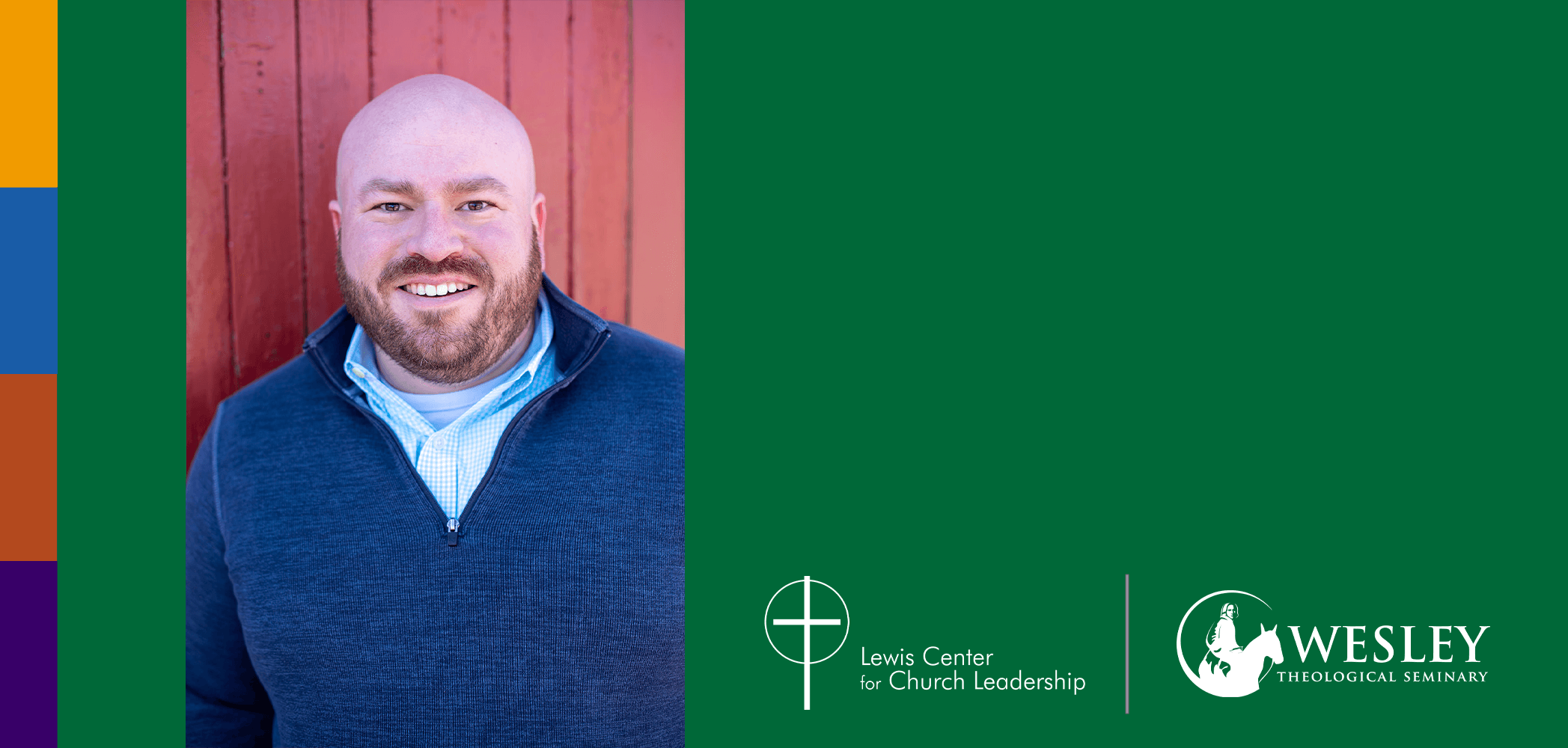
Jonathan Page, the new director of the Lewis Center for Church Leadership, writes his first article for Leading Ideas as a letter to all the people who use and contribute to the Center’s work. He shares his appreciation for the work of the Lewis Center, points to new leadership challenges and opportunities facing church leaders, and invites the partnership of all stakeholders of the Center to meet these issues.
Friends,
Sometime in April of this year, I needed to resource a pastor with information about stewardship. I was confident that the Lewis Center for Church Leadership would have the resources that pastor needed, so I navigated to the website. While there, there was a note on the homepage: the Center was searching for a new Director. I looked at it for all of ten seconds, thought to myself, “That’s interesting,” and moved on with my day. That night after wrapping up some things, I went to the page again and saw the ad was still there. For the next month, despite loving my work in connection and innovation with the Virginia Annual Conference of the United Methodist Church, I couldn’t shake the sense that I should at least contact someone to see what might be needed next for the Lewis Center.
A few months later, that holy nudge has me writing to you, humbled and honored to be serving now as the Director of the Lewis Center for Church Leadership. Lovett Weems and Doug Powe have been incredible leaders of this space, and there are countless people who have served wonderfully in staff capacities, who have written insightful pieces for this newsletter, or have been a thought-provoking part of a Leading Ideas Talks podcast. I am so grateful for the shared sense of leadership that has brought us to this point.
In a call with Lovett shortly after accepting this role, he said to me that the core of the Lewis Center has always been delivering strategic, actionable insights. That’s something we will endeavor to continue as long as I’m a part of this team. We will be focused on offering resources to lead the church well, whether that leadership is coming from clergy, laity, or judicatories. We will be listening for stories of success that can be shared on a wider platform, especially those with the potential to inspire others in their leadership.
Beyond these principles, there are a number of strategic areas that are particularly interesting to me as I step into this role. In my first communication in Leading Ideas, I’d like to focus on the area that I believe could carry with it the greatest impact for the church in the next 12-18 months: collaborative and community-based leadership.
In the early 2000s, a cinematic phenomenon began to unfold: the rise of the superhero movie. This wasn’t a novel idea–after all isn’t one of the best ways to define your generation to determine who played Batman when you were young? Spiderman, Wonder Woman, Superman, the Hulk–it felt for a significant time that comic books had come to life with these incredible individuals who were larger than life.
But around the middle of the 2010s the individual superhero film ceased to stand alone. Alongside it came the collaboration of heroes, with films like the Avengers, Justice League, and Guardians of the Galaxy. These films showed the incredible nature of collective power, often facing bigger challenges and foes than the superheroes were encountering individually.
Today, we see a blend of these films around the cinematic landscape. Individual superheroes with their own great stories haven’t gone away. But there is a sense that the biggest and best stories typically involve a shared sense of responsibility for doing the things superheroes tend to do.
I believe we are facing a similar shift in church leadership. As an elder millennial, much of my time growing up in the church and early on in my time as a church leader was focused on the idea of solo, heroic leadership. We haven’t always said that part out loud, but in my observation we tend to reward churches with strong, charismatic pastoral leadership, especially when that leadership comes from a white male between the ages of 35-55.
Today we see some of the challenges that come with this perspective. One person is only capable of so much. There has been a decline in both clergy recruitment and clergy retention. In places where clergy are persevering, there are challenges with burnout, overload, and loneliness.
If we are going to be setting direction for the future of church leadership, I think there has to be a sense of understanding the unique capacity and giftedness of individuals and how that can be shared in community to create space for broader and more complete transformation. Churches cannot depend on individual clergy to be the church or to lead the church–after all, the body of Christ has many parts. Likewise, clergy need to recognize the leadership force present within laypeople, affirm that, and empower that in every possible direction. From a broader lens, judicatories and faith-based institutions need to be focused on how to prioritize and incentivize forms of collaborative leadership that can reduce a sense of competition and punitive accountability and emphasize a sense of collaboration and hopeful accountability.
This can’t stop within the church though. Great leadership that is collaborative in nature must extend into the communities within which our churches are embedded. This means partnering with other faith-based organizations as well as entering into relationships with civic, philanthropic, and business organizations. It’s modeling a John 1:14 Christ-likeness where, as Eugene Peterson paraphrases in The Message, “The Word became flesh and blood, and moved into the neighborhood.” Church leadership cannot be collaborative or community-based without first being incarnational.
Leaning into this requires a rejection of some former ways. Specifically, there has to be a shared understanding of the primary audience for the work of the church. There is a popular financial institution in the mid-Atlantic that runs a number of ads, most of which end with the slogan “our members are our mission.” I have found that far too often, this is the implicit mission of the church–to satisfy and placate membership over and against building multidirectional discipling relationships in community.
Here’s the good news: A vast majority of churches serve locally. If church leadership is focused on community, it will find in most cases that it is serving its membership, because they are a part of the community too.
Following through on the priority of collaborative, community-based leadership requires some other emphases that are especially important in this era of church leadership. I believe engaging this work will require new definitions and measures of church vitality that reject transactional approaches and embrace transformation as the core outcome of the church’s work. It may require a departure from mission and vision statements and a greater understanding of the core and aspirational values that shape entire communities. It almost certainly will look at leadership through a lens of intersectionality, embracing the full array of God’s creation and the capacity inherent within all of God’s people to lead the work of God.
But in all of this, I believe we will discover that we are never alone. God is with us and leadership of the church that follows the leadership of the Holy Spirit will be met with blessing, whether or not we are capable of sensing that.
There is much to do, friends. I can’t wait to explore the ways we will lead together.
With every gratitude,
Jonathan
Related Resources
- Lewis Center Welcomes New Director Rev. Dr. Jonathan Page by the Lewis Center
- Creatively Engaging Your Community While Remaining True to Who You Are by Paul Nixon
- Launching Social Ventures that Transform Communities featuring Jaleesa Hall — Watch the Leading Ideas Talks podcast video | Listen to the podcast audio version | Read the in-depth interview