
Lewis Center Director Jonathan Page says that church leadership today requires holding two realities at once: engaging the needs of the community while also forming disciples within the church. He draws on examples from two recent United Methodist gatherings to illustrate how faithful leadership requires movement between the life of the church and the life of the community it serves.
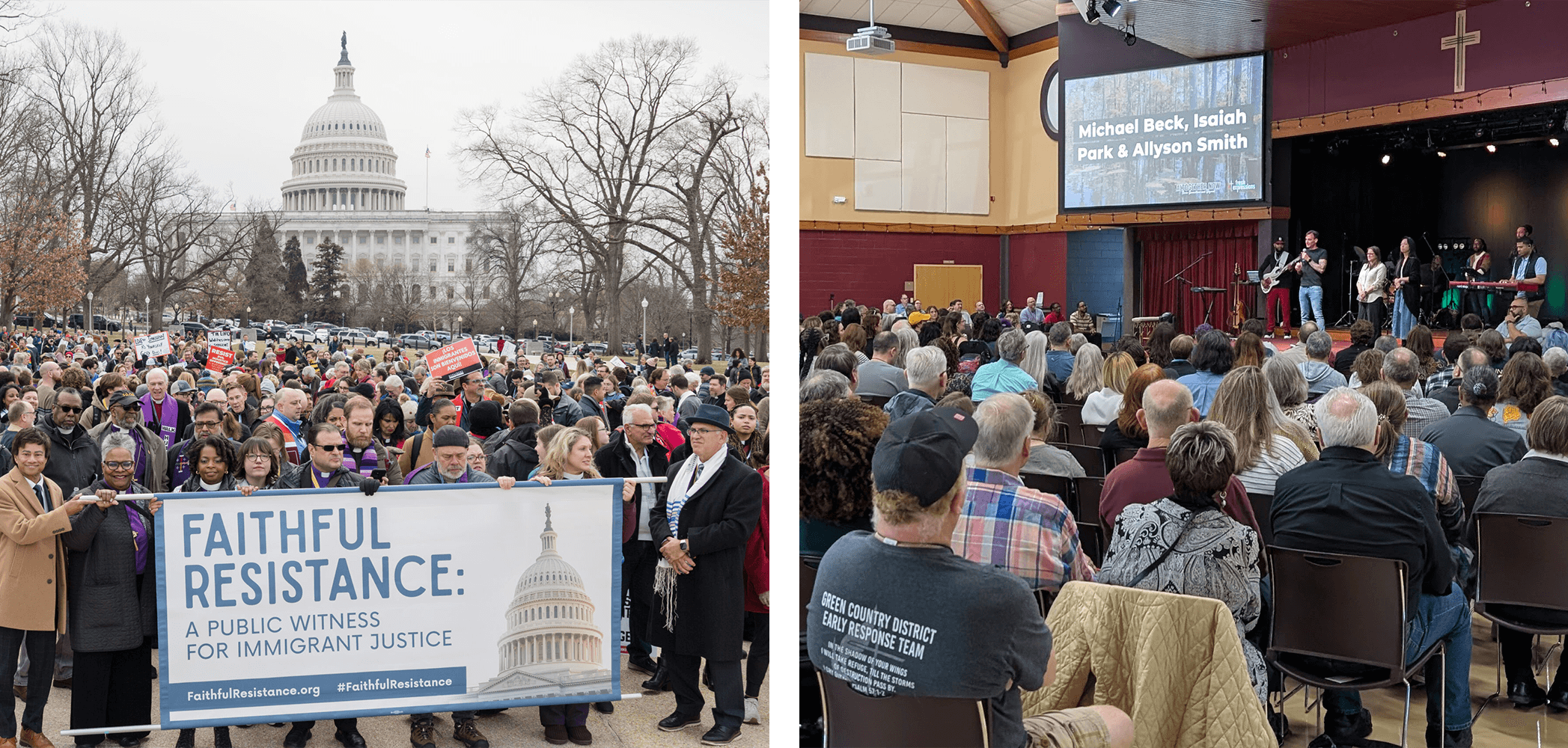
Last week, leaders from the United Methodist Church gathered for two events that speak to the dichotomy of church leadership. The first, a rally called “Faithful Resistance” in Washington, D.C., drew nearly 2,000 United Methodists from around the United States for a time of worship, a march, and meetings with legislators in an effort to bring public witness to the need for meaningful change in the United States.
The next day, over 500 people (not all of whom were United Methodist) began meeting in Florida for the Fresh Expressions National Gathering, a time “designed to ignite generational discipleship and deepen our shared calling to be the church, altogether now.” The conference was filled with worship, teaching, and immersive activities to grow capacities in clergy and laity to bring Jesus into their communities.
It would be easy to see Faithful Resistance as an “outside” event, a time motivated around bearing witness in the public square. Likewise, it would be easy to see Fresh Expressions as an “inside” event, a time motivated around building capacity for church leadership. The beauty of these two spaces, however, is the way in which they demonstrate for leaders that there are moments for outside-in leadership, moments for inside-out leadership, and the understanding that it is rare for anything in the life of a leader to be exclusively outside or inside.
Outside-in Leadership
In many ways, outside-in leadership serves as a form of cultural exegesis; in other words, we take that which is happening in the world and allow it to inform the leadership we offer within the local church. At times, this can have a generalist or national approach. For example, when a natural disaster impacts a distant part of the world, a clergyperson may mention the tragedy as a part of a prayer time or ask for contributions to a denominational relief effort in that area.
More often, however, outside-in leadership brings the life of a local community or neighborhood to the body of Christ to inquire, “What is God calling us to do about this?” The unique, contextually-driven perspective that can come from choosing to attend to the neighborhood first bears fruit in the ways churches can be in connection with community and the kind of influence the voice of the church can have within a community context. Outside-in leadership is a way of defining the kind of church leadership being taught and promoted in the Fresh Expressions context.
Obtaining the data to inform this conversation can come from a few different sources:
- Engaging in one-on-one conversations with local leaders such as a mayor, city councilperson, school principal, police or fire chief, or chamber of commerce leader. In this conversation, ask, “What is the biggest gap in our community that the church could be a part of addressing?”
- Staying current with newsletters and briefings from local schools, non-profits, and relief agencies.
- Fostering a relationship with neighborhood associations and community advocacy groups that allow those bodies to use the church building for meetings and forums.
As this data comes to life, it is essential to convene with leadership teams to decide how to prioritize action. Knowing there is a challenge or opportunity and sitting idly by is damaging to the witness of the church. It is not imperative that you or your church do everything, but you are called to do something.
Inside-out Leadership
A counterpoint to outside-in leadership, inside-out leadership stands on a Biblical and discipleship-oriented worldview. How are we carrying the story of faith into communities? While there are opportunities for this to be a generalist work, the most effective forms of inside-out leadership happen in local settings.
The Faithful Resistance gathering is a good example of this. While one could argue this was a generalist event—after all, thousands of people from around the country gathered in a single place for a moment in time—the structure of it allowed for localized messaging. Constituents meeting with policy makers from their home areas allowed for a wide-scale message with a local impact.
Staging a march for a few thousand people is not the only way to achieve inside-out leadership; however, this form of leadership requires intention on the part of church leadership teams. There are many factors that can impact the capacity of a church to lead inside-out, but there is one that rises above the rest: how your church prays for the community it serves.
When churches are active in praying for their communities, they are more apt to take the messaging of the church into those communities. The church building then becomes not a boundary between a congregation and its neighbors, but one of many places where the body of Christ can gather, be formed, and go forth to offer the love of God.
If church leaders want to bring the messaging of the church into closer connection with their surrounding community, the first step is to pray, and then to discover that many prayers have legs.
The Outside-Inside Parallel
Perhaps the most important learning for church leaders is that there is very little that can be exclusively outside-in or exclusively inside-out. Our cultural perspective should always impact our discipleship, and our discipleship should always impact our cultural perspective.
There is a reason that Paul writes letters to different churches. While there are some traits of community life that can be held in common, Paul knew that there were cultural distinctions amongst the various communities he held relationship with. Likewise, he knew the influence of people following Jesus together would be different in Rome than it would be in Phillipi.
Fast forward to today, where the things that we see on walks, driving our cars, or watching the news should impact how we interpret the work of the church, and our love for God lived day by day should impact the love we have for our neighbors. Maybe this is why Jesus will say “You will know them by their fruit.”
Leaders, may you be outside and inside. May you see your work as public and private. May you know your leadership matters to your church, your community, and to the God of all creation.
Related Resources
- Quiet Acts of Strategic Resistance Open a Congregation to its Neighbors by Laura Heikes
- 50 Ways to Take Church to the Community, a free Lewis Center resource
- Fresh Expressions articles and podcast episodes from the Lewis Center
If you would like to share this article in your newsletter or other publication, please review our reprint guidelines.